

2026 The Most Effective H12-831_V1.0-ENU with 465 Questions Answers
Try Free and Start Using Realistic Verified H12-831_V1.0-ENU Dumps Instantly.
The Huawei H12-831_V1.0-ENU exam consists of multiple-choice questions and requires candidates to demonstrate their ability to apply their knowledge to real-world scenarios. H12-831_V1.0-ENU exam is designed to test the candidates' ability to solve problems and make decisions in a fast-paced and dynamic environment. H12-831_V1.0-ENU exam also includes simulations that require candidates to configure and troubleshoot complex network scenarios.
NEW QUESTION # 211
The ipv6 enable topology standard is configured in IS-IS protocol view. The meaning of this command is that Pv4 and IPv6 share the same topology.
- A. TRUE
- B. FALSE
Answer: A
NEW QUESTION # 212
Which of the following statements about MPLS header TTL is correct?
- A. MPLSTcorrect toTTLis handled in two ways. one isIPmessage is enteringMPLSwhen the network MPLSheadTTLcopyIPTTLValue: The other is at the entranceLERWillMPLSheadTTLsystem-settings for 255
- B. copyIPTTLThe way the value is handled is hiddenMPLSDomainLSRPlayed a role in the safety of the lake
- C. Banned from holding shellsTTLin the case of,tracertcan see passingMPLSDomainLSR
- D. Can prevent infinite loop forwarding of packets
Answer: A,D
NEW QUESTION # 213
Regarding the description of the label encapsulation format in MPLS, which one is correct? (Multiple choice)
- A. The total length of a single MPLS label is 4 bytes (32 bits)
- B. The TTL field in the label is similar to the TTL (Time To Live) in the IP packet, and it also has the effect of preventing loops.
- C. The S field in the label: 1 bit, used to identify whether the label is a label at the bottom of the stack, when the value is 1, it is the penultimate layer label
- D. For Ethernet and PPP packets, the label stack is located between the layer 2 header and the data like the "underlay*": when there is a VLAN tag, the MPLS header is placed between the Ethernet header and the VLAN tag
Answer: A,B
NEW QUESTION # 214
An administrator runs the display mpls lsp command to view LSPs on a device. The command output is shown in the figure.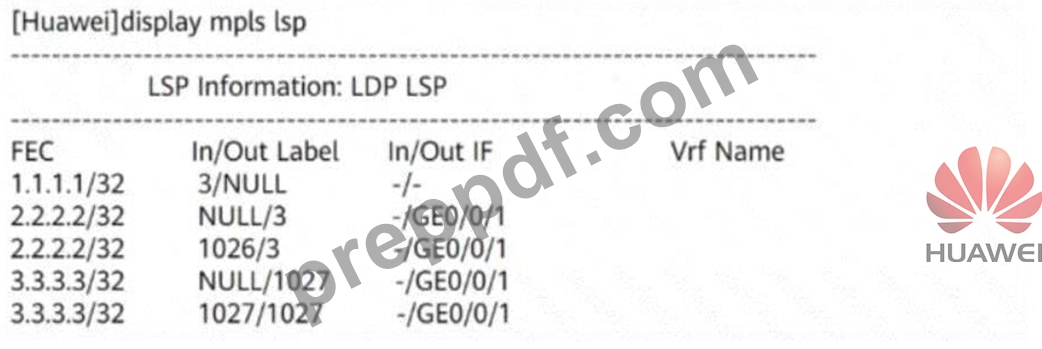
Which of the following statements is true?
Options:
- A. Before forwarding a packet destined for any IP address, the device removes labels from the packet.
- B. Before forwarding a packet destined for 3.3.3.3, the device adds label 1027 to the packet.
- C. Before forwarding a packet destined for 1.1.1.1, the device adds label 3 to the packet.
- D. Before forwarding a packet destined for 2.2.2.2, the device adds label 3 to the packet.
Answer: B
Explanation:
Comprehensive and Detailed In-Depth Explanation:
1. Understanding MPLS Label Forwarding Information
The output of the display mpls lsp command shows the Label Forwarding Information Base (LFIB) used by the router to forward MPLS packets.
Each entry consists of:
* FEC (Forwarding Equivalence Class): The destination IP prefix.
* In Label / Out Label: Incoming label (received) and outgoing label (sent).
* In IF / Out IF: Incoming and outgoing interfaces.
2. Analyzing the Given LSP Table
FEC (Destination IP)
In Label
Out Label
Outgoing Interface
1.1.1.1/32
3
NULL
-
2.2.2.2/32
NULL
3
GE0/0/1
2.2.2.2/32
1026
3
GE0/0/1
3.3.3.3/32
NULL
1027
GE0/0/1
3.3.3.3/32
1027
1027
GE0/0/1
Key Observations:
* NULL means the label is removed (Penultimate Hop Popping - PHP).
* Label 3 is the implicit null label, meaning the label is removed before sending to the next router.
* For destination 3.3.3.3, the router adds label 1027 before forwarding it to GE0/0/1.
3. Evaluating Each Answer Option
* Option A: "Before forwarding a packet destined for 2.2.2.2, the device adds label 3 to the packet."
# Incorrect.
* The output shows that packets destined for 2.2.2.2 have the NULL (label 3) entry, which means the label is removed before forwarding, not added.
* Option B: "Before forwarding a packet destined for 1.1.1.1, the device adds label 3 to the packet."
# Incorrect.
* The entry 1.1.1.1 # 3/NULL means the label is removed (PHP), so the device does not add label
3.
* Option C: "Before forwarding a packet destined for any IP address, the device removes labels from the packet." # Incorrect.
* The device removes labels only for some destinations (e.g., 1.1.1.1 and 2.2.2.2), but it adds label 1027 for 3.3.3.3.
* Not all IPs have their labels removed.
* Option D: "Before forwarding a packet destined for 3.3.3.3, the device adds label 1027 to the packet." # Correct.
* The entry 3.3.3.3 # NULL/1027 means that the router adds label 1027 before forwarding packets to GE0/0/1.
Final answer:
D: (Before forwarding a packet destined for 3.3.3.3, the device adds label 1027 to the packet).
HCIP-Datacom-Advanced Routing & Switching Technology References:
* Understanding MPLS LDP (Label Distribution Protocol) and LFIB
* Implicit Null (Label 3) and Penultimate Hop Popping (PHP)
* MPLS Label Swapping and Forwarding Process
NEW QUESTION # 215
MPLS has the concept of FEC forwarding equivalence class, so FEC cannot be allocated based on which of the following standards?
- A. Destination Addess
- B. Fragment of fiset
- C. Application Protocol
- D. Class of Service
Answer: B
NEW QUESTION # 216
An OSPFv3 NSSA LSA is generated by an ASBR, describes routes to a destination outside the AS, and is advertised in an NSSA.
- A. TRUE
- B. FALSE
Answer: A
NEW QUESTION # 217
Which of the following is not a hardware preparation for cutover?
- A. Test the operation of the board
- B. Power-on test
- C. Device version check
- D. Cable Continuity Test
Answer: C
NEW QUESTION # 218
After troubleshooting the problem, the network engineer wrote a troubleshooting report, in which he simplified the actual networking into the network shown in the figure.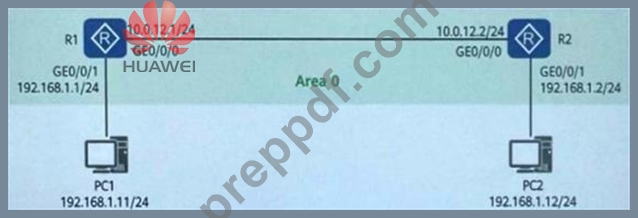
In the faulty network, R1 and R2 both enable OSPF and serve as gateways for PC1 and PC2 respectively. Which of the following descriptions of the faulty network connectivity are correct?
(Multiple choice)
- A. PC1 and PC2 cannot ping each other.
- B. R1 can ping 192.168.1.21
- C. R1 can ping 192.168.1.22
- D. R2 can ping 192.168.1.11
Answer: A,B,C,D
NEW QUESTION # 219
There is the concept of forwarding equivalent FEC in MPLS. Which of the following descriptions is wrong? (Multiple choice)
- A. The division of FEC is very flexible. It can be based on any combination of source address, address, source port, destination port, protocol type or VPN, etc.
- B. The packets of the same FEC will be processed differently in the MPLS network
- C. A forwarding equivalence FEC will be assigned a unique label value on all routers
- D. MPLS classifies packets with the same forwarding processing method into one category, which is called FEC
Answer: B,C
NEW QUESTION # 220
The figure shows the debugging information on an OSPF router. Which of the following is the router ID of this router?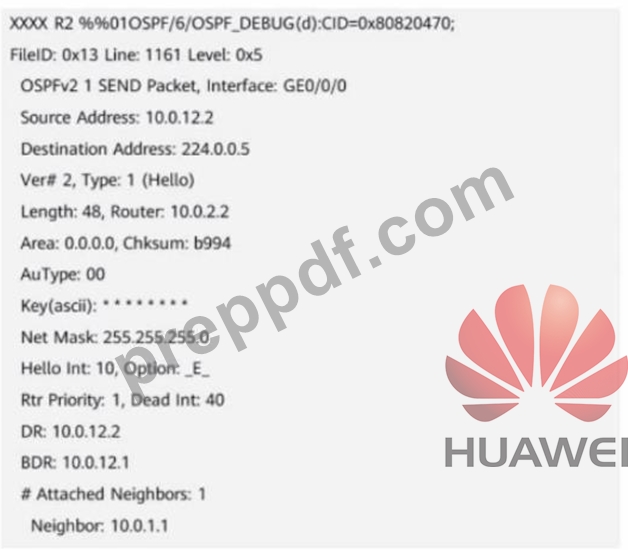
- A. 10.0.12.2
- B. 10.0.1.1
- C. 10.0.12.1
- D. 10.0.2.2
Answer: D
NEW QUESTION # 221
Regarding the description of the encapsulation format of labels in MPLS, the correct one is
- A. For Ethernet,PPPpacket, the tag stack is like 'shim*-between the L2 header and the data: yesVLAN tagTime,MPLShead on the ether head withVLAN tagbetween
- B. in the labelTTLfields andIPgroupedTTL( Time To Live.,time-to-live) is similar in meaning and also has the effect of preventing loops
- C. in the labelSfield:lbit,Used to identify whether the label is the bottom label of the stack, the value is1is indicated as the penultimate layer label
- D. MPLSThe total length of a single label is4bytes(32bits)
Answer: B,D
NEW QUESTION # 222
In the OSPF network shown in the figure, area 1 is an NSSA area, area 2 is a common area, and R4 imports external route 10.0.4.4/32. The Router ID of each device is 10.0.0.X, where X is the device number.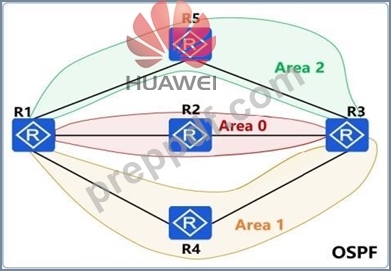
The "asbr-summary 10.0.4.0 255.255.255.0" command is configured in the OSPF processes of R1 and R3. Which of the following routers have routing entries for 10.0.4.0/24 in their routing tables? (Multiple choice)
- A. R3
- B. R1
- C. R5
- D. R2
Answer: C,D
NEW QUESTION # 223
Please match the characteristics and functions of the IS-IS protocol.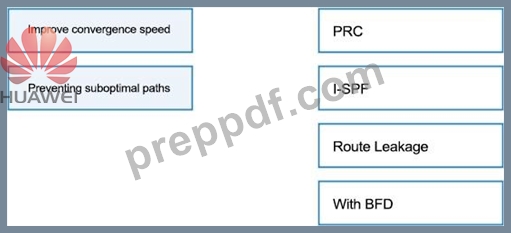
Answer:
Explanation: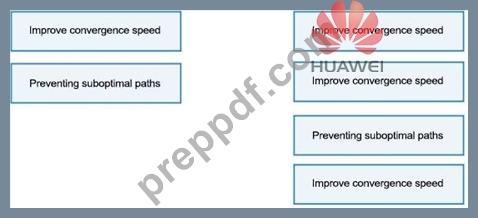
NEW QUESTION # 224
A network engineer entered the following information when troubleshooting OSPF faults. Based on this, you can judge what causes the adjacency relationship to fail to be established normally?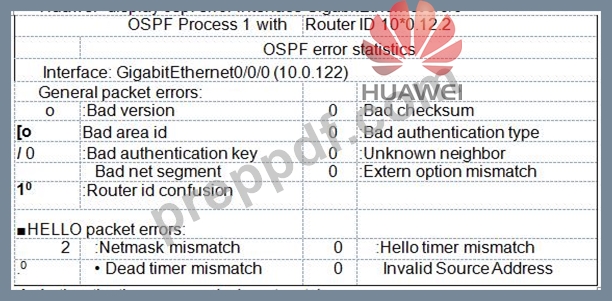
- A. Hell. Inconsistent message sending interval
- B. Inconsistent area type
- C. Authentication passwords do not match
- D. interfaceIPInconsistent address masks
Answer: D
NEW QUESTION # 225
In the network shown in the figure, OSPF protocol is running between R1, R2, and R3, and OSPF BFD feature is turned on. IBGP neighbor relationship is established between R1 and R3 using loopback interface. If GE0/0/1 interface of R2 is shut down, and BGP neighbor relationship is checked on R1, by default, which of the following is the longest time for R1 BGP neighbor relationship to change from Up state to Down state?
- A. 3s
- B. 180s
- C. 60s
- D. 40s
Answer: B
NEW QUESTION # 226
In the network shown in the figure, R1, R2, R4, and R5 run IS-IS, and the area number is
49.0001. R3 and R6 run IS-IS, and the area number is 49.0002. Within AS 65000, R1, R3, R4, and R6 all establish IBGP neighbor relationships with R2 and R5, where R2 and R5 are RRs and R1, R4, R3, and R6 are clients. IBGP neighbor relationships are all established using the Loopback0 interface. R2 and R5 also establish an IBG neighbor relationship. The IP address of the Loopback0 interface of each device is 10.0.X.X/32, and the Router ID is 10.0.XX, where X is the device number. R1 and R4 introduce the external network 192.168.0/24 into BGP through import.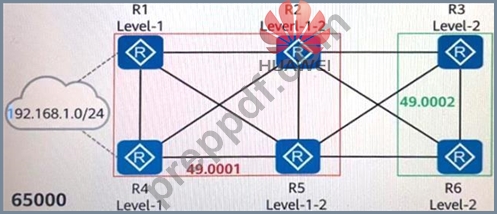
For 192.168.1.0/24, match the number of valid routes in the display bgp routing-table output.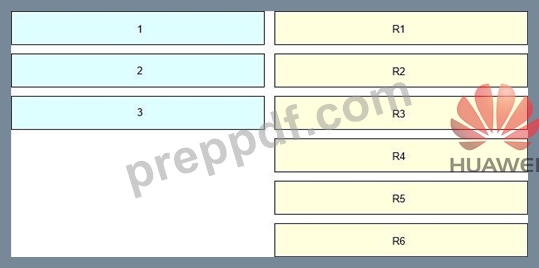
Answer:
Explanation: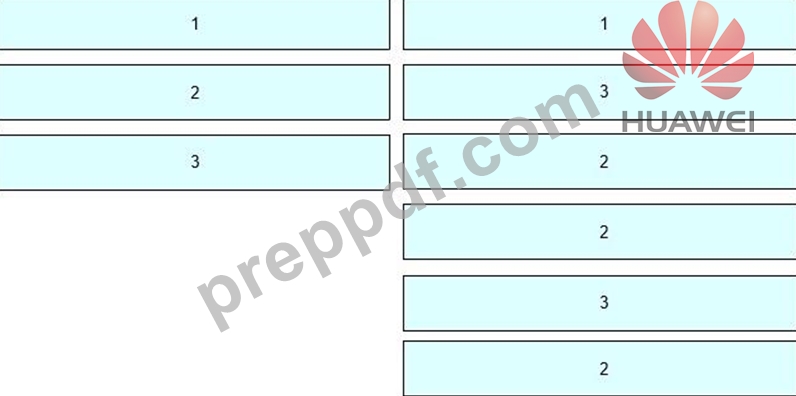
NEW QUESTION # 227
If the migration preparation is insufficient, which of the following problems may occur? (Multiple Choice):
- A. When an interface cannot go up but no network cable tester is available, it is difficult to determine whether the interface hardware or cable is faulty.
- B. Engineers cannot arrive at the migration site at the scheduled time.
- C. The migration fails, and the configuration file is not backed up. As a result, the service rollback fails.
- D. A hardware fault occurs on a board, but no spare board is available.
Answer: A,B,C,D
NEW QUESTION # 228
BGP's prefix-based ORF (Outbound Route Filtering) capability can send the prefix- based ingress policy configured on the local device to the BGP neighbor through the route refresh message.
The BGP neighbor constructs the egress policy based on these policies and filters the routes when they are sent. Compared with configuring the routing policy on the BGP neighbor, this method not only avoids the local device from receiving a large number of useless routes, reduces the CPU usage of the local device, but also effectively reduces the configuration work of the local device.
- A. False
- B. True
Answer: B
NEW QUESTION # 229
IS-IS is a link-state routing protocol that uses the SPF algorithm for route calculation. As shown in the figure, a campus deploys both IPv4 and IPv6 and runs IS-IS to achieve network interconnection. R2 only supports IPv4. Which of the following statements is true about the topology calculation of this network?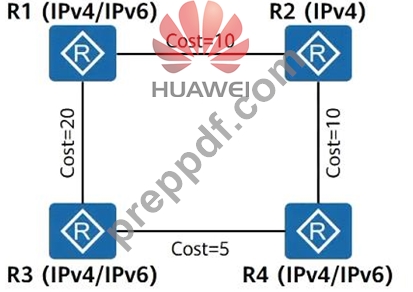
- A. By default, since R2 does not support IPv6, in the shortest path tree formed by IPv6 network calculation, the path from R1 to R4 is: R1-R3-R4
- B. By default, in the shortest path tree formed by IPv6 network calculation, the path from R1 to R4 is: R1-R2-R4. Since R2 does not support IPv6, R2 will directly discard IPv6 packets after receiving them, causing traffic loss.
- C. By default, IPv4 and IPv6 networks will be calculated separately to form different shortest path trees
- D. If you want IPv4 and IPv6 network computation to form the same shortest path tree, you need to run the ipv6 enable topology ipv6 command to enable the IPv6 capability in the IS-IS process.
Answer: A
NEW QUESTION # 230
The concepts of RD and RT are introduced in BGP/MPLS IP VPN network. Which of the following descriptions about RD and RT are correct? (Multiple choice)
- A. VPNv4 address is 96 bits in total, of which the RD value is 64 bits long
- B. A VPNv4 route can only contain one RD value and one RT value
- C. RD is used to resolve IPv4 address conflicts before adding it to the IPv4 address.
- D. The RD value is not used to identify the origin of a route, nor is it used to determine which VPN instance the route should be added to.
Answer: A,C,D
NEW QUESTION # 231
The security protection actions that a secure MA, C address can perform does not include which of the following?
- A. Protect
- B. Remark
- C. Shutdown
- D. Restrict
Answer: B
NEW QUESTION # 232
On the 05PFv3 network shown in the figure, each interface of R1 and R2 has two IPv6 addresses. Although the IPv6 address prefixes of R1 and R2 are different, they can still be used to establish an OSPFv3 neighbor relationship. If R2 is the DR, the Intra-Area-Prefix-LSA generated by R2 contains four prefixes.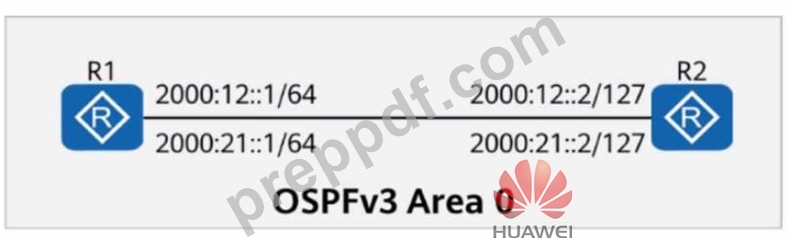
- A. TRUE
- B. FALSE
Answer: A
NEW QUESTION # 233
Which description is correct about the label encapsulation format in MPLS? (Multiple choice)
- A. The total length of a single MPLS label is 4 bytes (32 bits)
- B. The TTL field in the label is similar to the TTL (Time To Live.) in the IP packet, and it also has the effect of preventing loops.
- C. The S field in the label: 1 bit, used to identify whether the label is the bottom label of the stack, when the value is 1, it indicates the second-to-last label
- D. For Ethernet and PPP packets, the label stack is located between the layer 2 header and the data like a "underlay*": when there is a VLAN tag, the MPLS header is placed between the Ethernet header and the VLAN tag
Answer: A,B
NEW QUESTION # 234
......
Download Free Latest Exam H12-831_V1.0-ENU Certified Sample Questions: https://www.preppdf.com/Huawei/H12-831_V1.0-ENU-prepaway-exam-dumps.html
H12-831_V1.0-ENU Actual Questions - Instant Download 465 Questions: https://drive.google.com/open?id=1Z63FtP0h7NcgODqSh-Tpn0DAzpTMr6Qu