

300-510 Training & Certification Get Latest CCNP Service Provider Updated on Mar 08, 2026
Certification Training for 300-510 Exam Dumps Test Engine
Cisco 300-510 exam is part of the Cisco Certified Specialist - Service Provider Advanced Routing Implementation certification track. Implementing Cisco Service Provider Advanced Routing Solutions certification is intended for network engineers, network administrators, and network architects who work in service provider environments and are responsible for designing, implementing, and managing routing solutions. Implementing Cisco Service Provider Advanced Routing Solutions certification validates the skills required to implement advanced routing solutions in a service provider environment, including the ability to design and implement scalable, high-performance networks that meet the needs of customers.
NEW QUESTION # 131
Refer to the exhibit.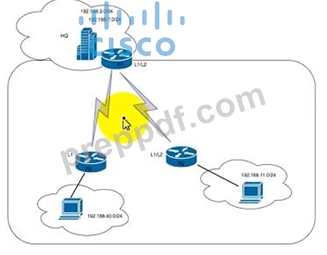
Refer to the exhibit The branch office in area 10 is connected to HQ via Frame Relay uplinks with bandwidth constraints After a recent implementation of QoS on the R2 and R3 networks the system has been logging %SYS-2-MALLOCFAIL: Memory allocation of 65536 bytes failed from 0x224E321, alignment 0 messages To reduce traffic load and memory utilization on R2 and R3 the network engineer configured R1 to announce only one user subnet per location by issuing the summary address 192.168.0.0 255.255.248.0 command en R1 However, the engineer noticed that router R2 still has two routes and a summary address from HQ and R3 also has two routes from HQ Which two actions must the engineer take on R1 to fix the issue so that only one route is announced' (Choose two.)
- A. Configure a summary route for Level 1 devices.
- B. Configure the subnet range with the network command under the IS-IS process.
- C. Configure a summary route for Level 1-Level 2 devices.
- D. Redistribute both routes into the ISIS process.
- E. Configure RI as a Level 1 device.
Answer: A,C
NEW QUESTION # 132
Refer to the exhibit.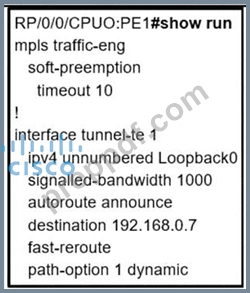
A network operator is troubleshooting TE tunnels and discovers that the soft preemption is not working as desired. Where should the soft preemption be applied to solve the issue?
- A. on the tail-end device for tunnel-te1 192.168.0.7
- B. explicitly for tunnel-te 1 under the Cisco MPLS TE configuration mode after the timeout setting
- C. Under the interface Loopback0 necessary for this deployment type.
- D. under the tunnel-te1 interface on PE1
Answer: D
NEW QUESTION # 133
Refer to the exhibit.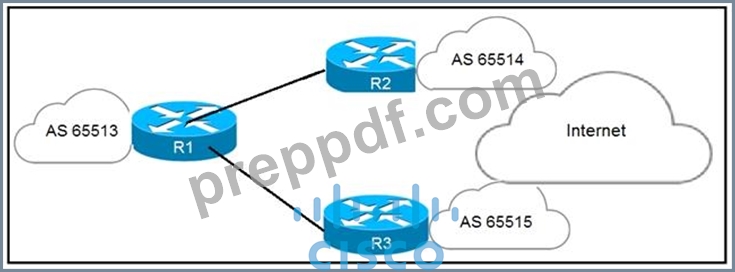
An engineer has successfully fixed BGP peering issue. R1 has an established eBGP peering with R2 and R3. Which mechanism should the engineer apply in order to steer the traffic correctly?
- A. The MED attribute can be applied on R2 to influence R1 to use it as the primary path.
- B. The local preference attribute can be applied on R3 to influence AS 65513 to use AS 65515 as the secondary path.
- C. The IGP metric can be manipulated on R1 to allow traffic to be load balanced between R2 and R3.
- D. The weight attribute can be applied on R2 to influence AS 65513 to use AS 65515 as the primary path.
Answer: C
NEW QUESTION # 134
Which two statements about mapping multicast IP addresses to MAC addresses are true?
(Choose two.)
- A. All multicast MAC addresses end with 0x0100.5E
- B. All mapped multicast MAC addresses begin with 0x0100.5E
- C. The router performs the mapping before it hands the packet off to a switch
- D. The mapping process may generate overlapping addresses, which can cause receivers to receive unwanted packets
- E. All destination MAC addresses begin with an octet of binary 1s
Answer: B,D
NEW QUESTION # 135
A network engineer is troubleshooting OSPF multiarea. Which Cisco IOS XR feature should the engineer use in order to streamline OSPF issue?
- A. show ip ospf topology command
- B. hierarchical CLI
- C. routing process enabled by default on all interfaces
- D. DR support for topology management
Answer: B
Explanation:
Explanation/Reference: https://www.cisco.com/c/en/us/td/docs/routers/xr12000/software/xr12k_r4-0/routing/configuration/ guide/rc40xr12k_chapter4.html#con_1059437
NEW QUESTION # 136
Refer to me exhibit. A network engineer sets up a multihoming eBGP topology where multiple Autonomous Systems connect to ASN 64501.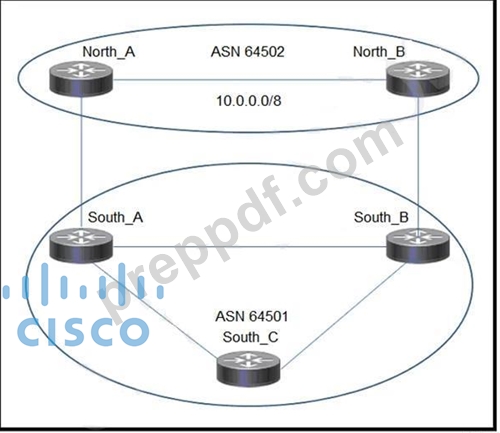
The engineer wants to block all the routers coming from ASN 64502. but allow all the others. For that purpose, the following AS Pam prefix 1st s being used:
(config)#ip as-path access-list 10 deny _64502$
What must be fixed to achieve this result?
- A. At the end ip as-path access-list 10 permit .* must be included
- B. The AS-PATH filter must be defined inside the route-map mode
- C. The statement must CM modified with ip as path access list 1 deny A64502$
- D. The statement must be modified with ip as-path access-list 1 deny _64502_
Answer: A
NEW QUESTION # 137
Refer to the exhibit.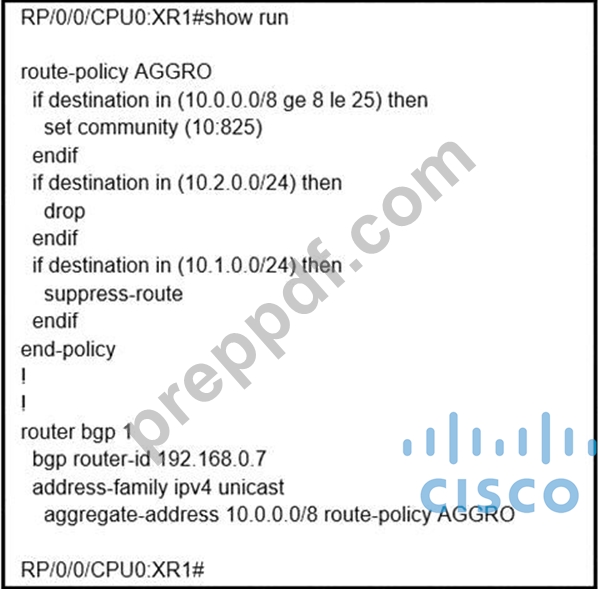
A network operator is working to filter routes from being advertised that are covered under an aggregate announcement. The receiving router of the aggregate announcement block is still getting some of the more specific routes plus the aggregate. Which configuration change ensures that only the aggregate is announced now and in the future if other networks are to be added?
- A. Set each specific route in the AGGRO policy to remove instead of suppress-route
- B. Filter the routes on the receiving router
- C. Configure the summary-only keyword on the aggregate command
- D. Set each specific route in the AGGRO policy to drop instead of suppress-route
Answer: C
NEW QUESTION # 138
Refer to the exhibit.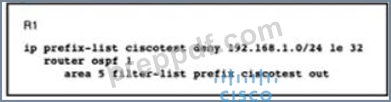
An engineer applied the configuration on R1 to prevent network 192.168.1.0/24 from being propagated outside of area 5. After the change, users have reported they are not able to access any of the application servers that were working before. While checking the routing table of the peer router. The engineer notices R1 stopped propagating any routes outside are 5. Which action must be taken to fix the problem?
- A. Change the prefix-list action to permit and add an explicit deny statement for network 192.168.1.0/24
- B. Reconfigure the filter-list statement to apply in the inbound direction
- C. Configure an additional filter-list on R1 for inbound traffic to allow external router into area 5.
- D. Add a permit statement for 0.0.0.0/0 le 32 to the end of the prefix-list 10 override the implicit deny.
Answer: D
NEW QUESTION # 139
Refer to the exhibit. Dedicated MPLS Layer 3 services for VRF customer A are configured on the MPLS network for FTP access. OSPF with area 0 configuration is used as the interior routing protocol between the routers, and LDP is up and running on the MPLS network. After recent maintenance work on the MPLS network, IP address 172.16.100.1 cannot access the FTP server with IP address 172.16.192.21. All loopbacks are reachable on the network. Which configuration must the engineer apply to correct the problem?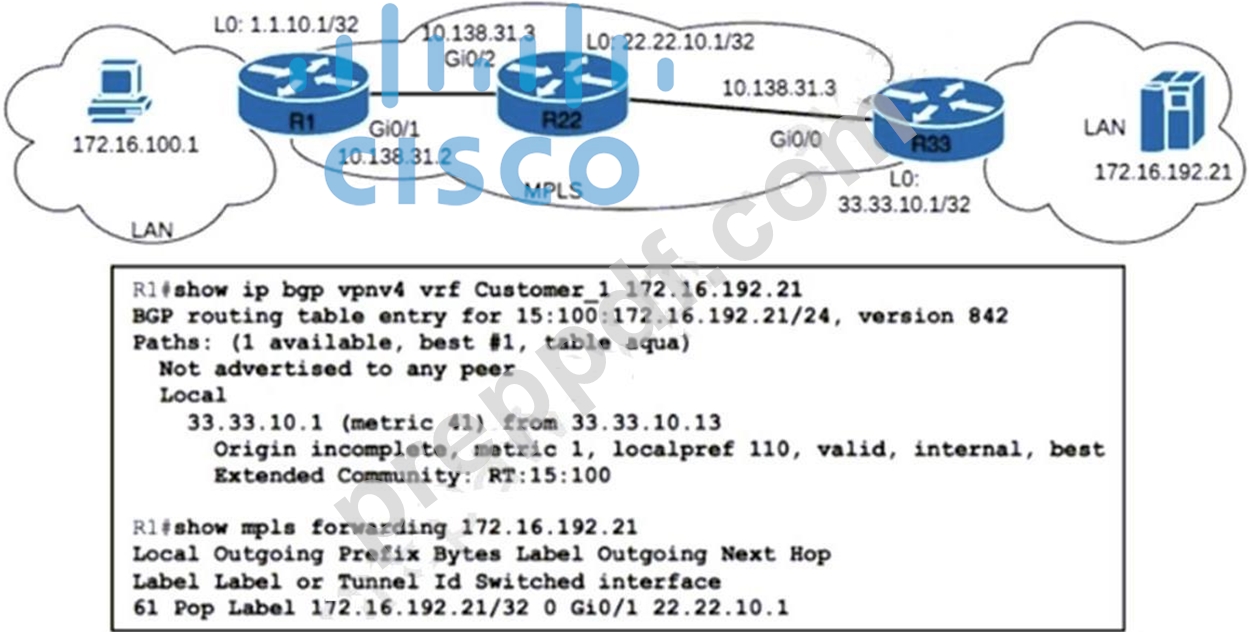
- A. Configure network 33.33.10.1 0.0.0.255 area 0 under the OSPF configuration on R33.
- B. Configure ip cef under the global configuration on R22.
- C. Configure passive-interface under the Gi0/2 interface on R22.
- D. Configure ip ospf network point-to-point under the Lo0 interface on R33.
Answer: B
Explanation:
The MPLS Layer 3 VPN services depend on Label Distribution Protocol (LDP) for forwarding traffic. The MPLS forwarding table on R1 shows the route to 172.16.192.21/32 uses a pop label action with R22 as the next hop. This indicates that R22 should perform label switching to forward the packet correctly to R33.
IP CEF is a prerequisite for MPLS to operate. Without IP CEF, LDP cannot function properly, and label switching will fail. If CEF is disabled on R22, it prevents proper MPLS label forwarding, which causes traffic to drop.
Configuring ip cef globally on R22 ensures that MPLS forwarding and LDP label switching work as expected.
NEW QUESTION # 140
Refer to the exhibit. ISP_A in AS 635 has four BGP neighbors connected one-by-one, starting from AS 12. R1 has been configured with bgp deterministic-med and bgp additional-paths install to influence egress traffic. After a recent reload of R10, all traffic was automatically re-routed via AS 87. A network engineer must correct the traffic flow and route the traffic via AS 101. Which configuration must the engineer apply to R1 to correct the problem without affecting the second BGP attribute?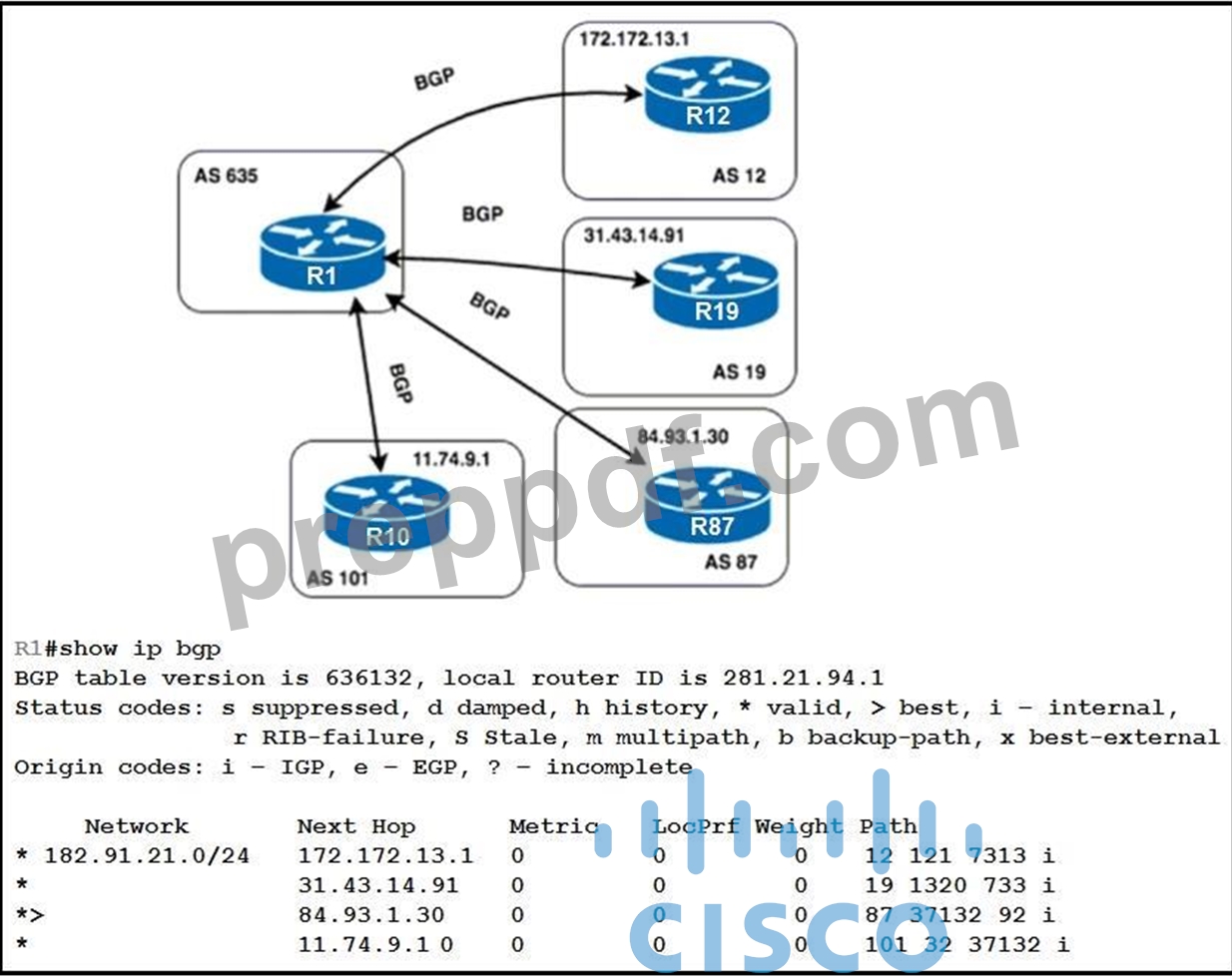
- A. bgp always-compare-med
- B. bgp default local-preference 200
- C. bgp bestpath med missing-as-worst
- D. bgp bestpath compare-routerid
Answer: D
NEW QUESTION # 141
For which reason can two BGP peers fail to establish a neighbor relationship?
- A. Their BGP timers are mismatched
- B. Their BGP send-community strings are misconfigured
- C. They are both activated under an IPv4 address family
- D. Their remote-as numbers are misconfigured
Answer: D
NEW QUESTION # 142
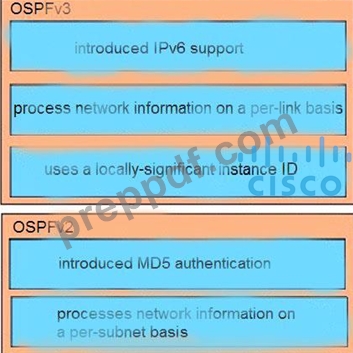
Compare different features between OSPFv2 and OSPFv3. Drag and drop the descriptions of OSPF from the left onto the correct OSPF versions on the right.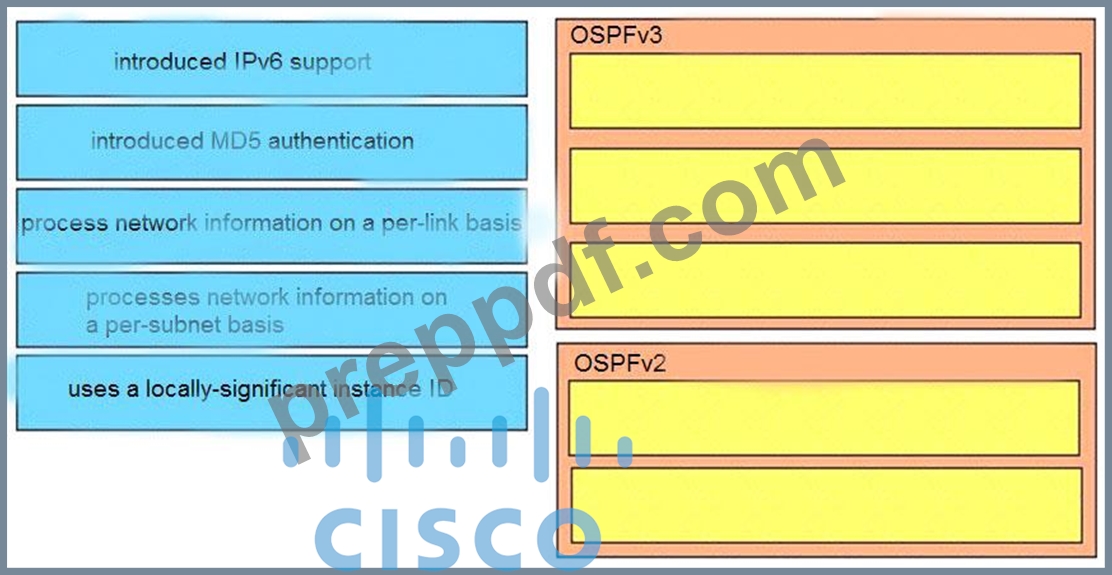
Answer:
Explanation: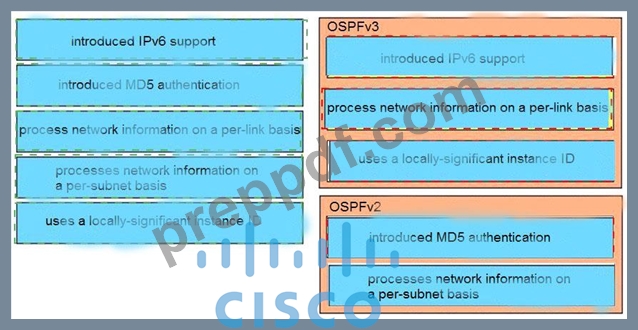
NEW QUESTION # 143
Refer to the exhibit.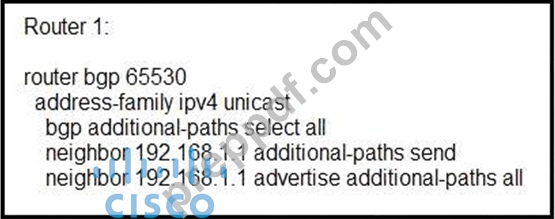
Which statement about this configuration is true?
- A. Router 1 sends up to two paths to neighbor 192.168.1.1 for all routes
- B. Router 1 receives only the best path from neighbor 192.168.1.1
- C. Router 1 receives up to two paths from neighbor 192.168.1.1 for all routes in the same AS
- D. Router 1 sends and receives multiple best paths from neighbor 192.168.1.1
Answer: D
NEW QUESTION # 144
Refer to the exhibit.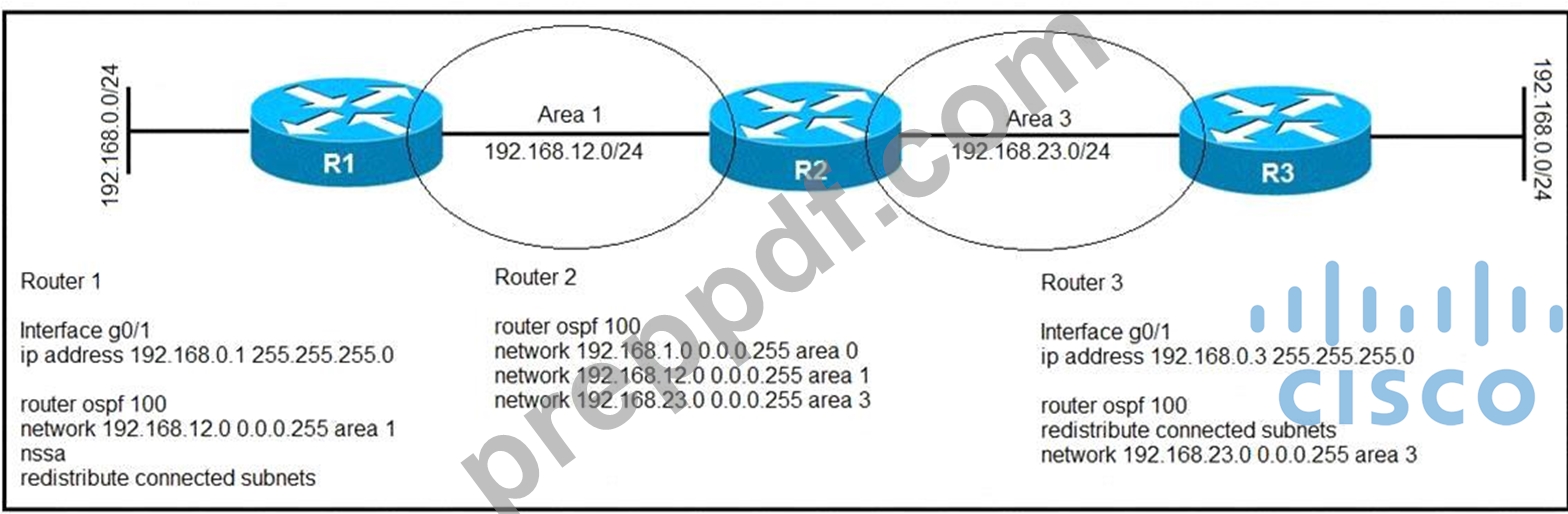
After troubleshooting an OSPF adjacency issue, routers 1, 2, and 3 have formed OSPF neighbor relationships. Which statement about the configuration is true?
- A. Router 2 uses router 1 as the next hop for 192.168.0.0/24
- B. Router 2 receives a Type 5 LSAs from router 1 for its connected subnets
- C. Router 2 uses router 3 as the next hop for 192.168.0.0/24
- D. Router 2 receives a Type 7 LSAs from router 3 for its connected subnets
Answer: A
Explanation:
From IOS 15.1(2)S onwards, Cisco uses the OSPF path selection order is O > O IA > N1 > E1 > N2 > E2
https://www.cisco.com/c/en/us/support/docs/ip/open-shortest-path-first-ospf/212608-ospf-external-path- selection-external-t.html
NEW QUESTION # 145
Refer to the exhibit. An engineer has configured all routers in the environment to run IS-IS Level 1 and Level 2 routing. The engineer wants traffic from R1 to R5 to pass via R2. but IS-IS routing has calculated the best path via R4. Which action corrects the problem?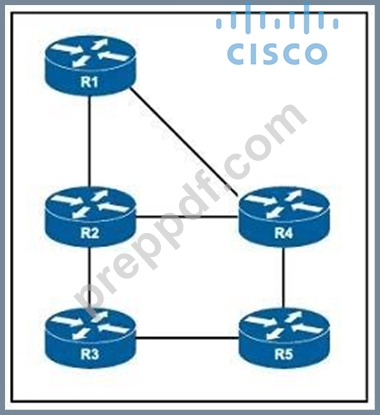
- A. Configure routers R1, R4, and R5 for Level 2 routing only.
- B. Set the link metric on R2 for the links from router R2 to routers R3 and R4 to 30 or more.
- C. Configure routers R1, R2, and R5 for Level 1 routing only.
- D. Set the link metric for the link from router R1 to router R4 to 30 or more.
Answer: D
NEW QUESTION # 146
Refer to the exhibit. An engineer working on a client's network is trying to solve the BGP community issue on R1 and R2 routers. After displaying the BGP entries, the engineer notices that both routers still have different outputs. Which action must the engineer perform to any of the routers to correct the problem and get the same output?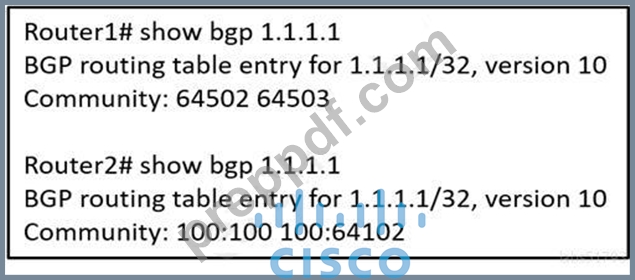
- A. Advertise the route to Router2 as extended community.
- B. Execute the lp bgp-community new-format command in Router1.
- C. Remove the lp bgp-community new-format command in Router1.
- D. Advertise the route to Router2 as standard community.
Answer: B
Explanation:
https://www.noction.com/blog/understanding-bgp-communities
NEW QUESTION # 147
Refer to the exhibit. Which LSA type is indicated by this router output?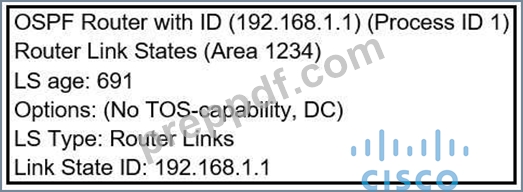
- A. type 4 LSA
- B. type 3 LSA
- C. type 1 LSA
- D. type 2 LSA
Answer: C
NEW QUESTION # 148
Refer to the exhibit. VPN users that are connected to PE routers are facing network issues.
Traffic that originates from CE1 drops before reaching CE2. An engineer finds no outgoing traffic statistics on PE1 and PE2 routers toward CE devices and finds that the PE1 router is running the older software image. Which action must be implemented to resolve the issues?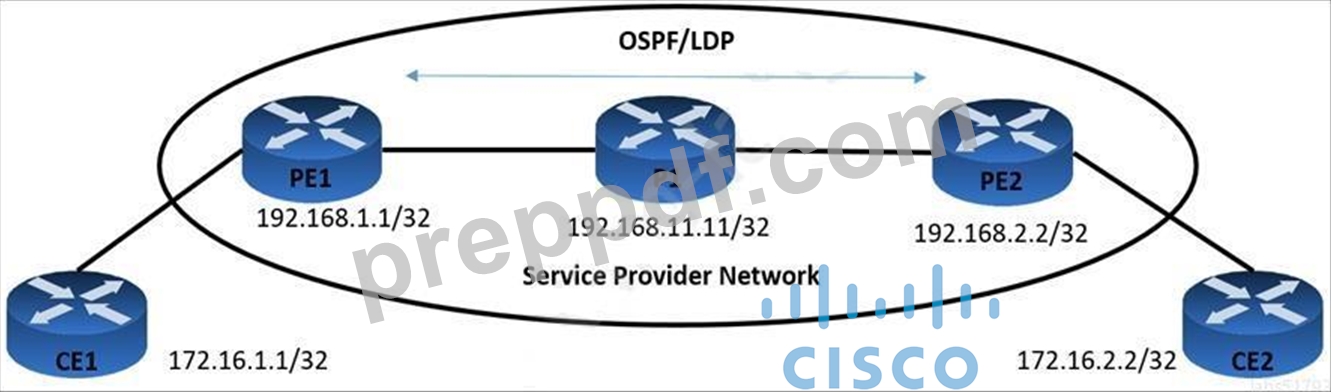
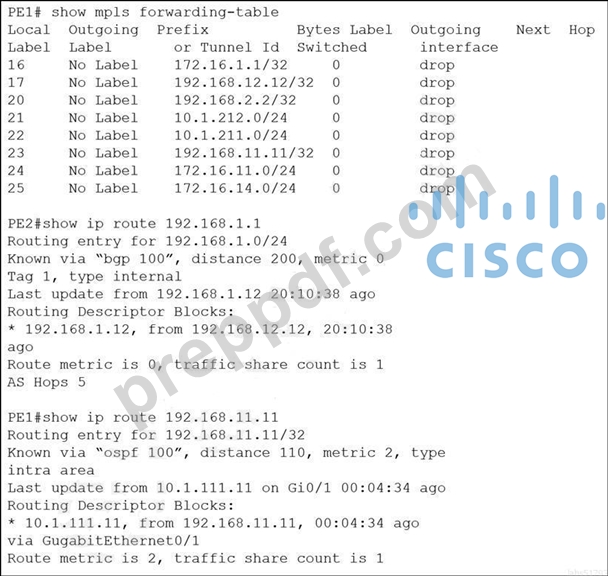
- A. Advertise PE2 router loopback on PE1 in OSPF.
- B. Enable LDP protocol on PE1 and PE2 routers.
- C. Advertise P1 router loopback on PE1 in OSPF.
- D. Enable CEF-based forwarding on PE1 router.
Answer: D
Explanation:
https://www.cisco.com/c/en/us/td/docs/ios-xml/ios/mp_basic/configuration/xe-3s/mp-basic-xe-3s- book/mp-mpls-cisco-rtrs.html
NEW QUESTION # 149 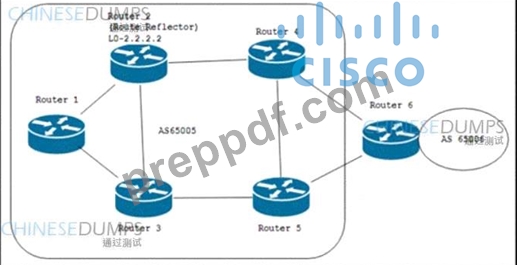
Refer to the exhibit. The initial BGP configuration of the network is complete, and all the routers have established BGP neighborship. The engineer configured Router 2 with additional BGP paths to install and advertise more paths to Router 1 and Router 3. Which configuration must the engineer apply to Router 1 and Router 3 so that they will use and install all additional paths?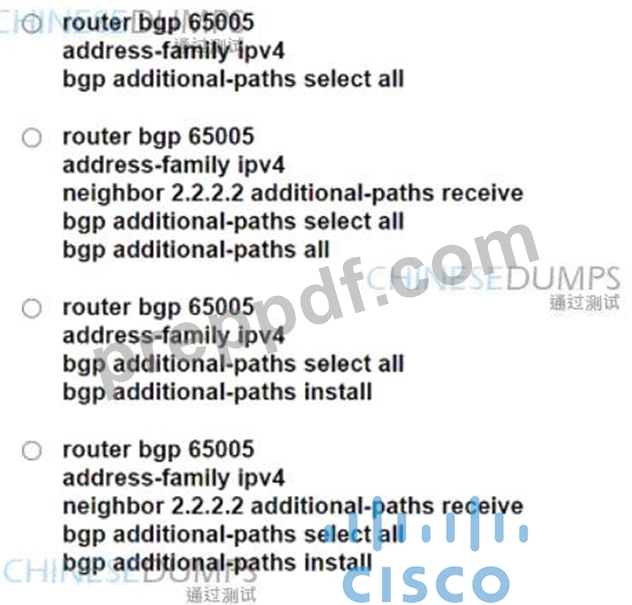
- A. Option C
- B. Option D
- C. Option A
- D. Option B
Answer: B
NEW QUESTION # 150
Refer to the exhibit.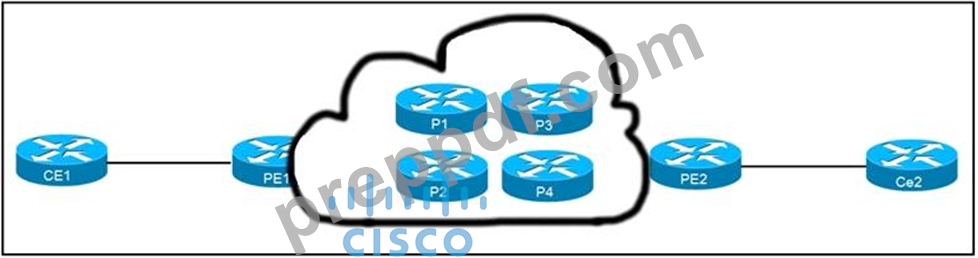
CE1 and CE2 cannot communicate through the service provider BGP peering is established between PE1 and PE2. IS-IS is the only routing protocol running in the service provider core. What step can be done to troubleshoot the issue?
- A. Verify the MPLS LSPs.
- B. Switch the IGPs running in the core from IS-IS to OSPF to support a Cisco MPLS TE tunnel from PE1 to PE2.
- C. Confirm that IS-IS is running with metric-style narrow.
- D. Configure BGP between CE and PE routers.
Answer: C
NEW QUESTION # 151
Refer to the exhibit.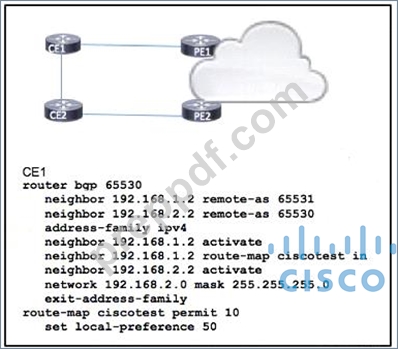
Refer to the exhibit. Routers CE1 and CE2 are in AS 65530. which is multihomed for Internet access. An engineer expects inbound traffic to AS 65530 to arrive from PE1. but it is coming from PE2 instead PE1 and PE2 routers are connected with CE routers through the same bandwidth Which action must be taken to correct the problem?
- A. Set the local-preference value on router CEI to 100 or greater
- B. On router CE2, configure inbound routes from PE2 to CE2 with a local-preference value of 50 or greater.
- C. Configure router CEI to prepend the AS path to routes it receives from PE 1.
- D. On router PEI , change the origin for routes that are redistributed from CEI to CE2.
Answer: A
NEW QUESTION # 152
......
Step by Step Guide to Prepare for 300-510 Exam: https://www.preppdf.com/Cisco/300-510-prepaway-exam-dumps.html
CCNP Service Provider 300-510 Real Exam Questions and Answers FREE Updated: https://drive.google.com/open?id=1r_SpvbXsoPCVpr7JvtBDvlSRBKMl1IS9