

[Apr-2026] Dumps Practice Exam Questions Study Guide for the Professional-Cloud-Developer Exam
Professional-Cloud-Developer Dumps with Practice Exam Questions Answers
NEW QUESTION # 95
Examine the image.
Which feature in macOS is opened by clicking on this dock icon?
- A. Finder
- B. Launchpad
- C. System Preferences
- D. Spotlight
Answer: B
Explanation:
Explanation/Reference: https://support.apple.com/en-us/HT202635
NEW QUESTION # 96
Your company has a BigQuery dataset named "Master" that keeps information about employee travel and expenses. This information is organized by employee department. That means employees should only be able to view information for their department. You want to apply a security framework to enforce this requirement with the minimum number of steps.
What should you do?
- A. Create a separate dataset for each department. Create a data pipeline for each department to copy appropriate information from the Master dataset to the specific dataset for the department. Give employees the permission to this department-specific dataset.
- B. Create a separate dataset for each department. Create a view with an appropriate WHERE clause to select records from a particular dataset for the specific department. Authorize this view to access records from your Master dataset. Give employees the permission to this department-specific dataset.
- C. Create a dataset named Master dataset. Create a separate view for each department in the Master dataset. Give employees access to the specific view for their department.
- D. Create a dataset named Master dataset. Create a separate table for each department in the Master dataset. Give employees access to the specific table for their department.
Answer: A
Explanation:
Explanation
NEW QUESTION # 97
You want to view the memory usage of your application deployed on Compute Engine. What should you do?
- A. Use the Stackdriver Metrics Explorer.
- B. Install the Stackdriver Monitoring Agent.
- C. Use the Google Cloud Platform Console.
- D. Install the Stackdriver Client Library.
Answer: A
Explanation:
Reference:
https://stackoverflow.com/questions/43991246/google-cloud-platform-how-to-monitor-memory-usage-of-vm-instances
NEW QUESTION # 98
You have an application deployed in production. When a new version is deployed, you want to ensure that all production traffic is routed to the new version of your application. You also want to keep the previous version deployed so that you can revert to it if there is an issue with the new version.
Which deployment strategy should you use?
- A. Recreate deployment
- B. Rolling deployment
- C. Blue/green deployment
- D. Canary deployment
Answer: C
Explanation:
https://www.redhat.com/en/topics/devops/what-is-blue-green-deployment
NEW QUESTION # 99
You are planning to deploy your application in a Google Kubernetes Engine (GKE) cluster The application exposes an HTTP-based health check at /healthz. You want to use this health check endpoint to determine whether traffic should be routed to the pod by the load balancer.
Which code snippet should you include in your Pod configuration?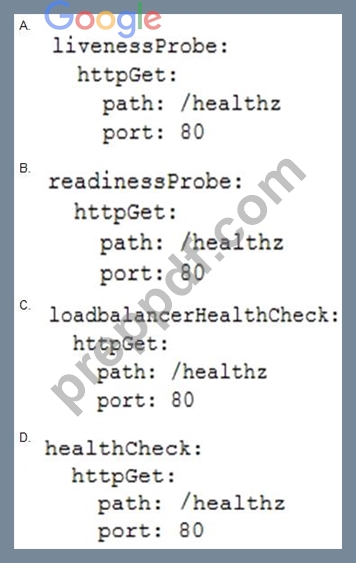
- A. Option D
- B. Option C
- C. Option B
- D. Option A
Answer: C
Explanation:
For the GKE ingress controller to use your readinessProbes as health checks, the Pods for an Ingress must exist at the time of Ingress creation. If your replicas are scaled to 0, the default health check will apply.
NEW QUESTION # 100
You need to migrate an internal file upload API with an enforced 500-MB file size limit to App Engine.
What should you do?
- A. Use FTP to upload files.
- B. Use CPanel to upload files.
- C. Change the API to be a multipart file upload API.
- D. Use signed URLs to upload files.
Answer: D
Explanation:
Reference:
https://wiki.christophchamp.com/index.php?title=Google_Cloud_Platform
Topic 1, HipLocal Case Study
Company Overview
HipLocal is a community application designed to facilitate communication between people in close proximity. It is used for event planning and organizing sporting events, and for businesses to connect with their local communities. HipLocal launched recently in a few neighborhoods in Dallas and is rapidly growing into a global phenomenon. Its unique style of hyper-local community communication and business outreach is in demand around the world.
Executive statement
We are the number one local community app; it's time to take our local community services global. Our venture capital investors want to see rapid growth and the same great experience for new local and virtual communities that come online, whether their members are 10 or 10,000 miles away from each other.
Solution concept
HipLocal wants to expand their existing service, with updated functionality, in new regions to better serve their global customers. They want to hire and train a new team to support these regions in their time zones. They will need to ensure that the application scales smoothly and provides clear uptime data.
Existing technical environment
HipLocal's environment is a mix of on-premises hardware and infrastructure running in Google Cloud Platform. The HipLocal team understands their application well but has limited experience in global scale applications. Their existing technical environment is as follows:
* Existing APIs run on Compute Engine virtual machine instances hosted in GCP
* State is stored in a single instance MySQL database in GCP
* Data is exported to an on-premises Teradata/Vertica data warehouse
* Data analytics is performed in an on-premises Hadoop environment
* The application has no logging
* There are basic indicators of uptime; alerts are frequently fired when the APIs are unresponsive Business Requirements HipLocal's investors want to expand their footprint and support the increase in demand they are seeing. Their requirements are:
* Expand availability of the application to new regions
* Increase the number of concurrent users that can be supported
* Ensure a consistent experience for users when they travel to different regions
* Obtain user activity metrics to better understand how to monetize their product
* Ensure compliance with regulations in the new regions (for example, GDPR)
* Reduce infrastructure management time and cost
* Adopt the Google-recommended practices for cloud computing
Technical Requirements
* The application and backend must provide usage metrics and monitoring
* APIs require strong authentication and authorization
* Logging must be increased, and data should be stored in a cloud analytics platform
* Move to serverless architecture to facilitate elastic scaling
* Provide authorized access to internal apps in a secure manner
NEW QUESTION # 101
You are creating an App Engine application that writes a file to any user's Google Drive.
How should the application authenticate to the Google Drive API?
- A. With the App Engine service account with delegated domain-wide authority.
- B. With the App Engine service account and https://www.googleapis.com/auth/drive.file scope that generates a signed JWT.
- C. With an OAuth Client ID with delegated domain-wide authority.
- D. With an OAuth Client ID that uses the https://www.googleapis.com/auth/drive.file scope to obtain an access token for each user.
Answer: D
Explanation:
https://developers.google.com/drive/api/v3/about-auth
NEW QUESTION # 102
You have an analytics application that runs hundreds of queries on BigQuery every few minutes using BigQuery API. You want to find out how much time these queries take to execute. What should you do?
- A. Use Stackdriver Monitoring to plot query execution times.
- B. Use Stackdriver Trace to plot query execution time.
- C. Use Stackdriver Monitoring to plot slot usage.
- D. Use Stackdriver Trace to plot API execution time.
Answer: A
NEW QUESTION # 103
You are working on a social media application. You plan to add a feature that allows users to upload images. These images will be 2 MB - 1 GB in size. You want to minimize their infrastructure operations overhead for this feature. What should you do?
- A. Change the application to create signed URLs for Cloud Storage. Transfer these signed URLs to the client application to upload images to Cloud Storage.
- B. Change the application to accept images directly and store them in the database that stores other user information.
- C. Set up a web server on GCP to accept user images and create a file store to keep uploaded files. Change the application to retrieve images from the file store.
- D. Create a separate bucket for each user in Cloud Storage. Assign a separate service account to allow write access on each bucket. Transfer service account credentials to the client application based on user information. The application uses this service account to upload images to Cloud Storage.
Answer: A
Explanation:
Reference:
https://cloud.google.com/blog/products/storage-data-transfer/uploading-images-directly-to-cloud-storage-by-using-signed-url
NEW QUESTION # 104
You are writing a Compute Engine hosted application in project A that needs to securely authenticate to a Cloud Pub/Sub topic in project B.
What should you do?
- A. Configure Application Default Credentials to use the private key of a service account owned by project B. Add the service account as a Cloud Pub/Sub publisher to project A.
- B. Configure Application Default Credentials to use the private key of a service account owned by project A. Add the service account as a publisher on the topic
- C. Configure the instances with a service account owned by project B. Add the service account as a Cloud Pub/Sub publisher to project A.
- D. Configure the instances with a service account owned by project A. Add the service account as a publisher on the topic.
Answer: D
Explanation:
https://cloud.google.com/pubsub/docs/access-control
"For example, suppose a service account in Cloud Project A wants to publish messages to a topic in Cloud Project B. You could accomplish this by granting the service account Edit permission in Cloud Project B"
NEW QUESTION # 105
You are deploying a single website on App Engine that needs to be accessible via the URL http://www.altostrat.com/. What should you do?
- A. Define a mapping in dispatch.yaml to point the domain www.altostrat.com to your App Engine service. Define an A record pointing to the single global App Engine IP address.
- B. Define a mapping in dispatch.yaml to point the domain www.altostrat.com to your App Engine service. Create a DNS CNAME record to point to the App Engine canonical name ghs.googlehosted.com.
- C. Verify domain ownership with Webmaster Central. Define an A record pointing to the single global App Engine IP address.
- D. Verify domain ownership with Webmaster Central. Create a DNS CNAME record to point to the App Engine canonical name ghs.googlehosted.com.
Answer: D
Explanation:
Reference:
https://cloud.google.com/appengine/docs/flexible/dotnet/mapping-custom-domains?hl=fa
NEW QUESTION # 106
Which of the following statements empathize with the customer or helps resolve a conflict? (Choose three.)
- A. "You are right. I would be frustrated as well."
- B. "It is not possible to repair it by Monday."
- C. "Calm down. You are being ridiculous."
- D. "I'm sorry to hear that."
- E. "I can understand why you are upset."
- F. "These devices are expensive, I cannot change that."
- G. "Please control yourself. That is not how it works."
Answer: A,D,E
NEW QUESTION # 107
You are configuring a continuous integration pipeline using Cloud Build to automate the deployment of new container images to Google Kubernetes Engine (GKE). The pipeline builds the application from its source code, runs unit and integration tests in separate steps, and pushes the container to Container Registry. The application runs on a Python web server.
The Dockerfile is as follows:
FROM python:3.7-alpine
COPY . /app
WORKDIR /app
RUN pip install -r requirements.txt
CMD [ "gunicorn", "-w 4", "main:app" ]
You notice that Cloud Build runs are taking longer than expected to complete. You want to decrease the build time. What should you do? (Choose two.)
- A. Store application source code on Cloud Storage, and configure the pipeline to use gsutil to download the source code.
- B. Deploy a Container Registry on a Compute Engine VM in a VPC, and use it to store the final images.
- C. Select a virtual machine (VM) size with higher CPU for Cloud Build runs.
- D. Change the base image in the Dockerfile to ubuntu:latest, and install Python 3.7 using a package manager utility.
- E. Cache the Docker image for subsequent builds using the -- cache-from argument in your build config file.
Answer: C,E
Explanation:
https://cloud.google.com/build/docs/optimize-builds/increase-vcpu-for-builds By default, Cloud Build runs your builds on a standard virtual machine (VM). In addition to the standard VM, Cloud Build provides several high-CPU VM types to run builds. To increase the speed of your build, select a machine with a higher vCPU to run builds. Keep in mind that although selecting a high vCPU machine increases your build speed, it may also increase the startup time of your build as Cloud Build only starts non-standard machines on demand.
https://cloud.google.com/build/docs/optimize-builds/speeding-up-
builds#using_a_cached_docker_image
The easiest way to increase the speed of your Docker image build is by specifying a cached image that can be used for subsequent builds. You can specify the cached image by adding the -- cache-from argument in your build config file, which will instruct Docker to build using that image as a cache source.
NEW QUESTION # 108
Which of the following types of data are backed up to iCloud? (Choose two.)
- A. Apple Pay information and settings
- B. Touch ID Settings
- C. iCloud Music Library
- D. Messages
- E. Device Settings
Answer: D,E
NEW QUESTION # 109
You are a developer at a large organization. You are deploying a web application to Google Kubernetes Engine (GKE). The DevOps team has built a CI/CD pipeline that uses Cloud Deploy to deploy the application to Dev Test, and Prod clusters in GKE. After Cloud Deploy successfully deploys the application to the Dev cluster you want to automatically promote it to the Test Cluster. How should you configure this process following Google-recommended best practices?
- A. 1 Create a Cloud Function that calls the Google Cloud Deploy API to promote the application to the Test cluster
2 Configure this function to be triggered by SUCCEEDED Pub/Sub messages from the clouddeploy operations topic - B. 1 Create a Cloud Build pipeline that uses the gke-deploy builder
2 Create a Cloud Build trigger that listens to SUCCEEDED Pub/Sub messages from the cloud-builds topic
3 Configure this pipeline to run a deployment step to the Test cluster - C. 1 Create a Cloud Build trigger that listens for SUCCEEDED Pub/Sub messages from the clouddeploy-operations topic.
2 Configure Cloud Build to include a step that promotes the application to the Test cluster - D. 1 Create a Cloud Function that calls the Google Cloud Deploy API to promote the application to the Test cluster
2 Configure this function to be triggered by SUCCEEDED Pub/Sub messages from the cloud-builds topic
Answer: D
NEW QUESTION # 110
Your application is running on Compute Engine and is showing sustained failures for a small number of requests. You have narrowed the cause down to a single Compute Engine instance, but the instance is unresponsive to SSH. What should you do next?
- A. Enable and check the serial port output.
- B. Delete the machine and create a new one.
- C. Reboot the machine.
- D. Take a snapshot of the disk and attach it to a new machine.
Answer: C
NEW QUESTION # 111
......
Free Cloud Developer Professional-Cloud-Developer Exam Question: https://www.preppdf.com/Google/Professional-Cloud-Developer-prepaway-exam-dumps.html
Professional-Cloud-Developer by Cloud Developer Actual Free Exam Practice Test: https://drive.google.com/open?id=1yFMoACRz4Qi-ddcoGUXD2YLm4ksiHGOr