

FCSS_SDW_AR-7.4 Practice Test Questions Updated 75 Questions
Fortinet FCSS_SDW_AR-7.4 Dumps - Secret To Pass in First Attempt
NEW QUESTION # 45
Within the context of SD-WAN, what does SIA correspond to?
- A. Software Internet Access
- B. Remote Breakout
- C. Local Breakout
- D. Secure Internet Authorization
Answer: B
Explanation: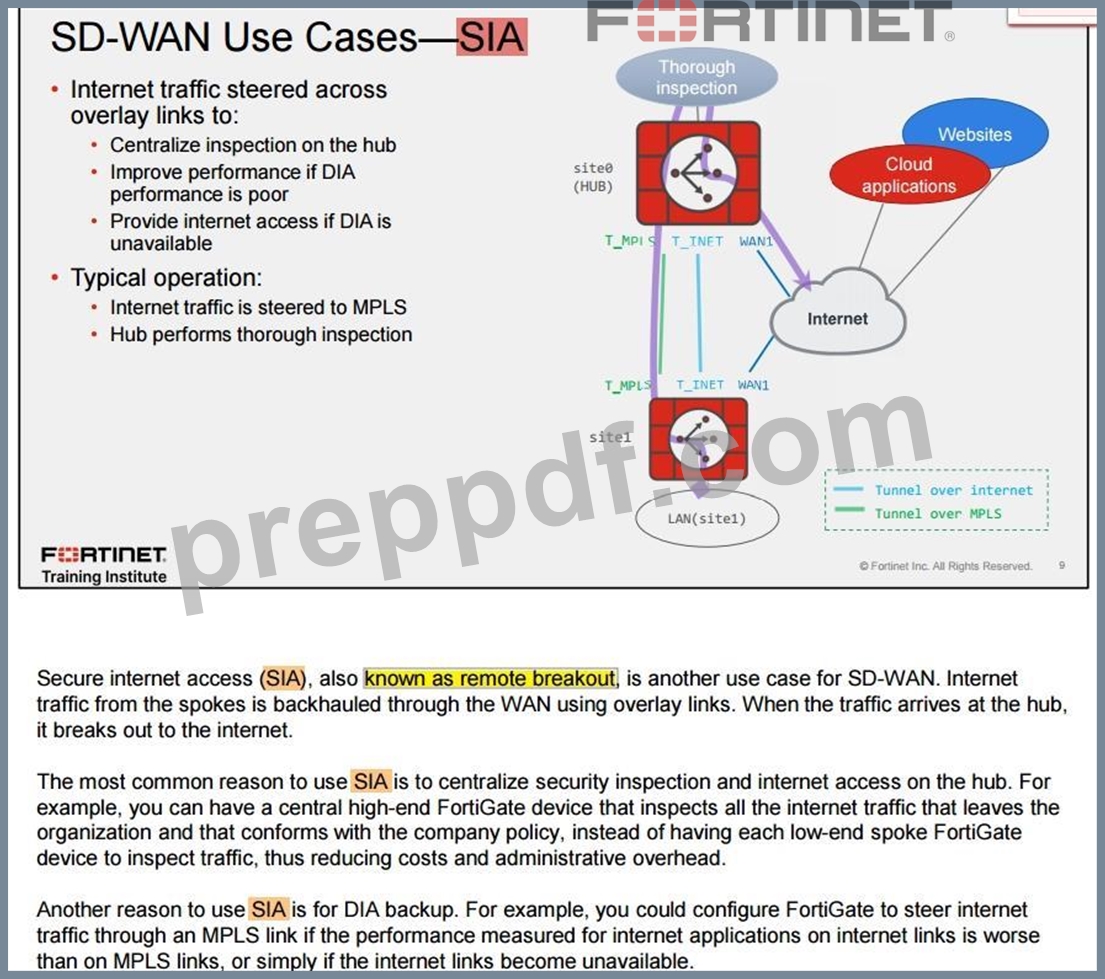
NEW QUESTION # 46
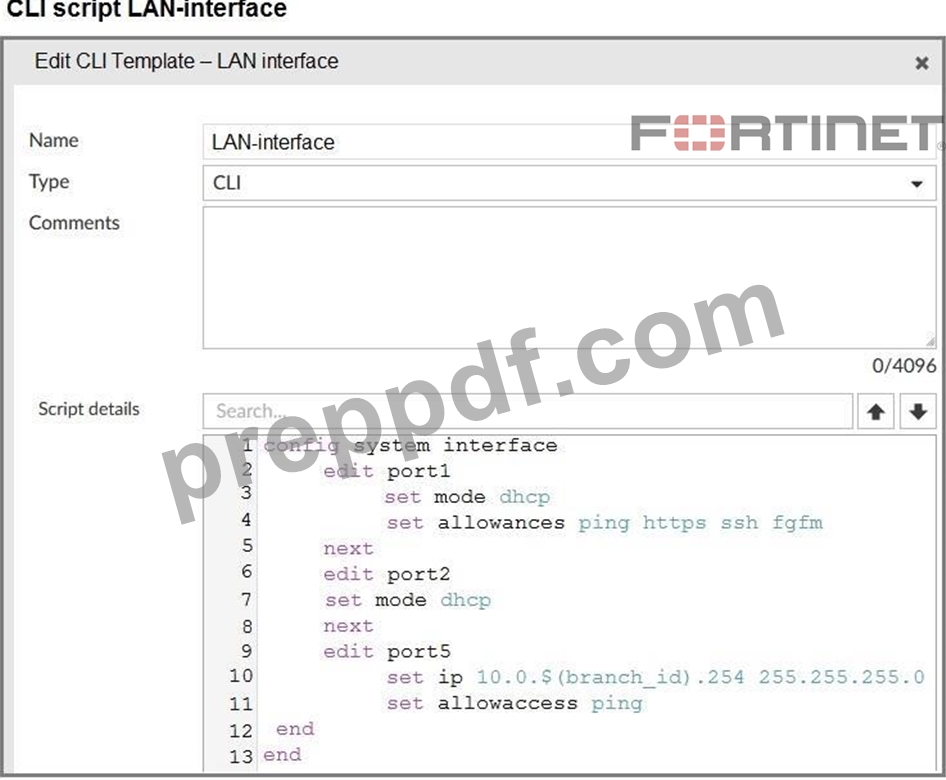
Refer to the exhibits. The administrator configured a device blueprint and CLI scripts as shown in the exhibits, to prepare for onboarding FortiGate devices in the company's stores. Later, a technician prepares a FortiGate 51G with a basic configuration and connects it to the network.
The basic configuration contains the port1 configuration and the minimal configuration required to allow the device to connect to FortiManager.
After the device first connects to FortiManager, FortiManager updates the device configuration.
Based on the exhibits, which actions does FortiManager perform?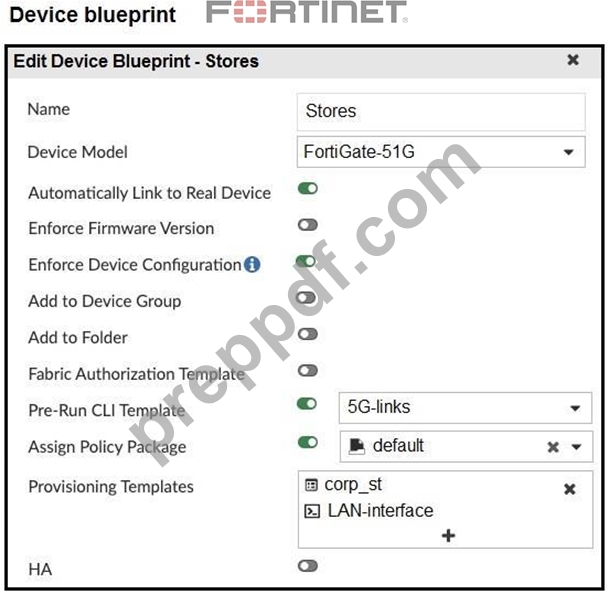
- A. FortiManager does not update the port1 configuration because FortiManager does not change the configuration of interfaces with fgfm access.
- B. FortiManager updates access rights only for port1. FortiManager cannot update the IP address because it was already set manually.
- C. FortiManager updates the configuration of port1, port2, and port5. The three ports might get new IP addresses.
- D. FortiManager updates the device configuration according to the selected templates. It applies the corp_st template first.
Answer: C
Explanation:
Enforce Device Configuration is enabled and the blueprint applies the provisioning CLI templates.
The LAN-interface script sets port1 and port2 to DHCP and assigns a static IP to port5 (using the branch_id variable). Therefore, when FortiManager pushes the blueprint, it updates the configurations of port1, port2, and port5 - and their IP addresses may change accordingly.
NEW QUESTION # 47
Refer to the exhibit. Which statement best describe the role of the ADVPN device in handling traffic?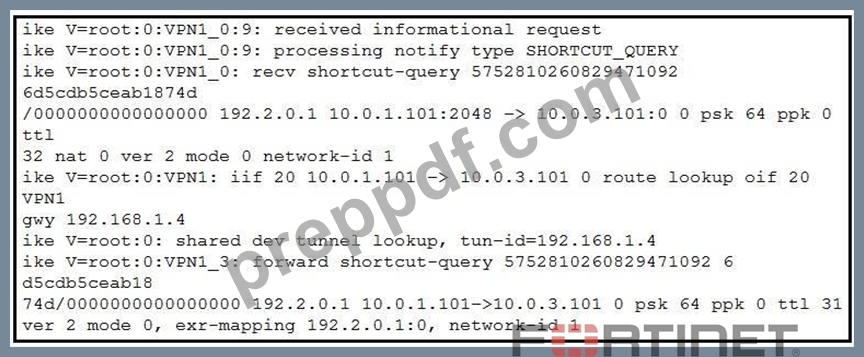
- A. This is a spoke. The kernel received a shortcut request and forwards the query to another spoke.
- B. This is a spoke that has received a shortcut query from another spoke and has forwarded the response to its hub.
- C. This is a hub that has received a query from a spoke and has forwarded it to another spoke.
- D. This is a hub in a dual-region topology. The remote hub tunnel ID is 10.0.2.101.
Answer: C
Explanation: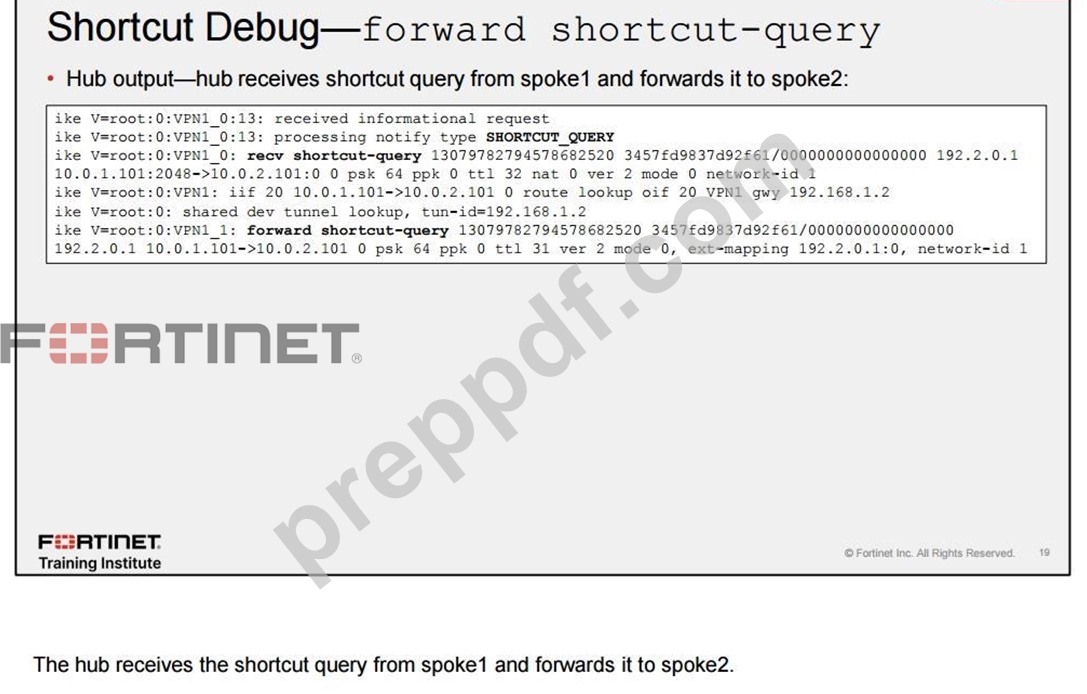
NEW QUESTION # 48
The administrator uses the FortiManager SD-WAN overlay template to prepare an SD-WAN deployment. Using information provided through the SD-WAN overlay template wizard, FortiManager creates templates ready to install on the spoke and hub devices.
What are the three templates created by the SD-WAN overlay template for a spoke device?
(Choose three.)
- A. Rules template
- B. CLI template
- C. BGP template
- D. Static route template
- E. IPsec tunnel template
Answer: A,C,E
Explanation:
Rules template → Defines the SD-WAN rules for traffic steering.
BGP template → Configures dynamic routing for overlay tunnels.
IPsec tunnel template → Builds the IPsec VPN tunnels from the spoke to the hubs.
NEW QUESTION # 49
The SD-WAN overlay template helps to prepare SD-WAN deployments. To complete the tasks performed by the SD-WAN overlay template, the administrator must perform some post-run tasks.
What are three mandatory post-run tasks that must be performed? (Choose three.)
- A. Assign a branch_id metadata variable to each branch device.
- B. Configure SD-WAN rules.
- C. Configure routing through overlay tunnels created by the SD-WAN overlay template.
- D. Assign an sdwan_id metadata variable to each device (branch and hub).
- E. Create policy packages for branch devices.
Answer: A,B,C
NEW QUESTION # 50
Refer to the exhibit. Which two conclusions can you draw from the output shown? (Choose two.)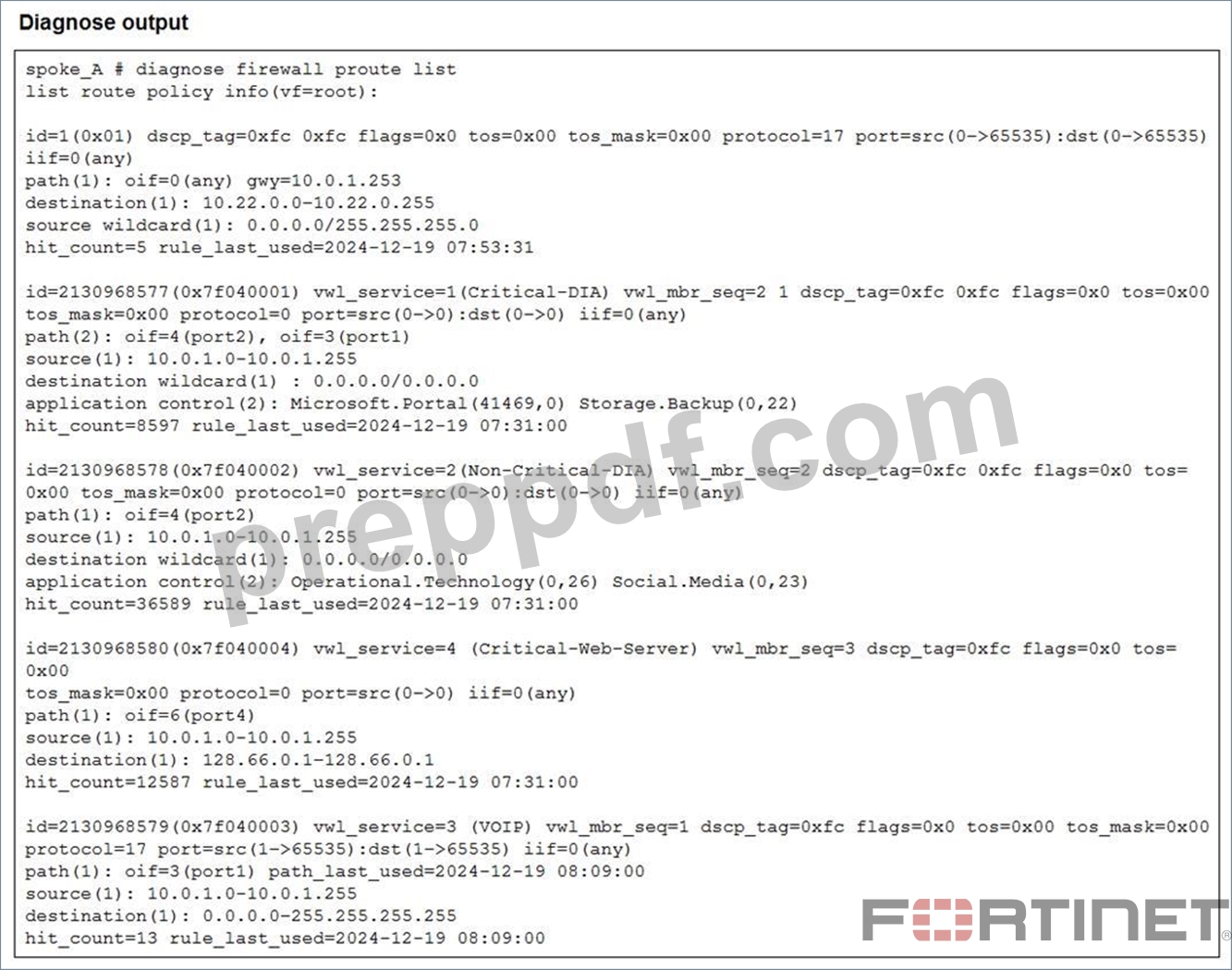
- A. UDP traffic destined to the subnet 10.22.0.0/24 matches a policy route.
- B. One SD-WAN rule allows traffic load balancing.
- C. One SD-WAN rule is defined with application categories as the destination.
- D. UDP traffic destined to the subnet 10.22.0.0/24 matches a manual SD-WAN rule.
Answer: A,C
Explanation:
One SD-WAN rule is defined with application categories as the destination → The diagnose output shows application control matches such as Microsoft.Portal, Operational.Technology, and Social.Media, confirming that SD-WAN rules are using application categories as destinations.
UDP traffic destined to the subnet 10.22.0.0/24 matches a policy route → The first entry (id=1) shows protocol=17 (UDP) with destination 10.22.0.0/24, confirming this traffic is handled by a policy route instead of an SD-WAN rule.
NEW QUESTION # 51
Refer to the exhibit. Which SD-WAN rule and interface uses FortiGate to steer the traffic from the LAN subnet 10.0.1.0/24 to the corporate server 10.2.5.254?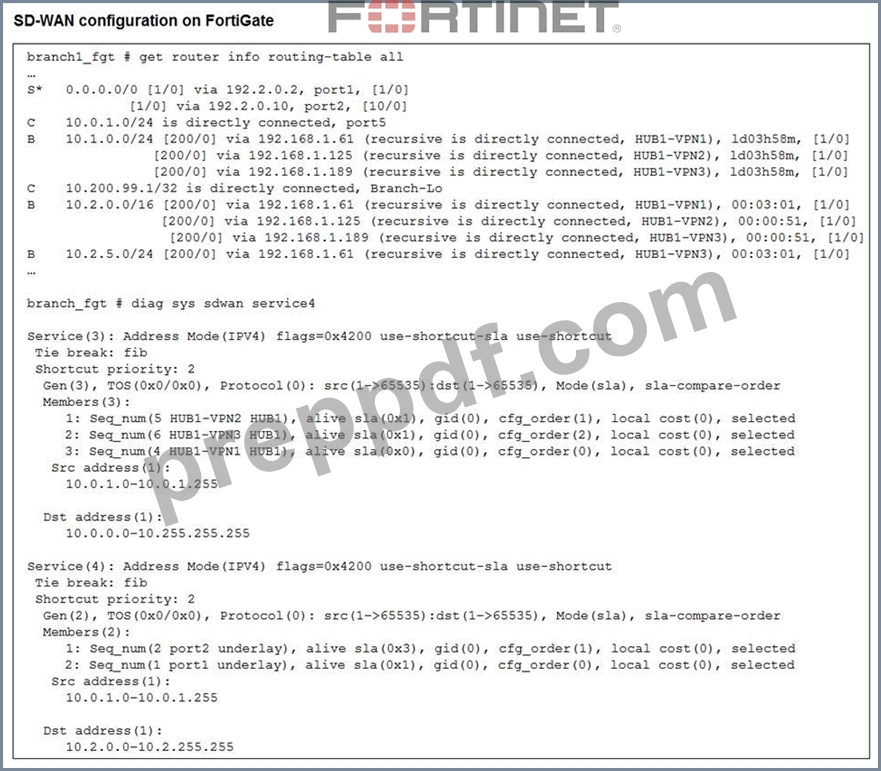
- A. SD-WAN service rule 3 and interface HUB1-VPN3.
- B. SD-WAN service rule 3 and interface HUB1-VPN2.
- C. SD-WAN service rule 4 and port1 or port2.
- D. SD-WAN service rule 4 and interface port2.
Answer: D
Explanation:
The destination IP 10.2.5.254 falls within 10.2.0.0/16, which is covered by SD-WAN service rule
4. The output of service rule 4 shows port2 as the selected interface, which FortiGate uses to steer the traffic.
NEW QUESTION # 52
Refer to the exhibits.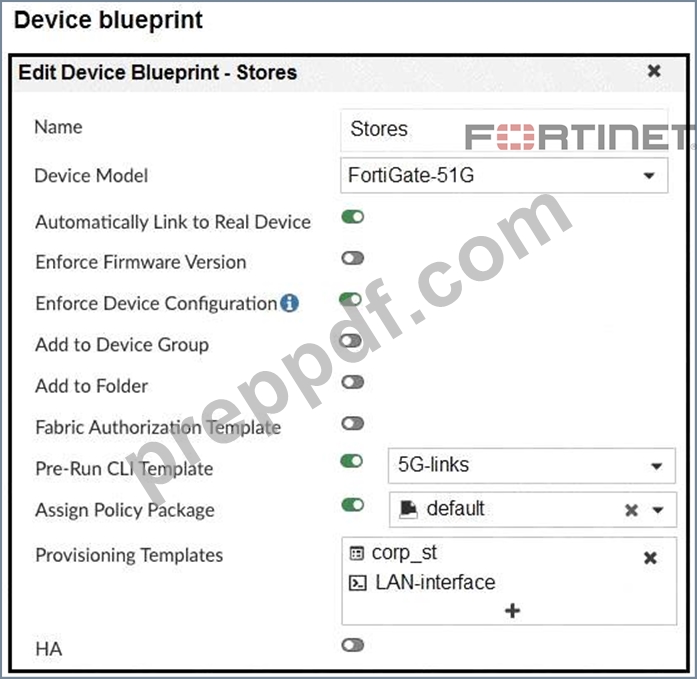
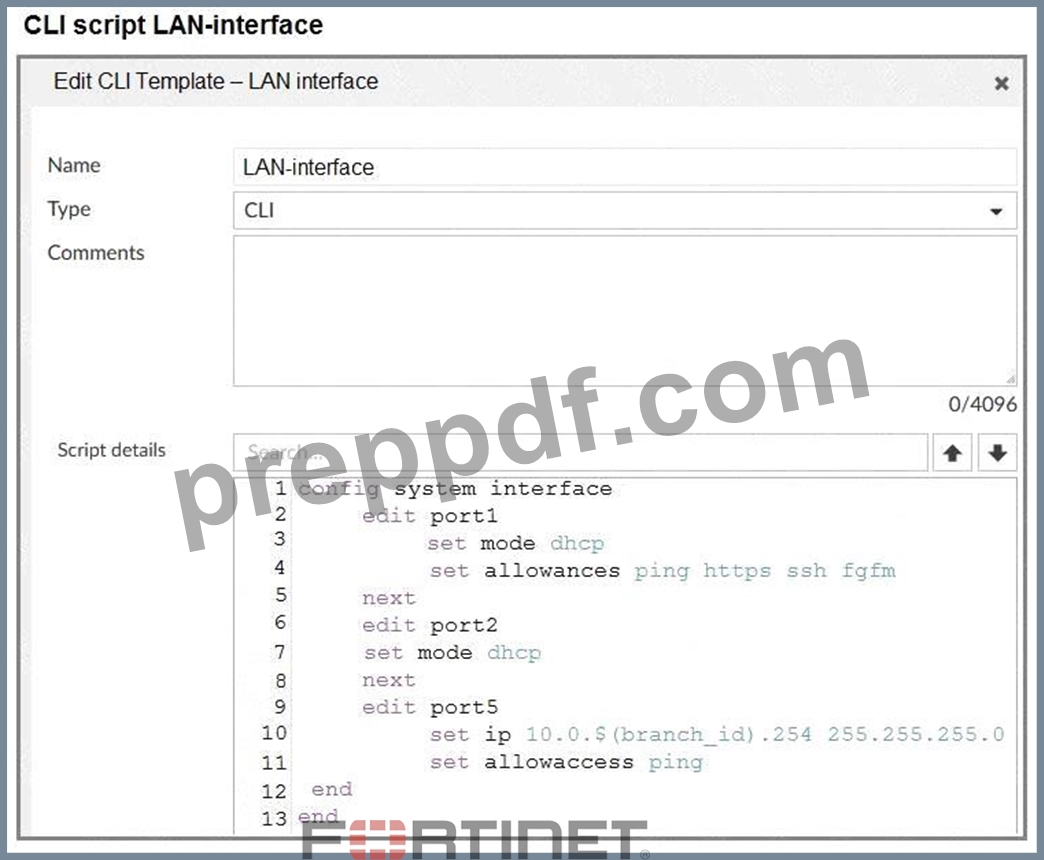
The administrator configured a device blueprint and CLI scripts as shown in the exhibits, to prepare for onboarding FortiGate devices in the company's stores. Later, a technician prepares a FortiGate 51G with a basic configuration and connects it to the network. The basic configuration contains the port1 configuration and the minimal configuration required to allow the device to connect to FortiManager.
After the device first connects to FortiManager, FortiManager updates the device configuration.
Based on the exhibits, which actions does FortiManager perform?
- A. FortiManager does not update the port1 configuration because FortiManager does not change the configuration of interfaces with fgfm access.
- B. FortiManager updates access rights only for port1. FortiManager cannot update the IP address because it was already set manually.
- C. FortiManager updates the configuration of port1, port2, and port5. The three ports might get new IP addresses.
- D. FortiManager updates the device configuration according to the selected templates. It applies the corp_st template first.
Answer: C
Explanation:
Enforce Device Configuration is enabled and the blueprint applies the provisioning CLI templates. The LAN- interface script sets port1 and port2 to DHCP and assigns a static IP to port5 (using the branch_id variable).
Therefore, when FortiManager pushes the blueprint, it updates the configurations of port1, port2, and port5 - and their IP addresses may change accordingly.
NEW QUESTION # 53
Refer to the exhibit. Which action will FortiGate take if it detects SD-WAN members as dead?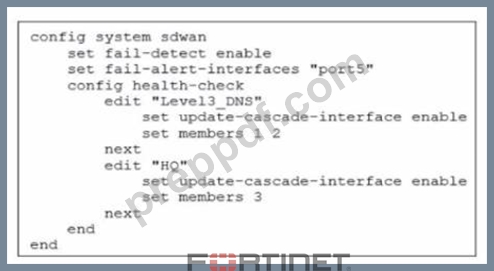
- A. FoftiGate bounces port5 after it detects all SD-WAN members as dead.
- B. FortiGate sends alert messages through poft5 when it detects all SD-WAN members as dead.
- C. FortiGate fails over to the secondary device after it detects port5 as dead.
- D. FortiGate brings down port5 after it detects all SD-WAN members as dead.
Answer: D
NEW QUESTION # 54
Refer to the exhibit.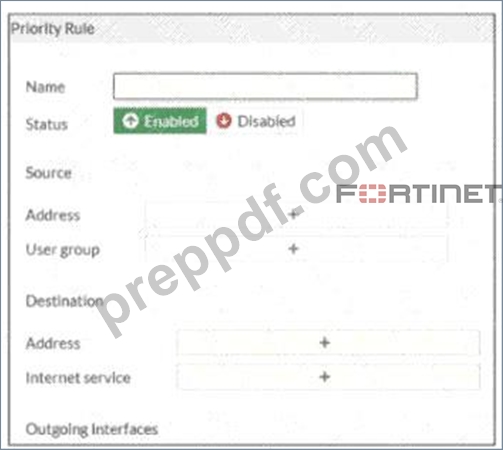
An administrator configures SD-WAN rules for a DIA setup using the FortiGate GUI. The page to configure the source and destination part of the rule looks as shown in the exhibit. The GUI page shows no option to configure an application as the destination of the SD-WAN rule Why?
- A. You must enable the feature first using the GUI menu System > Feature Visibility.
- B. FortiGate allows the configuration of applications as the destination of SD-WAN rules only on the CLI.
- C. You must enable the feature on the CLI.
- D. You cannot use applications as the destination when FortiGate is used for a DIA setup.
Answer: A
NEW QUESTION # 55
The administrator uses the FortiManager SD-WAN overlay template to prepare an SD-WAN deployment.
Using information provided through the SD-WAN overlay template wizard, FortiManager creates templates ready to install on the spoke and hub devices.
What are the three templates created by the SD-WAN overlay template for a spoke device? (Choose three.)
- A. Rules template
- B. CLI template
- C. BGP template
- D. Static route template
- E. IPsec tunnel template
Answer: A,C,E
Explanation:
Rules template # Defines the SD-WAN rules for traffic steering.
BGP template # Configures dynamic routing for overlay tunnels.
IPsec tunnel template # Builds the IPsec VPN tunnels from the spoke to the hubs.
NEW QUESTION # 56
Refer to the exhibits. The exhibits show the configuration for SD-WAN performance. SD-WAN rule, the application IDs of Facebook and YouTube along with the firewall policy configuration and the underlay zone status. Which two statements are true about the health and performance of SD-WAN members 3 and 4? (Choose two.)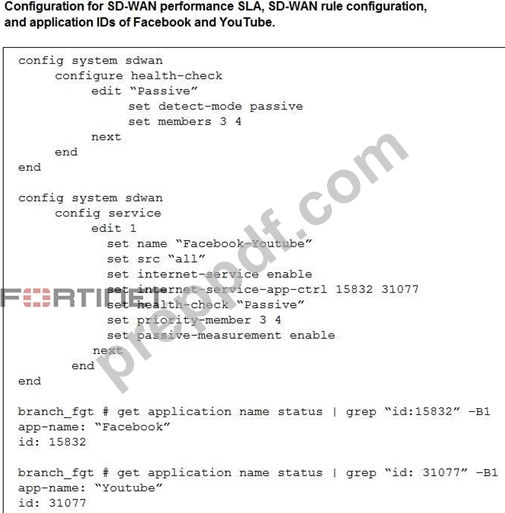
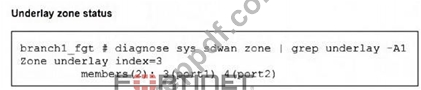
- A. Only related TCP traffic is used for performance measurement.
- B. FortiGate identifies the member as dead when there is no Facebook and YouTube traffic passing through the member.
- C. The performance is an average of the metrics measured for Facebook and YouTube traffic passing through the member.
- D. Encrypted traffic is not used for the performance measurement.
Answer: A,C
NEW QUESTION # 57
What are three key routing principles of SD-WAN? (Choose three.)
- A. SD-WAN rules are skipped if the best route to the destination is not an SD-WAN member.
- B. Policy routes have precedence over SD-WAN rules.
- C. SD-WAN rules are skipped if the best route to the destination is a static route
- D. Directly connected routes have precedence over SD-WAN rules.
- E. SD-WAN members are skipped if they do not have a valid route to the destination.
Answer: A,B,E
Explanation:
SD-WAN members without a valid route to the destination are skipped during path selection.
If the best route is not via an SD-WAN member, SD-WAN rules are skipped.
Policy routes take precedence over SD-WAN rules in the routing decision process.
NEW QUESTION # 58
Refer to the exhibit.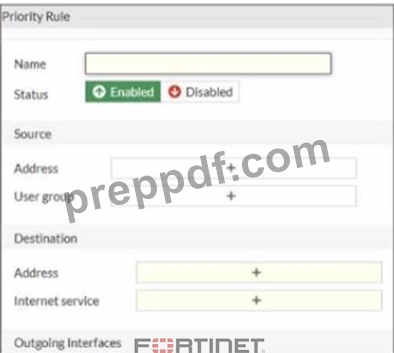
An administrator configures SD-WAN rules for a DIA setup using the FortiGate GUI. The page to configure the source and destination part of the rule looks as shown in the exhibit. The GUI page shows no option to configure an application as the destination of the SD-WAN rule Why?
- A. You must enable the feature first using the GUI menu System > Feature Visibility.
- B. FortiGate allows the configuration of applications as the destination of SD-WAN rules only on the CLI.
- C. You must enable the feature on the CLI.
- D. You cannot use applications as the destination when FortiGate is used for a DIA setup.
Answer: D
NEW QUESTION # 59
Exhibit.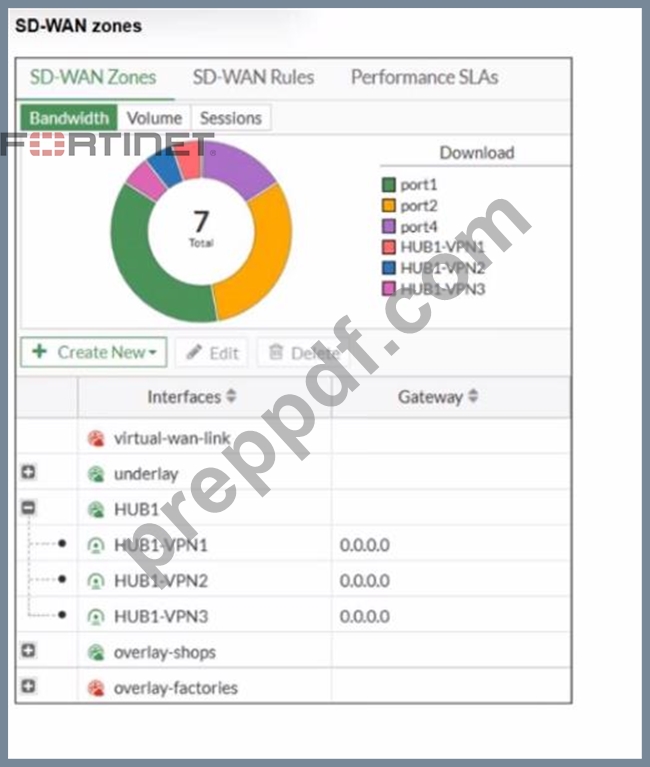
Refer to the exhibit, which shows an SD-WAN zone configuration on the FortiGate GUI. What can you conclude about the zone and member configuration on this device?
- A. You can delete the virtual-wan-link zones.
- B. You can move HUB1-VPN3 from the HUB1 zone to the overlay-shops zone.
- C. The overlay-factories zone contains no member.
- D. The underlay zone contains three members.
Answer: C
NEW QUESTION # 60
You are tasked with configuring ADVPN 2.0 on an SD-WAN topology already configured for ADVPN. What should you do to implement ADVPN 2.0 in this scenario?
- A. Delete the existing ADVPN configuration and configure ADVPN 2.0.
- B. Update the IPsec tunnel configurations on the hub.
- C. Update the SD-WAN configuration on the branches.
- D. Update the IPsec tunnel configuration on the branches.
Answer: C
NEW QUESTION # 61
......
Fortinet FCSS_SDW_AR-7.4 Exam Dumps [2026] Practice Valid Exam Dumps Question: https://www.preppdf.com/Fortinet/FCSS_SDW_AR-7.4-prepaway-exam-dumps.html
FCSS_SDW_AR-7.4 Dumps - Grab Out For [NEW-2026] Fortinet Exam: https://drive.google.com/open?id=1lICbfdipE_dikABlGawbRfqgoxdisMu2