

L6M9 Actual Questions 100% Same Braindumps with Actual Exam!
L6M9 Study Material, Preparation Guide and PDF Download
CIPS L6M9 Exam Syllabus Topics:
| Topic | Details |
|---|---|
| Topic 1 |
|
| Topic 2 |
|
| Topic 3 |
|
NEW QUESTION # 30
Mabel, theOperations Directorat a hotel, is engaged in a debate abouttrade-offs. The CFO believes that efficiency and effectiveness cannot be achieved together. Is this correct?
- A. Yes - the hotel must make a trade-off between efficiency or effectiveness, it cannot have both
- B. No - with improvements to technology and communications, there is no need for trade-offs
- C. Yes - engaging in trade-offs means that continuous improvement methodologies are no longer required
- D. No - the concept of trade-offs means that the organisation can position itself to achieve both effectiveness and efficiency
Answer: D
Explanation:
* Trade-offs involve balancing objectives(cost, quality, speed) toenhance both efficiency and effectiveness.
* Technology helps (D), but trade-offs still existin areas likesustainability and ethical sourcing.
* Continuous improvement (B) remains crucialeven with trade-offs.
(LO 2.2, See p.128-129)
NEW QUESTION # 31
Ping Lin Ltd is a toy manufacturer based in China. The company has acomplex supply chaininvolving raw material suppliers, retailers, international distributors, and logistics firms. Zeng, a Logistics Coordinator, has noticedirregularities in the ordering of materials in the lower part of the supply chain. Combined with irregular consumer buying patterns, this poses a risk to the organisation.
What is this phenomenon known as?
- A. The Forrest Effect
- B. The Bullwhip Effect
- C. The Hierarchy Effect
- D. The Butter Effect
Answer: B
Explanation:
TheBullwhip Effectdescribes howsmall changesin demand at the consumer level createlarger variancesin supply chain orders upstream. It leads to inefficiencies, overstocking, or shortages.
#Note:This is also known as theForrester Effect(not "Forrest Effect"-that was a trick!). A famous real- world example occurred duringCOVID-19, when panic-buying causedtoilet paper shortages.
For more insights, read:#The Bullwhip Effect & Toilet Paper Shortages(See LO 1.1, p.12)
NEW QUESTION # 32
Linear Programming (LP) can be adopted bymany business functions. Who out of the following could use LP modelling?Select ALL that apply.
- A. The logistics coordinator who is planning delivery routes
- B. An operations director who needs to choose between two products to manufacture
- C. A financial assistant who needs to create a budget for the manufacturing department
- D. The HR manager who needs to plan work schedules for the staff
- E. The marketing manager who is deciding how many social media posts to create
Answer: A,D,E
Explanation:
* LP is used for quantitative decision-making-finding the best possible outcome using numerical data.
* Option C (Marketing Manager)-LP can calculateoptimal ad frequencyfor sales conversion.
* Option D (HR Manager)-LP can help inworkforce scheduling.
* Option E (Logistics Coordinator)-LP can optimisedelivery routesfor cost efficiency.
* Option A and B are incorrectas LP doesn't apply to subjective decisions like product selection or budgeting.
(LO 1.3)
NEW QUESTION # 33
Manuel has created an Efficient Frontier diagram mapping six options his organisation can take. Is it possible for there to be two curves on this diagram?
- A. No - the diagram should only have straight lines, not curves
- B. No - only one curve is needed as this plots the trade-offs and level of risk
- C. Yes - the second curve can represent what is achievable should the organisation engage in continuous improvement
- D. Yes - there should always be at least two curves on the graph to demonstrate different timescales for the options
Answer: C
Explanation:
AnEfficient Frontier diagramcan have multiple curves. The first curve shows potential return on investment under current conditions, while the second curve models improvements if the organisation engages in continuous improvement. A third curve may represent a long-term vision, but this is less common. (See p.
136)
NEW QUESTION # 34
In a bottom-up process for planning and control, who would make the strategic plan?
- A. Senior managers
- B. Middle managers
- C. Stakeholders
- D. Operational staff
Answer: D
Explanation:
Operational staff would make the plan and pass this up to senior managers for approval. This is the opposite of a top-down approach, where senior managers make the plan and tell the operational staff what to do. (See p.
187)
NEW QUESTION # 35
Which of the following arenotcharacteristics of good information?
- A. Interpreted
- B. Accurate
- C. Timely
- D. Analysed
- E. Relevant
Answer: A,D
Explanation:
Analysed and interpreted arenotcharacteristics of good information. The key characteristics of good information are accuracy, reliability, timeliness, relevance, and completeness. (See p.178)
NEW QUESTION # 36
XYZ Ltd is a perfume manufacturer based in France. They have created a new perfume and research has shown that demand for the perfume will outstrip supply. The Chief Operating Officer (COO) and the Chief Financial Officer (CFO) are meeting to discuss this. The COO believes that the organisation needs to reallocate resources in order to meet demand. Are there any exceptions to when this may be the case?
- A. No - this would negatively affect the profit the organisation could make
- B. No - organisations should always aim to meet customer demand or resources will be underutilised
- C. Yes - there are occasions when an organisation would choose not to fulfil customer demand
- D. Yes - there are exceptions, but these are always outside of the organisation's control
Answer: C
Explanation:
While organisations generally try to fulfil customer demand, there are times when theystrategicallychoose not to. A common reason is maintaining a premium image-limiting supply can increase desirability and justify a higher price. For example, luxury brands often limit product availability. (See p.169)
NEW QUESTION # 37
White Moon Ltd, amanufacturing organisation, is consideringoutsourcing transportation. What would be areason for doing this?
- A. To avoid the inefficiency trap
- B. To decrease fixed costs
- C. To gain better access to emerging markets
- D. To please shareholders
Answer: B
Explanation:
* Outsourcing replaces fixed costs with variable costs-companies onlypay for what they use, rather than maintaining their own fleet.
* Option A is incorrectbecause gaining market access is abenefit of offshoring, not outsourcing.
* Option C is incorrectas there is no mention of shareholders in the scenario.
* Option D is incorrectsince the inefficiency trap relates tooffshoring.
(LO 1.2, See p.44)
NEW QUESTION # 38
Dev is creating anOperations Strategyfor hishealthcare consultancybusiness. Which of the following describes anOperations Strategy? SelectALLthat apply.
- A. The Operations Strategy is aligned with the Organisational Strategy
- B. Operations Strategy focuses on external processes
- C. Operations Strategy is a short-ranged plan
- D. Operations Strategy supports the competitive advantage of the company
Answer: A,D
Explanation:
* Option B is correctbecause Operations Strategy helps build acompetitive advantagefor the organisation.
* Option C is correctbecause Operations Strategy must align with theoverall organisational goals.
* Option A is incorrect-it isSupply Chain Managementthat focuses onexternalprocesses.
* Option D is incorrectbecauseOperations Strategy is long-term, not short-ranged.
(See LO 2.1, p.63)
NEW QUESTION # 39
The operations department of ABC Ltd has recently launched a new product. The product is manufactured within a large factory and then sent to retailers for sale. The department has a system in place which details the components required for the product and the quantities required to fulfil customer demand. The system works online and links to other areas of the business including HR and finance.
So far, several large orders have been placed for the product from different retailers. The Chief Operations Officer (COO) has decided to programme the completion of the orders based on when the orders were placed.
The benefit of this strategy is that it will give each customer a similar lead time. Thus far no buffer stock has been created as products are only created when orders are received.
Three teams are required to make the product and the product flows from team one to team two toteam three, each team adding a component to the product. Unfortunately, team two are short staffed and are completing their work at a slower rate than the other two teams. This is a huge consideration for the COO as it will impact upon the capacity of the organisation.
The retailers have all signed contracts with ABC Ltd and the COO is extremely happy that they are long term contracts. Contract 1 is with retailer X and the price is set for three years. Contract 2 is with retailer Y and is a five year contract where the price will be reviewed annually in line with CPI. Contract 3 has a variable pricing mechanism based on the volume of products ordered.
What is the nature of the COO's consideration?
- A. Theory of Constraints
- B. Corporate strategy
- C. Variance analysis
- D. Push technique
Answer: A
Explanation:
This is an issue related to theTheory of Constraints, as Team 2 is thebottleneckaffecting overall production efficiency. TheTheory of Constraintsfocuses on identifying and managing the most critical limitation in a system. (See LO 3.3)
NEW QUESTION # 40
Scenario:
Five manufacturing organisations usedifferent order prioritisation methodsandworkflow patterns. Each company follows a uniquestrategy for order processingandworkflow structure.
For eachorganisation, select thecorrect Prioritisation MethodandPattern of Workflow.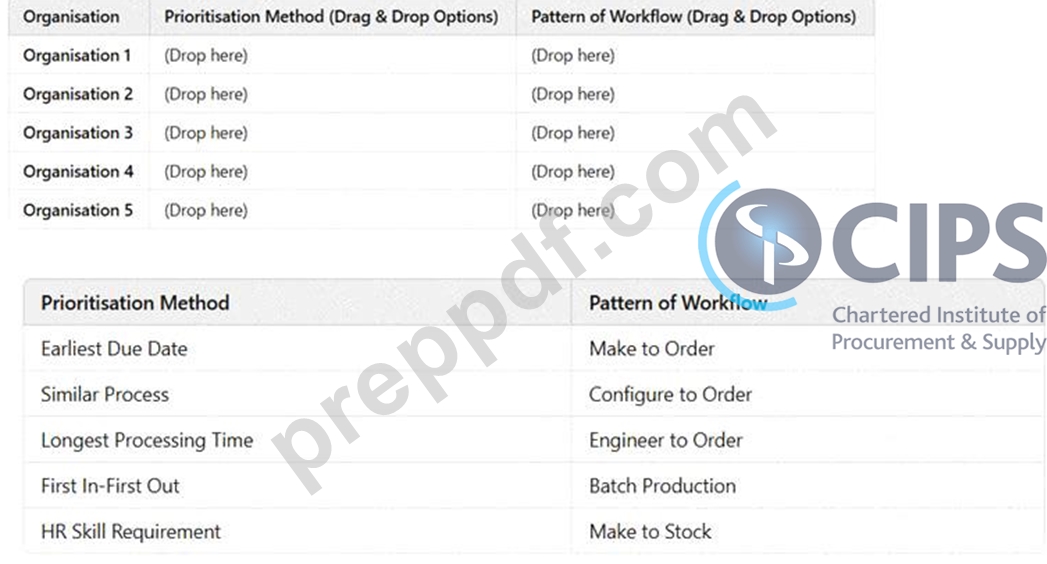
Answer:
Explanation: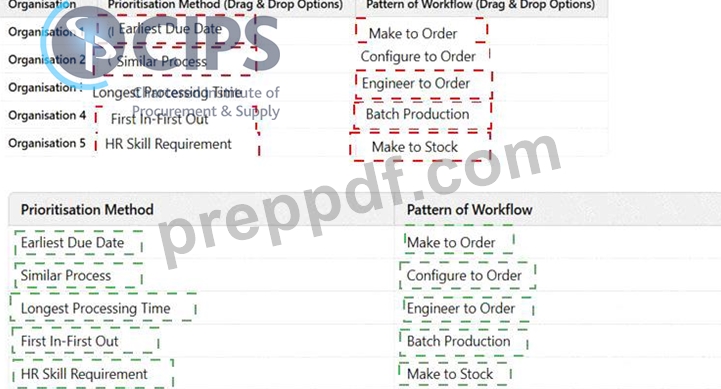
Explanation:
A screenshot of a product list AI-generated content may be incorrect.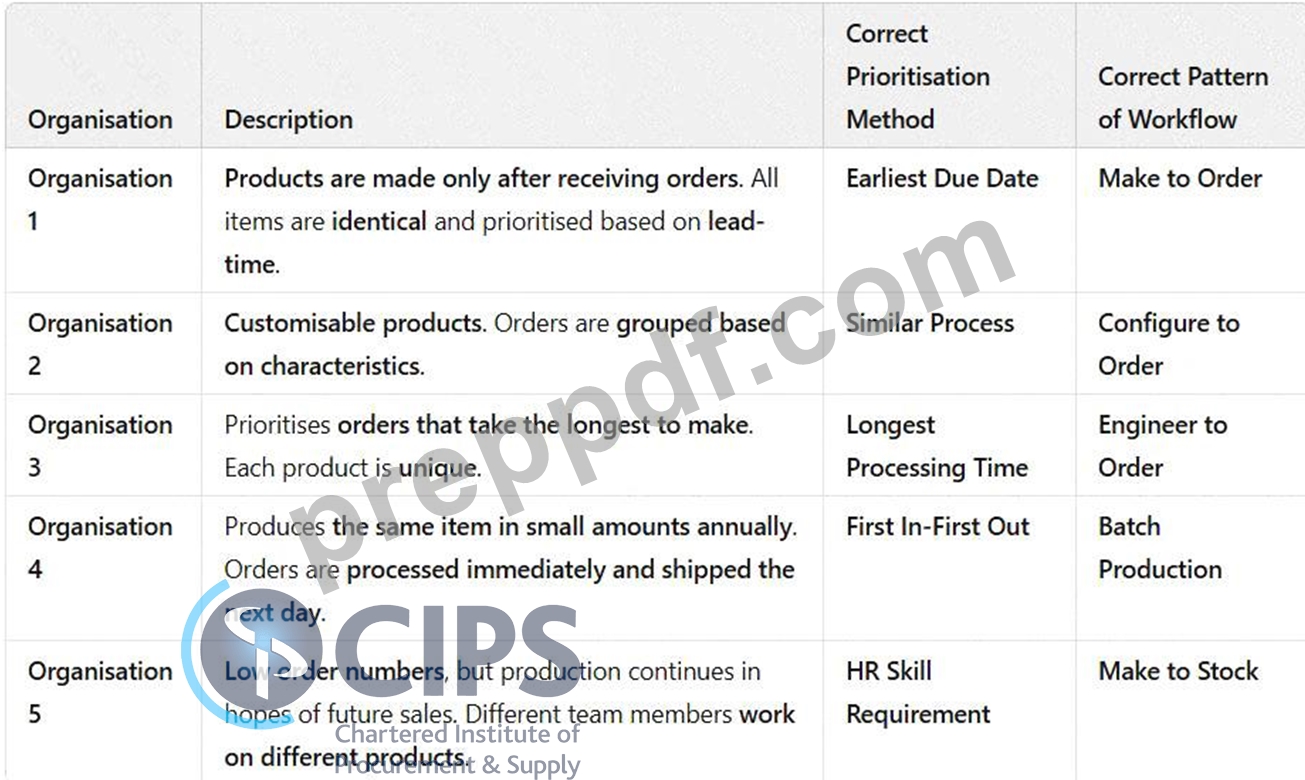
NEW QUESTION # 41
Which of the followingcapacity planning strategiesis theleast conservative?
- A. Incremental strategy
- B. Lead strategy
- C. Demand smoothing
- D. Lag strategy
Answer: B
Explanation:
* Lead strategyis theleast conservativeas itincreases capacity before demand is proven, making it risky but proactive.
* Lag strategy (B)waits for demand toexceed capacitybefore expanding.
* Incremental strategy (C)expandsgradually over time.
* Demand smoothing (D)focuses onmanaging demand fluctuations, not increasing capacity.
(LO 1.3, See p.54-55)
NEW QUESTION # 42
Megan, theDirector of Operationsat Orange Windows Ltd, is concerned aboutovercapacity. Should she be worried?
- A. No - overcapacity means there are unused resources within the operations department
- B. No - undercapacity will lead to unsold products
- C. Yes - overcapacity means that the organisation has wasted resources
- D. Yes - overcapacity means that some customer orders may not be fulfilled
Answer: C
Explanation:
* Overcapacitymeans the organisationhas more production than demand, leading towaste and inefficiency.
* Customer orders will still be fulfilled(eliminating option B).
* Under capacity (D) is incorrect, asovercapacity, not undercapacity, leads to excess stock.
(LO 2.2, See p.115)
NEW QUESTION # 43
Paul is the Operations Manager at a button factory. Buttons are incorporated into many different fashion garments, and as they are currently 'on trend,' there is a high demand for more buttons. Paul is concerned that the factory cannot produce the number of buttons that is being demanded in the marketplace. He has calculated that each team within the factory only has the capacity to create 1,000 buttons per day, and he will decline any requests for buttons that exceed this amount. In terms of Capacity Loading, what is this called?
- A. Process loading
- B. Maximum loading
- C. Finite loading
- D. Complete loading
Answer: C
Explanation:
This isfinite loading. There is a finite amount of buttons that can be produced. Finite means there is a limit.
This is the opposite ofinfinite loading, where a team can take on additional tasks/orders without any issues.
Maximum loadingis similar to finite loading, but the difference is subtle-maximum is the amount of work that is possible in a given time period, but no limits are placed on this. Infinite loading, a strict limit is placed.
(See p.181)
NEW QUESTION # 44
Which of the following is adifferencebetween a supply chain and a supply network?Select ALL that apply.
- A. Dimension difference
- B. Location of the players
- C. Profit made
- D. Complexity
- E. Number of players involved
Answer: A,D,E
Explanation:
Asupply chainis asimple, linearsystem where products move from A # B # C.Asupply networkismulti- layered, withhorizontal and vertical connections, making itmore complex.
* Dimension difference (B):Supply networks have largerdimensions, with multiple supply channels and flows.
* Complexity (C):A supply network ismore intricatethan a single supply chain.
* Number of players (D):Supply networks involvemore entitiesthan a simple supply chain.
* Profit made (A) is incorrect, asboth supply chains and supply networks can be profitable.
* Location of players (E) is incorrect, as both supply chains and networks can belocal or global.
(LO 1.1, See p.8)
NEW QUESTION # 45
......
L6M9 Certification Study Guide Pass L6M9 Fast: https://www.preppdf.com/CIPS/L6M9-prepaway-exam-dumps.html
Free L6M9 Certification Sample Questions with Online Practice Test: https://drive.google.com/open?id=1D1TBvtIf7EytURyj9d9vfDX-x69DIjV5