

C_THR86_2405 Certification - The Ultimate Guide [Updated 2025]
C_THR86_2405 Practice Exam and Study Guides - Verified By PrepPDF
SAP C_THR86_2405 Exam Syllabus Topics:
| Topic | Details |
|---|---|
| Topic 1 |
|
| Topic 2 |
|
| Topic 3 |
|
| Topic 4 |
|
| Topic 5 |
|
| Topic 6 |
|
NEW QUESTION # 49
A customer would like percentage fields to only show decimal places if they are available. For example 40
00% should display as 40%,but if the percentage calculation is 40.54%. they want to display the decimal places.What number format should you use?
- A. defPercentFormat #
- B. defAmountFormat # ##0
- C. defPercentFormat #
- D. defPercentFormat #00
Answer: D
NEW QUESTION # 50
How many custom columns may be used as Formula Criteria for Guidelines?
- A. 0
- B. 1
- C. There is no limit on custom columns
- D. 2
Answer: D
NEW QUESTION # 51
A customer's performance process has a Final Review step at the end of the route map during which the reward team reviews the recommendations that have been made to ensure budget spend meets limits.The merit guideline is based upon performance rating, compa ratio, and two custom fields. Country and Job Family The customer wishes that the merit increase is reset to the default when theCountry changes for an employee, but NOT when the Job Family changes.How can this requirement be met?
- A. Ensure the default value for all merit guidelines is non zero*Make sure the Country and Job Famity columns are both reloadable
- B. Set the Force Default On Rating Change option within guidelines to Yes*Make sure the Country column is reloadable and Job Family is not.
- C. Set the Force Default On Custom Column Change option within guidelines to Yes*Make sure the Country column is reloadable and Job Family is not
- D. Set the Force Default On Custom Column Change option within guidelines to Yes*Make sure the Country and Job Famity columns are both reloadable
Answer: C
NEW QUESTION # 52
You configure the following salary rule in the compensation plan template:
How does the system behave?
- A. A pop-up message asks the planner if the exceeded amount should be assigned to Lump Sum.
*The planner can save the merit recommendation by selecting Cancel in the pop-up message. - B. The rule prevents the planner from saving the merit increase.
*The planner must go back change their merit recommendation. - C. A pop-up message asks the planner if the exceeded amount should be assigned to Lump Sum.
*The planner CANNOT save the merit increase by selecting Cancel in the pop-up message. - D. The rule alerts the planner that the range penetration threshold has been exceeded the merit field text turns red.
*The planner can save the merit recommendation.
Answer: A
NEW QUESTION # 53
In an EC-integrated compensation worksheet, what are some of the reasons you might include a lookup table in your configuration? Note: There are 3 correct answers to this question.
- A. Determining appropriate car allowance by grade
- B. Converting a code into its text equivalent for display
- C. Converting money values from functional to local currency
- D. Holding previous year's salary by Employee ID
- E. Providing budget percentage by country
Answer: A,D,E
NEW QUESTION # 54
Your non-EC customer wants only users in Pay Grade 1 2 to be ineligible for Lump Sum; Pay Grades 3 through 9 are eligible.
What can you do to fulfill this requirement?
Note: There are 3 correct answers to this question.
- A. Start with all employees are eligible. In the UDF, set the LUMPSUM ELIGIBLE field to FALSE for Grades 1 2, TRUE for Grades 3 through 9.
- B. Start with all employees are ineligible. Using the legacy eligibility rules engine, create a rule condition that makes the Pay Grades 1 2 ineligible for the Lump Sum field.
- C. Start with all employees are eligible. Using the legacy eligibility rules engine, create a rule condition that makes the Pay Grades 3 through 9 eligible for the Lump Sum field.
- D. Start with all employees are eligible. Using the legacy eligibility rules engine, create a rule condition that makes the Pay Grades 1 2 ineligible for the Lump Sum field.
- E. Start with all employees are ineligible. Using the legacy eligibility rules engine, create a rule condition that goes through the eligible Pay Grades makes them eligible for the Lump Sum field.
Answer: A,B,E
NEW QUESTION # 55
A customer is using the following number format Mode Round down Multiple 100 How will a value of 9575
50 be displayed?
- A. 0
- B. 1
- C. 2
- D. 3
Answer: A
NEW QUESTION # 56
Your customer has part-time and full-time employees. You notice that for part-time employees, their compa-ratio in EC is different than in Compensation. What do you configure in the system to have it calculate the correct compa-ratio and take into account the FTE?
- A. Set the XML attribute isActualSalarylmported to False in the compensation plan template
- B. Set SALARY_PRORATING in the user data file (UDE) to the percent that the employees work full time
- C. Set COMPENSATION_SAL_RATE_TYPE in the user data file (UDF) to FULL-TIME or PART-TIME
- D. Set the XML attribute isActualSalarylmported to True in the compensation plan template
Answer: A
NEW QUESTION # 57
What types of custom fields can you use as formula criteria within the guidelines.Note There are 2 correct answers to this question.
- A. String fields based on a custom formula calculation
- B. Percent fields input on the worksheet
- C. Date fields uploaded from the User Data File
- D. Money fields based on a custom formula calculation
Answer: B,C
NEW QUESTION # 58
Your customer has part-time full-time employees. You notice that for part-time employees, their compa-ratio in EC is different than in Compensation. What do you configure in the system to have it calculate the correct compa-ratio take into account the FTE?
- A. Create a custom Amount column to store FTE rather than using the standard FTE column.
- B. Set the XML attribute isActualSalary Imported to False in the compensation plan template ensure standard FTE field is used.
- C. Set the XML attribute isActualSalaryImported to True in the compensation plan template ensure standard FTE field is used.
- D. Add values in the EC Pay Range object to align with each FTE.
Answer: B
NEW QUESTION # 59
Your customer wants to include information on the planning form that is visible and read-only to planners, but may be edited by the Reward Team. How can you achieve this?
- A. Configure a custom field and use field-based permissions to set the field to be hidden from planners
- B. Configure a custom field and set the field to be reportable
- C. Configure a custom field and set the field to read-only
- D. Configure a custom field and use field based permissions to set the field to be non-editable to planners
Answer: A
NEW QUESTION # 60
When should you configure a compensation template using the Second Manager hierarchy? Note: There are 2 correct answers to this question.
- A. Your customer has more than three manager approval levels in their route map.
- B. Your customer wants only directors above to do planning.
- C. Your customer wants to include HR in their route map.
- D. Your customer wants someone other than the standard manager to make compensation recommendations.
Answer: B,D
NEW QUESTION # 61
What triggers can be used to force a planner to add comments without using custom validations? Note: There are 2 correct answers to this question.
- A. Any time an employee is given a raise, stock, or options.
- B. An employee is NOT given a raise, stock, or options at all.
- C. When an employee's final salary is below range penetration minimum.
- D. When an employee's raise exceeds the range penetration maximum.
Answer: A,B
Explanation:
In SAP SuccessFactors Compensation, comments can be required to provide context or justification for certain compensation decisions, without the need for custom validations.
* Force Comments Based on Actions Taken or Not Taken
* Option A: When an employee is awarded a raise, stock, or options, SuccessFactors can be configured to prompt a mandatory comment. This is managed through standard settings without custom validation.
* Option C: Conversely, if an employee does not receive a raise, stock, or options, a forced comment rule can ensure planners justify this decision.
* Why Other Options Are Incorrect
* Options B and D are not standard triggers for forced comments in SAP SuccessFactors Compensation. These types of validations would typically require custom validation logic.
* Reference Documentation
* SAP SuccessFactors Compensation Guide onStandard Comment RulesandForce Comment Settings.
NEW QUESTION # 62
You are implementing an EC-integrated template.
Which compensation fields are commonly mapped to a pay component or pay component group? Note: There are 3 correct answers to this question.
- A. FTE
- B. Pay Grade
- C. Units Per Year
- D. Local Currency Code
- E. Current Salary
Answer: C,D,E
NEW QUESTION # 63
Your customer uses a look-up table to calculate custom budgets, as shown in the screenshot. The budget is based on an employee's country status. In the template, the country is defined with field ID customCountry the status is defined with field ID customStatus.
What is the correct syntax to calculate the adjustment budget?
- A. toNumber(lookup("2018_BudgetPool", custom Country.customStatus,2))"'curSalary
- B. toNumber(lookup("2018_BudgetPool", custom Country,customStatus,adjustment))"curSalary
- C. toNumber(lookup("2018_BudgetPool,custom Country, customStatus, Adjustment))*curSalary
- D. toNumber(lookup("2018_BudgetPool", custom Country,customStatus,1))"'curSalary
Answer: D
Explanation:
In SAP SuccessFactors Compensation, using look-up tables in formulas is a common method to calculate budget adjustments based on multiple criteria like an employee's country and status. This question is about selecting the correct syntax for using a look-up table to calculate a custom budget based on these criteria. Let's break down the logic and syntax for why option A is correct.
* Look-up Table Functionality in Compensation TemplatesIn SuccessFactors Compensation, look-up tables are used to fetch values dynamically based on specific conditions. Thelookupfunction in SAP allows fetching data from a pre-defined table by matching values from specified columns.
* Syntax and Parameters in the Lookup FunctionThelookupfunction syntax in SAP SuccessFactors Compensation is generally:
plaintext
Copy code
lookup("<lookupTableName>", <lookupKey1>, <lookupKey2>, <columnIndex>)
* <lookupTableName>: Name of the look-up table (in this case, "2018_BudgetPool").
* <lookupKey1>and<lookupKey2>: The fields in the form template used to search in the look-up table. Here, thecustomCountryandcustomStatusfields are used to locate the relevant budget value.
* <columnIndex>: Specifies the index of the column to retrieve. In this scenario, "1" refers to the budget adjustment percentage in the look-up table.
* Correct Formula Explanation
* Option A:toNumber(lookup("2018_BudgetPool", customCountry, customStatus, 1)) * curSalary
* This option correctly uses thelookupfunction to locate the appropriate adjustment factor (e.
g., 1%) from the2018_BudgetPooltable based on the employee's country (customCountry) and status (customStatus).
* ThetoNumber()function is applied to ensure the fetched value is numeric, allowing it to be used in multiplication.
* The formula then multiplies the adjustment factor by the current salary (curSalary) to calculate the adjustment budget.
* Why Other Options Are Incorrect
* Option B:toNumber(lookup("2018_BudgetPool, customCountry, customStatus, Adjustment)) * curSalary
* This option contains syntax errors, such as missing quotation marks around the table name, and "Adjustment" is not a parameter in this lookup. The syntax is incorrect for SuccessFactors' formula setup.
* Option C:toNumber(lookup("2018_BudgetPool", customCountry.customStatus, 2)) * curSalary
* Incorrect becausecustomCountry.customStatusis treated as a single parameter, which is invalid. Each key (customCountry and customStatus) should be separated by a comma, not a period.
* Option D:toNumber(lookup("2018_BudgetPool", customCountry, customStatus, adjustment)) * curSalary
* This option misuses "adjustment" as a parameter in the lookup, which is not defined within the context of the table structure.
* Additional SAP SuccessFactors Compensation References
* SAP SuccessFactors Compensation Guide: Refer to SAP Help Portal's SuccessFactors Compensation Guide for syntax rules of lookup tables.
* Lookup Table Configuration: In the configuration, ensure that the look-up table (2018_BudgetPool) is correctly defined withcustomCountryandcustomStatusas keys, and that the adjustment percentage is in the correct column (column index 1 in this example).
The correct formula,Option A, follows SAP's syntax requirements and functional logic to retrieve the adjustment budget accurately.
NEW QUESTION # 64
You configure the following salary rule in the compensation plan template,see Image.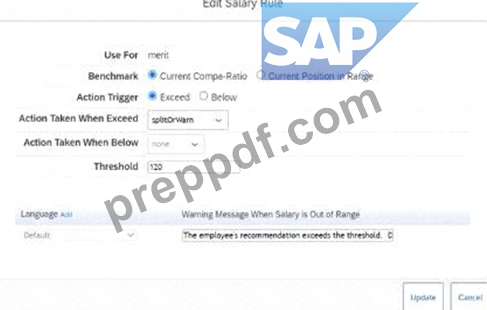
How does the system behave?
- A. The rule prevents the planner from saving the merit increase*The planner must go back and change their merit recommendation.
- B. A pop-up message asks the planner if the exceeded amount should be assigned to Lump Sum*The planner CANNOT save the merit increase by selecting Cancel in the pop-up message
- C. The rule alerts the planner that the range penetration threshold has been exceeded and the merit field text turns red*The planner can save the merit recommendation.
- D. A pop-up message asks the planner if the exceeded amount should be assigned to Lump Sum*The planner can save the merit recommendation by selecting Cancel in the pop-up message
Answer: D
NEW QUESTION # 65
You set up a merit guideline rule based on the performance rating and country. You configure guideline formulas as shown in the screenshot. See image below.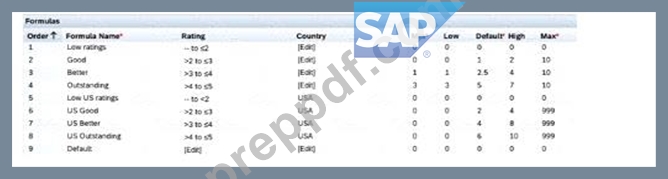
An employee in the USA has a rating of 4. What would be their default merit increase?
- A. 0.01
- B. 0.04
- C. 0.02
- D. 0
Answer: C
NEW QUESTION # 66
You use date-based proration and you do NOT include a proration end date in your template. What dates does the system use to calculate the proration percent?
- A. The proration end date configured in the compensation template
- B. The end date of the compensation worksheet
- C. The end date of the customer's fiscal year
- D. December 31 of the current year
Answer: C
NEW QUESTION # 67
Which of the following Permissions is NOT recommended to be given to all HRBPs who are supporting a Salary Review Process?
- A. Report Permissions
- B. Compensation Management Permissions
- C. Executive Review Export Permissions
- D. Executive Review Edit Permissions
Answer: D
Explanation:
In SAP SuccessFactors Compensation, granting the appropriate permissions to HR Business Partners (HRBPs) is crucial to supporting the salary review process effectively while maintaining data security and integrity. The following permissions are typically managed with caution:
* Executive Review Edit Permissions (Option C):
* It is not recommended to grant all HRBPs "Executive Review Edit Permissions" as this allows for extensive changes across compensation plans, which may be inappropriate for all HRBP roles. This permission should generally be reserved for high-level administrators or managers who need to make adjustments at the executive review level.
Other Permissions:
* Executive Review Export Permissions (Option A)andReport Permissions (Option B)are commonly provided to HRBPs for data analysis.
* Compensation Management Permissions (Option D)is often necessary for HRBPs to carry out their roles effectively, enabling them to manage employee compensation-related tasks.
NEW QUESTION # 68
......
Ultimate Guide to the C_THR86_2405 - Latest Edition Available Now: https://www.preppdf.com/SAP/C_THR86_2405-prepaway-exam-dumps.html
2025 Updated Verified Pass C_THR86_2405 Study Guides & Best Courses: https://drive.google.com/open?id=1bpglowLOFXLhg8Cmva9vdw2TDG3Zavfl