

100% Pass Your 350-701 Exam Dumps at First Attempt with PrepPDF
Penetration testers simulate 350-701 exam PDF
Cisco 350-701 certification exam is designed to test the knowledge and skills required to implement and operate core security technologies. 350-701 exam is a requirement for those who wish to obtain the CCNP Security or CCIE Security certification. 350-701 exam covers a wide range of topics, including network security, cloud security, endpoint protection, and secure network access. It is a comprehensive exam that tests the abilities of security professionals to design, deploy, and manage security solutions in complex environments.
NEW QUESTION # 156
Refer to the exhibit.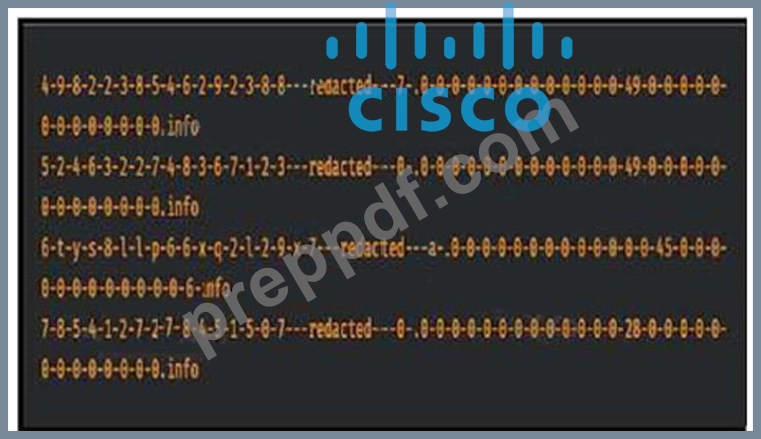
Consider that any feature of DNS requests, such as the length off the domain name and the number of subdomains, can be used to construct models of expected behavior to which observed values can be compared. Which type of malicious attack are these values associated with?
- A. Eternal Blue Windows
- B. Heartbleed SSL Bug
- C. W32/AutoRun worm
- D. Spectre Worm
Answer: C
NEW QUESTION # 157
Which method is used to deploy certificates and configure the supplicant on mobile devices to gain access to network resources?
- A. Simple Certificate Enrollment Protocol
- B. BYOD on boarding
- C. Client provisioning
- D. MAC authentication bypass
Answer: B
Explanation:
When supporting personal devices on a corporate network, you must protect network services and enterprise data by authenticating and authorizing users (employees, contractors, and guests) and their devices. Cisco ISE provides the tools you need to allow employees to securely use personal devices on a corporate network.
Guests can add their personal devices to the network by running the native supplicant provisioning (Network Setup Assistant), or by adding their devices to the My Devices portal.
Because native supplicant profiles are not available for all devices, users can use the My Devices portal to add these devices manually; or you can configure Bring Your Own Device (BYOD) rules to register these devices.
Reference:
m_ise_devices_byod.html
NEW QUESTION # 158
An engineer wants to automatically assign endpoints that have a specific OUl into a new endpoint group.
Which probe must be enabled for this type of profiling to work?
- A. NMAP
- B. SNMP
- C. DHCP
- D. NetFlow
Answer: A
NEW QUESTION # 159
An organization wants to improve its cybersecurity processes and to add intelligence to its data The organization wants to utilize the most current intelligence data for URL filtering, reputations, and vulnerability information that can be integrated with the Cisco FTD and Cisco WSA What must be done to accomplish these objectives?
- A. Create an automated download of the Internet Storm Center intelligence feed into the Cisco FTD and Cisco WSA databases to tie to the dynamic access control policies.
- B. Download the threat intelligence feed from the IETF and import it into the Cisco FTD and Cisco WSA databases
- C. Configure the integrations with Talos Intelligence to take advantage of the threat intelligence that it provides.
- D. Create a Cisco pxGrid connection to NIST to import this information into the security products for policy use
Answer: A
NEW QUESTION # 160
Which command enables 802.1X globally on a Cisco switch?
- A. aaa new-model
- B. dot1x system-auth-control
- C. authentication port-control auto
- D. dot1x pae authenticator
Answer: B
NEW QUESTION # 161
Drag and drop the capabilities from the left onto the correct technologies on the right.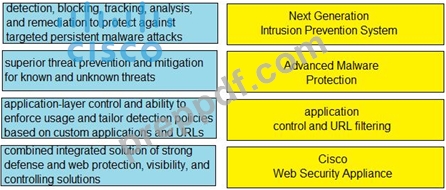
Answer:
Explanation: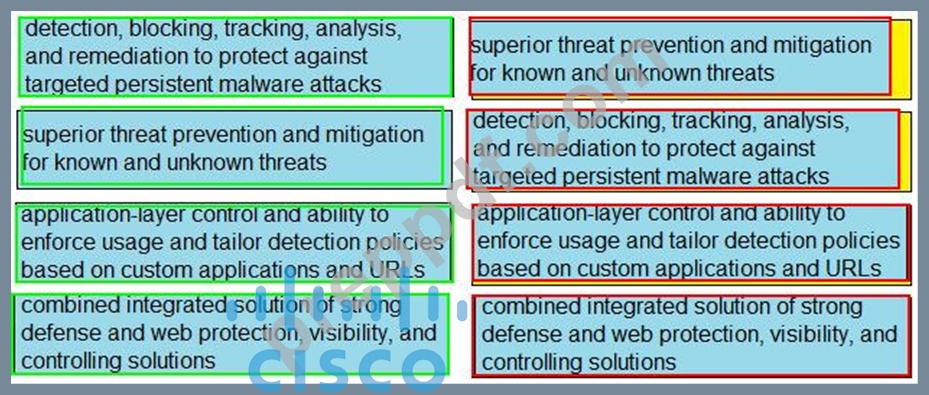
NEW QUESTION # 162
Which feature requires a network discovery policy on the Cisco Firepower Next Generation Intrusion Prevention System?
- A. security intelligence
- B. impact flags
- C. health monitoring
- D. URL filtering
Answer: B
NEW QUESTION # 163
Drag and drop the features of Cisco ASA with Firepower from the left onto the benefits on the right.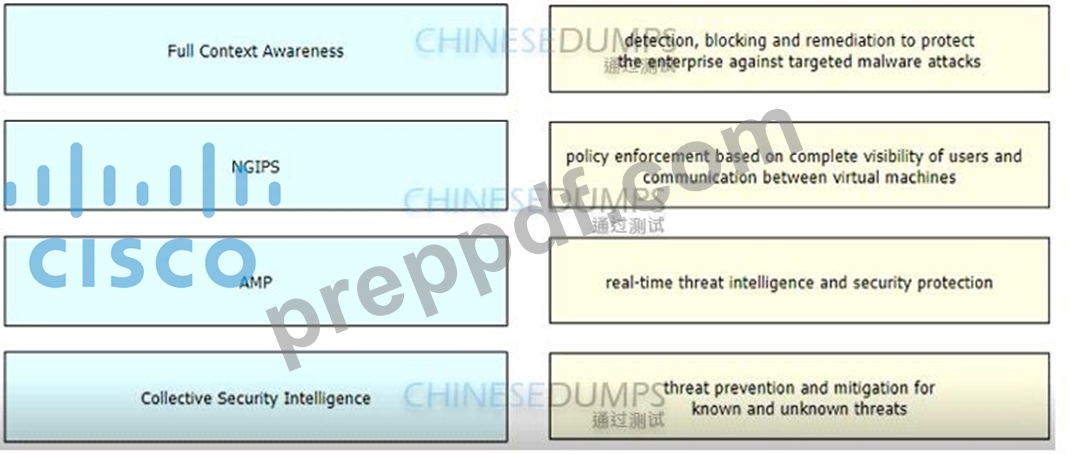
Answer:
Explanation: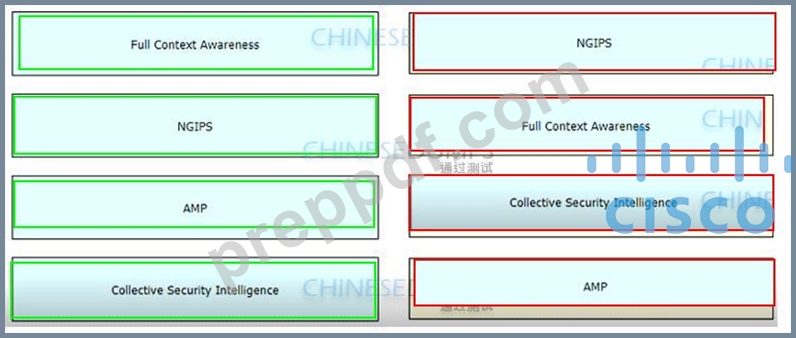
NEW QUESTION # 164
Drag and drop the capabilities of Cisco Firepower versus Cisco AMP from the left into the appropriate category on the right.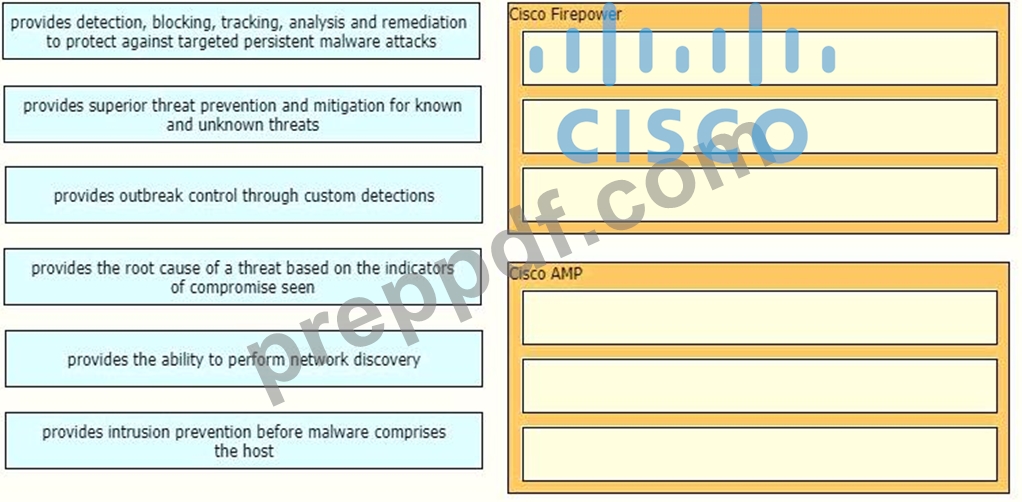
Answer:
Explanation: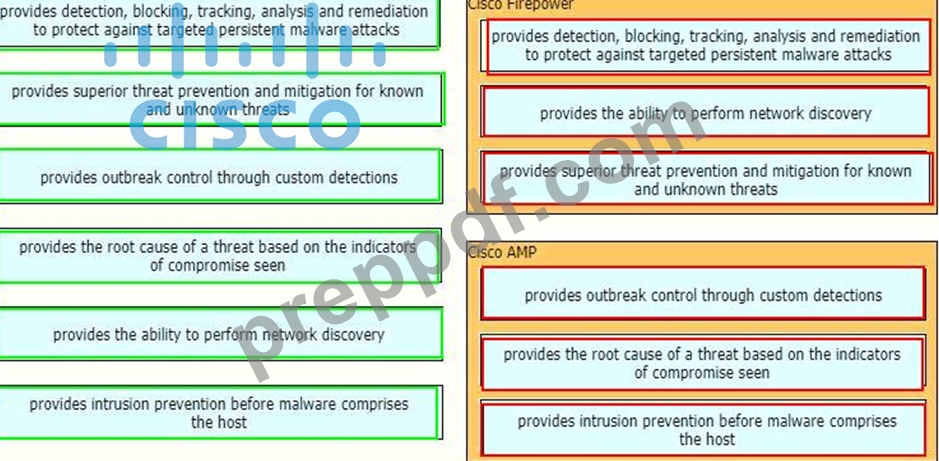
NEW QUESTION # 165
Drag and drop the Firepower Next Generation Intrustion Prevention System detectors from the left onto the correct definitions on the right.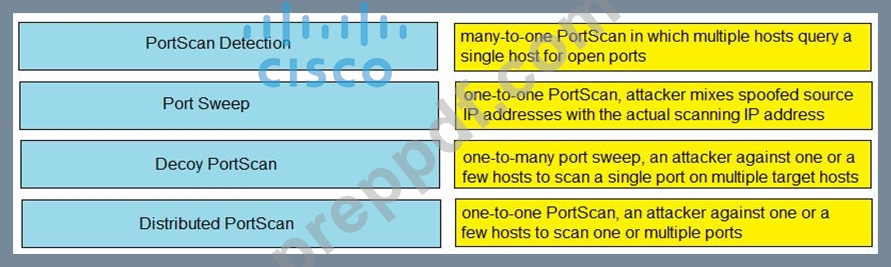
Answer:
Explanation: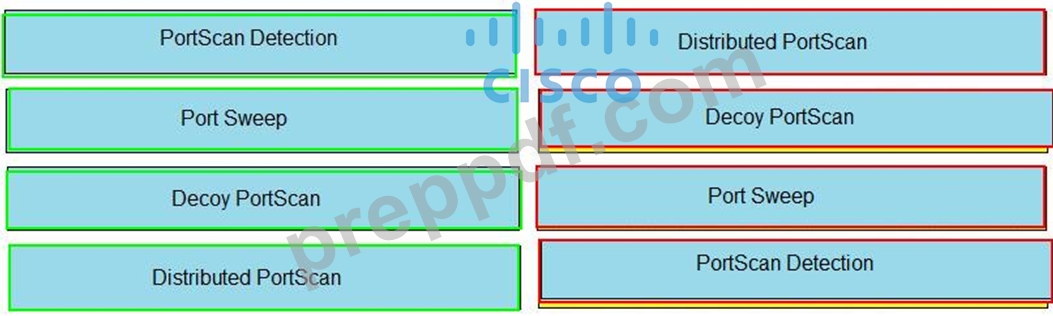
NEW QUESTION # 166
A security engineer must add destinations into a destination list in Cisco Umbrell a. What describes the application of these changes?
- A. The changes are applied only after the configuration is saved in Cisco Umbrella.
- B. The changes are applied immediately it the destination list is part or a policy.
- C. The destination list must be removed from the policy before changes are made to It.
- D. The user role of Block Page Bypass or higher is needed to perform these changes.
Answer: B
NEW QUESTION # 167
An engineer is configuring 802.1X authentication on Cisco switches in the network and is using CoA as a mechanism. Which port on the firewall must be opened to allow the CoA traffic to traverse the network?
- A. UDP 1812
- B. UDP 1700
- C. TCP 49
- D. TCP 6514
Answer: B
Explanation:
Reference:
NEW QUESTION # 168
An engineer is configuring their router to send NetfFow data to Stealthwatch which has an IP address of 1 1 11 using the flow record Stea!thwatch406397954 command Which additional command is required to complete the flow record?
- A. cache timeout active 60
- B. transport udp 2055
- C. match ipv4 ttl
- D. destination 1.1.1.1
Answer: C
NEW QUESTION # 169
What are the two most commonly used authentication factors in multifactor authentication? (Choose two.)
- A. biometric factor
- B. time factor
- C. knowledge factor
- D. confidentiality factor
- E. encryption factor
Answer: A,C
NEW QUESTION # 170
Which suspicious pattern enables the Cisco Tetration platform to learn the normal behavior of users?
- A. file access from a different user
- B. interesting file access
- C. privilege escalation
- D. user login suspicious behavior
Answer: D
Explanation:
Explanation Explanation The various suspicious patterns for which the Cisco Tetration platform looks in the current release are: + Shell code execution: Looks for the patterns used by shell code. + Privilege escalation: Watches for privilege changes from a lower privilege to a higher privilege in the process lineage tree. + Side channel attacks: Cisco Tetration platform watches for cache-timing attacks and page table fault bursts. Using these, it can detect Meltdown, Spectre, and other cache-timing attacks. + Raw socket creation: Creation of a raw socket by a nonstandard process (for example, ping). + User login suspicious behavior: Cisco Tetration platform watches user login failures and user login methods. + Interesting file access: Cisco Tetration platform can be armed to look at sensitive files. + File access from a different user: Cisco Tetration platform learns the normal behavior of which file is accessed by which user. + Unseen command: Cisco Tetration platform learns the behavior and set of commands as well as the lineage of each command over time. Any new command or command with a different lineage triggers the interest of the Tetration Analytics platform. Reference: https://www.cisco.com/c/en/us/products/collateral/data-center-analytics/tetration-analytics/whitepaper-c11-740380.html Explanation The various suspicious patterns for which the Cisco Tetration platform looks in the current release are:
+ Shell code execution: Looks for the patterns used by shell code.
+ Privilege escalation: Watches for privilege changes from a lower privilege to a higher privilege in the process lineage tree.
+ Side channel attacks: Cisco Tetration platform watches for cache-timing attacks and page table fault bursts.
Using these, it can detect Meltdown, Spectre, and other cache-timing attacks.
+ Raw socket creation: Creation of a raw socket by a nonstandard process (for example, ping).
+ User login suspicious behavior: Cisco Tetration platform watches user login failures and user login methods.
+ Interesting file access: Cisco Tetration platform can be armed to look at sensitive files.
+ File access from a different user: Cisco Tetration platform learns the normal behavior of which file is accessed by which user.
+ Unseen command: Cisco Tetration platform learns the behavior and set of commands as well as the lineage of each command over time. Any new command or command with a different lineage triggers the interest of the Tetration Analytics platform.
Explanation Explanation The various suspicious patterns for which the Cisco Tetration platform looks in the current release are: + Shell code execution: Looks for the patterns used by shell code. + Privilege escalation: Watches for privilege changes from a lower privilege to a higher privilege in the process lineage tree. + Side channel attacks: Cisco Tetration platform watches for cache-timing attacks and page table fault bursts. Using these, it can detect Meltdown, Spectre, and other cache-timing attacks. + Raw socket creation: Creation of a raw socket by a nonstandard process (for example, ping). + User login suspicious behavior: Cisco Tetration platform watches user login failures and user login methods. + Interesting file access: Cisco Tetration platform can be armed to look at sensitive files. + File access from a different user: Cisco Tetration platform learns the normal behavior of which file is accessed by which user. + Unseen command: Cisco Tetration platform learns the behavior and set of commands as well as the lineage of each command over time. Any new command or command with a different lineage triggers the interest of the Tetration Analytics platform. Reference: https://www.cisco.com/c/en/us/products/collateral/data-center-analytics/tetration-analytics/whitepaper-c11-740380.html
NEW QUESTION # 171
Which method is used to deploy certificates and configure the supplicant on mobile devices to gain access to network resources?
- A. Simple Certificate Enrollment Protocol
- B. BYOD on boarding
- C. Client provisioning
- D. MAC authentication bypass
Answer: B
NEW QUESTION # 172
What is a prerequisite when integrating a Cisco ISE server and an AD domain?
- A. Synchronize the clocks of the Cisco ISE server and the AD server
- B. Place the Cisco ISE server and the AD server in the same subnet
- C. Configure a common DNS server
- D. Configure a common administrator account
Answer: A
Explanation:
The following are the prerequisites to integrate Active Directory with Cisco ISE. + Use the Network Time Protocol (NTP) server settings to synchronize the time between the Cisco ISE server and Active Directory. You can configure NTP settings from Cisco ISE CLI. + If your Active Directory structure has multidomain forest or is divided into multiple forests, ensure that trust relationships exist between the domain to which Cisco ISE is connected and the other domains that have user and machine information to which you need access. For more information on establishing trust relationships, refer to Microsoft Active Directory documentation. + You must have at least one global catalog server operational and accessible by Cisco ISE, in the domain to which you are joining Cisco ISE. Reference: https://www.cisco.com/c/en/us/td/docs/security/ise/2-0/ise_active_directory_integration/ b_ISE_AD_integration_2x.html#reference_8DC463597A644A5C9CF5D582B77BB24F
+ Use the Network Time Protocol (NTP) server settings to synchronize the time between the Cisco ISE server and Active Directory. You can configure NTP settings from Cisco ISE CLI.
+ If your Active Directory structure has multidomain forest or is divided into multiple forests, ensure that trust relationships exist between the domain to which Cisco ISE is connected and the other domains that have user and machine information to which you need access. For more information on establishing trust relationships, refer to Microsoft Active Directory documentation.
+ You must have at least one global catalog server operational and accessible by Cisco ISE, in the domain to which you are joining Cisco ISE.
Reference:
The following are the prerequisites to integrate Active Directory with Cisco ISE. + Use the Network Time Protocol (NTP) server settings to synchronize the time between the Cisco ISE server and Active Directory. You can configure NTP settings from Cisco ISE CLI. + If your Active Directory structure has multidomain forest or is divided into multiple forests, ensure that trust relationships exist between the domain to which Cisco ISE is connected and the other domains that have user and machine information to which you need access. For more information on establishing trust relationships, refer to Microsoft Active Directory documentation. + You must have at least one global catalog server operational and accessible by Cisco ISE, in the domain to which you are joining Cisco ISE. Reference: https://www.cisco.com/c/en/us/td/docs/security/ise/2-0/ise_active_directory_integration/ b_ISE_AD_integration_2x.html#reference_8DC463597A644A5C9CF5D582B77BB24F
NEW QUESTION # 173
How does Cisco Umbrella archive logs to an enterprise owned storage?
- A. by sending logs via syslog to an on-premises or cloud-based syslog server
- B. by using the Application Programming Interface to fetch the logs
- C. by being configured to send logs to a self-managed AWS S3 bucket
- D. by the system administrator downloading the logs from the Cisco Umbrella web portal
Answer: C
Explanation:
Explanation The Cisco Umbrella Multi-Org console has the ability to upload, store, and archive traffic activity logs from your organizations' Umbrella dashboards to the cloud through Amazon S3. CSV formatted Umbrella logs are compressed (gzip) and uploaded every ten minutes so that there's a minimum of delay between traffic from the organization's Umbrella dashboard being logged and then being available to download from an S3 bucket. By having your organizations' logs uploaded to an S3 bucket, you can then download logs automatically to keep in perpetuity in backup storage. Reference: https://docs.umbrella.com/deployment-umbrella/docs/manage-logs The Cisco Umbrella Multi-Org console has the ability to upload, store, and archive traffic activity logs from your organizations' Umbrella dashboards to the cloud through Amazon S3. CSV formatted Umbrella logs are compressed (gzip) and uploaded every ten minutes so that there's a minimum of delay between traffic from the organization's Umbrella dashboard being logged and then being available to download from an S3 bucket.
By having your organizations' logs uploaded to an S3 bucket, you can then download logs automatically to keep in perpetuity in backup storage.
Explanation The Cisco Umbrella Multi-Org console has the ability to upload, store, and archive traffic activity logs from your organizations' Umbrella dashboards to the cloud through Amazon S3. CSV formatted Umbrella logs are compressed (gzip) and uploaded every ten minutes so that there's a minimum of delay between traffic from the organization's Umbrella dashboard being logged and then being available to download from an S3 bucket. By having your organizations' logs uploaded to an S3 bucket, you can then download logs automatically to keep in perpetuity in backup storage. Reference: https://docs.umbrella.com/deployment-umbrella/docs/manage-logs
NEW QUESTION # 174
Which encryption algorithm provides highly secure VPN communications?
- A. 3DES
- B. AES 256
- C. AES 128
- D. DES
Answer: B
NEW QUESTION # 175
......
Cisco 350-701 exam is a comprehensive exam that covers various security concepts, including network security, cloud security, and endpoint protection. 350-701 exam is designed to test the candidate’s knowledge and skills on identifying security threats, implementing security solutions, and managing complex security infrastructures. Passing the exam demonstrates the candidate’s proficiency in implementing and operating Cisco Security Core Technologies.
All 350-701 Dumps and Training Courses: https://www.preppdf.com/Cisco/350-701-prepaway-exam-dumps.html
Help candidates to study and pass the Implementing and Operating Cisco Security Core Technologies Exams hassle-free: https://drive.google.com/open?id=1WCDACgH1Ou_5Wd1LcobPIIQPwS08ZJ7G