

352-001 Free Exam Questions & Answers PDF Updated on Oct-2021
Latest 352-001 Exam Dumps Recently Updated 270 Questions
Certification Path
There is no formal prerequisite for CCDE. This CCDE Design Written Certification includes only one 352-001 exam.
NEW QUESTION 18
Study the following exhibit carefully. A customer is deploying three unicast applications (voice, video, and data) between these two PCs. OSPF is performing as a single area, Area 0, from P4S-R1 to P4S-R2.
Three MPLS TE tunnels have been set up between P4S-R1 and
P4S-R2. Each tunnel carries only one application's traffic. What is needed on P4S-R1 and P4S-R2 to separate the three types of traffic into the appropriate tunnels?
- A. TE autoroute announce
- B. policy-based routing
- C. VPLS
- D. multiple VRFs
Answer: B
Explanation:
Section: (none)
Explanation/Reference:
NEW QUESTION 19
Refer to the exhibit.
This Layer 2 ring has 10 VLANs with 1000 MAC addresses in each VLAN. Which protocol or mechanism provides the shortest traffic outage if the link marked with "X" fails?
- A. MST
- B. Ethernet ring protection switching
- C. Ethernet linear protection switching
- D. PVRST
Answer: B
NEW QUESTION 20
You are designing a traffic monitoring and analysis system for a customer. Which traffic monitoring technique would you recommend to place the amount of burden on the network infrastructure?
- A. SPAN monitor ports
- B. IP NBAR
- C. passive taps
- D. NetFlow
Answer: B
NEW QUESTION 21
The network administrator of a branch office network has decided to deploy Unicast RPF at the access layer. He insists that the design must guarantee that all the packets arriving on the router interfaces are assigned to the same interface subnet.
Which mode of Unicast RPF would you recommend as the lead network designer?
- A. RPF feasible mode
- B. uRPF VRF mode
- C. uRPF loose mode
- D. uRPF strict mode
Answer: D
Explanation:
Explanation/Reference:
Explanation:
NEW QUESTION 22
Refer to the exhibit.
Marketing Database Server
Your company wants to sell its marketing research data to its strategic partners. All strategic partners currently have a Multipoint GRE VPN setup to your hub remote access routers, and are running a separate OSPF process over the Multipoint GRE VPN with you.
Your internal IGP is also OSPF, and the internal application used to access the marketing research data is located within your company's data center. Which solution ensures the strategic partners are provided with only the access they need, and that both organization's routing designs are not negatively affected?
- A. Redistribute and tag all routes from the strategic partner's OSPF to your internal OSPF and send them only your data center routes. The tagged routes are advertised to your local
SP for Internet connectivity. - B. Redistribute and tag only internal routes from the strategic partner's OSPF to your internal OSPF and send them only your data center routes. The tagged routes are not advertised to your local SP for internet connectivity.
- C. Redistribute and tag only internal routes from the strategic partner's OSPF to your internal OSPF and send them all your organization's routes. The tagged routes are advertised to your local SP for Internet connectivity.
- D. Redistribute and tag all routes from the strategic partner's OSPF to your internal OSPF and send them a default route. The tagged routes are not advertised to your local SP for
Internet connectivity.
Answer: C
NEW QUESTION 23
Which design consideration is valid when you contrast fabricPath and trill?
- A. FabricPath permits active-active FHRP and TRILL
- B. FabricPath Permits ECMP, but TRILL does not
- C. FabricPath permits active-active mode, but TRILL supports only active-standby mode.
- D. FabricPath uses IS-IS, but TRILL uses VxLAN
Answer: A
NEW QUESTION 24
Refer to the exhibit.
The design is being proposed for use within the network. The CE devices are OSPF graceful restart- capable, and the core devices are OSPF graceful restart-aware. The WAN advertisements received from BGP are redistributed into OSPF. A forwarding supervisor failure event takes place on CE A.
During this event, how will the routes learned from the WAN be seen on the core devices?
- A. via CE B
- B. via CE A
- C. via CE Aand CE B
- D. no WAN routes will be accessible
Answer: A
Explanation:
Explanation/Reference:
Explanation:
NEW QUESTION 25
You are the lead network designer for an enterprise company called ABC, and you are leading design discussions regarding IPv6 implementation into their existing network. A question is raised regarding older Layer 2 switches that exist in the network, and if any changes are required to these Layer 2 switches for successful IPv6 implementation. Which two responses should you give? (Choose two.)
- A. If IPv6 anycast deployment is planned, then make sure that Layer 2 switches support
DHCPv6 snooping at Layer 2 switches. - B. If IPv6 multicast deployment is planned, then make sure that Layer 2 switches support
MLD snooping at Layer 2 switches. - C. If IPv6 anycast deployment is planned, then make sure that Layer 2 switches support
ND snooping at Layer 2 switches. - D. If IPv6 anycast deployment is planned, then make sure that Layer 2 switches support
ICMPv6 snooping at Layer 2 switches. - E. IPv6 is transparent on Layer 2 switches, so there is no need to make any changes to the
Layer 2 switches.
Answer: B,E
NEW QUESTION 26
Which two headend router scalability factors should be considered when designing a
DMVPN network solution that uses a hub-and-spoke topology? (Choose two.)
- A. the amount of bandwidth necessary to terminate all the remote tunnels
- B. the maximum number of tunnels supported by the headend router
- C. the routing protocol chosen for the data plane routing
- D. the CPU and memory of the headend router
- E. the required aggregated packet per second
Answer: B,E
NEW QUESTION 27
DRAG DROP
Answer:
Explanation:
NEW QUESTION 28
Which of the following design options meet the requirement to provide IPv6 interdomain multicast?
- A. Auto-RP
- B. PIM dense mode
- C. PIM SSM
- D. MSDP
Answer: C
Explanation:
NEW QUESTION 29
Refer to the exhibit.
Assume that no multicast optimization is done on LAN switches A and B.
Which two features can be used to optimize multicast traffic forwarding in this situation? (Choose two.)
- A. Configure a static MAC entry for the multicast server.
- B. Disable the IGMP query election process.
- C. Enable IGMP snooping querier on both switches.
- D. Enable PIM snooping on both switches.
- E. Disable IGMP snooping on both switches.
Answer: C,E
NEW QUESTION 30
]
Refer to the exhibit. All of these network devices are running IPv6. When host A is attached to this link, how will it discover the presence of routers B and C?
- A. Routers B and C send out periodic gratuitous ARPv6 messages to alert newly attached hosts to their presence.
- B. Routers B and C will detect the addition of the new host the first time it transmits any packets, and will send an ICMP router discovery reply to host A.
- C. Routers B and C will respond to an ICMP get route request sent by host A.
- D. Host A will discover routers B and C through the neighbor discovery process.
Answer: D
NEW QUESTION 31
Company X will be integrating an IPv6 application into their network and wants to develop a test environment to evaluate application performance across the network. This application will require both unicast and multicast communications. The company can do this implementation only in certain areas of its existing IPv4-only network, but wants all areas to communicate with each other. When developing the design to provide connectivity between these testing locations, what tunneling technology would work in this scenario?
- A. DMVPN
- B. ISATAP
- C. 6vPE
- D. 6PE
- E. 6to4
Answer: A
Explanation:
Explanation/Reference:
100% fit.
NEW QUESTION 32
An enterprise company is attaching to a new Gigabit Ethernet based link from the local service provider. This connection must have a 150 Mbps committed information rate. For the design of this new service. Which QoS mechanism must be used to ensure low packet loss within the service provider network?
- A. Policing
- B. CBWFQ
- C. LLQ
- D. Shaping
Answer: D
NEW QUESTION 33
You have been tasked to create a Layer 2 network design that uses vPC to provide resiliency and avoid loops. vPC removes Layer 2 loops while providing redundancy through which mechanism?
- A. Bridge Assurance
- B. address synchronization
- C. dual-active detection
- D. strict forwarding rules
Answer: D
NEW QUESTION 34 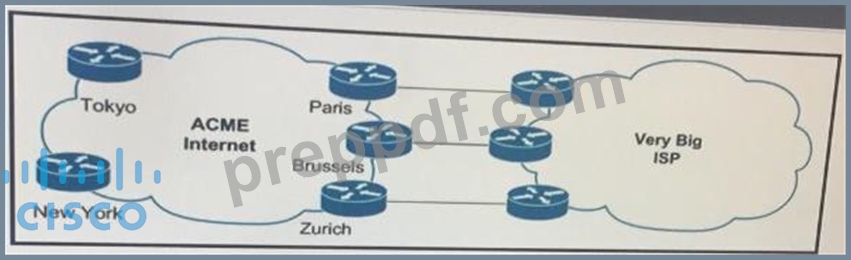
Refer to the exhibit. The service provider ACME Internet just added a 100Gbps peering in Paris to use as the default for inbound traffic from Very Big ISP. Which routing policy achieves the desired outcome?
- A. Apply an export policy that only permits a default route in Brussels and Zurich
- B. Apply an export policy in New York and Tokyo that adds a Weight attribute to routes sent to Very Big ISP via Paris
- C. Apply an export policy in Pans by applying a MED or Community attribute with a preference M Very Big ISP ads upon
- D. Use traffic engineering by injecting a preferred LocalPref attribute to routes advertised to Very Big ISP in Paris
Answer: C
NEW QUESTION 35
Which two mechanisms can provide fast Layer 2 down detection in Frame Relay networks?
(Choose two.)
- A. millisecond LMI timers
- B. A-bit signaling
- C. Frame BFD Lite
- D. asynchronous LMI
- E. section 9 LMI convergence
Answer: B,D
NEW QUESTION 36
......
Cisco 352-001 Real 2021 Braindumps Mock Exam Dumps: https://www.preppdf.com/Cisco/352-001-prepaway-exam-dumps.html