

[Apr 10, 2024] Valid MCD-Level-1 Test Answers & MCD-Level-1 Exam PDF
Valid MuleSoft Certified Developer MCD-Level-1 Dumps Ensure Your Passing
The MCD-Level-1 exam is essential for developers who want to demonstrate their proficiency in MuleSoft and its products. It is also a valuable certification for businesses that want to ensure that their developers have the skills and knowledge necessary to build and maintain Mule 4 applications successfully. MuleSoft Certified Developer - Level 1 (Mule 4) certification provides a level of assurance that an individual has the required expertise to work on projects that involve MuleSoft and its associated products.
NEW QUESTION # 114
Refer to the exhibit.
What Database expression transforms the input to the output?
A)
B)
C)
D)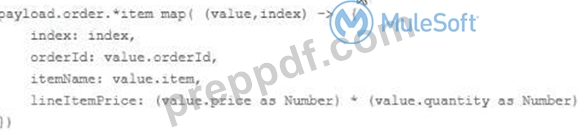
- A. Option D
- B. Option A
- C. Option B
- D. Option C
Answer: C
NEW QUESTION # 115
What is the default port used by Mule application debugger configuration in Anypoint Studio?
- A. 0
- B. 1
- C. 2
- D. 3
Answer: D
Explanation:
By default, Debugger listens for incoming TCP connections on localhost port 6666 You can change this in a project's run configuration.
MuleSoft Doc Ref : https://docs.mulesoft.com/studio/7.5/visual-debugger-concept
NEW QUESTION # 116
By default, what happens to a file after it is read using an FTP connector Read operation?
- A. The file stays in the same folder unchanged
- B. The file is moved to a different folder
- C. The file is renamed in the same folder
- D. The file is deleted from the folder
Answer: A
Explanation:
File is not updated when FTP read operations is performed.
MuleSoft Doc Ref : https://docs.mulesoft.com/file-connector/1.3/file-read
NEW QUESTION # 117
Refer to the exhibits.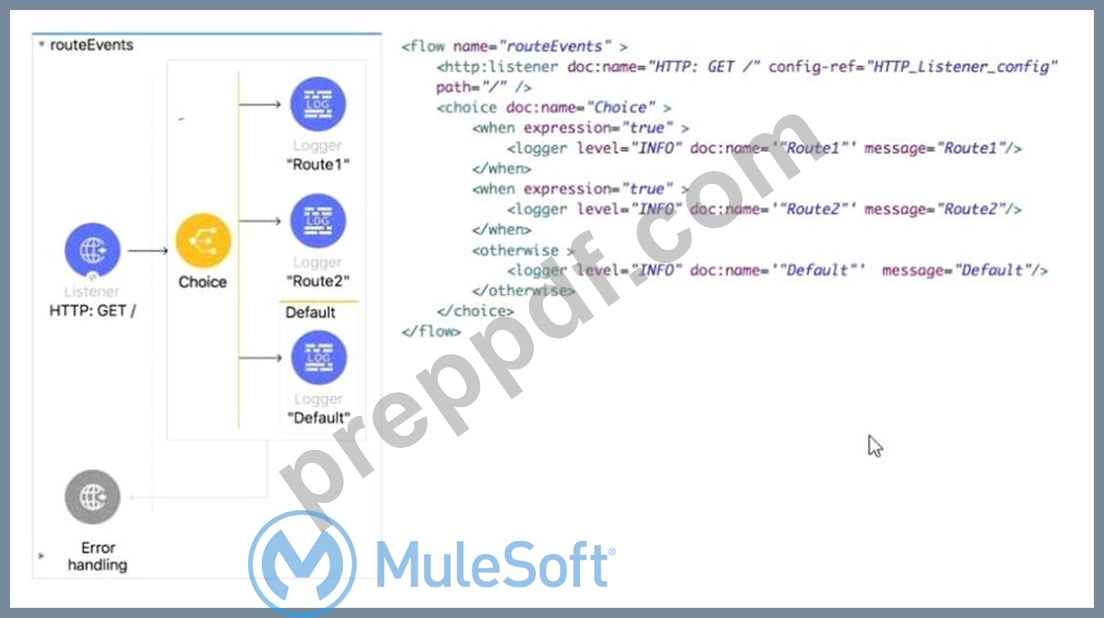
All three of the conditions for the Choice router are true. What messages are written in the application log?
- A. Route1,Route2,Default
- B. Route1
- C. Route2
- D. Route1,Route2
Answer: B
Explanation:
Only one of the routes in the Choice router executes, meaning that the first expression that evaluates to true triggers that route1 execution and the others are not checked. If none of the expressions are true, then the default route executes. Hence only Route1 will be executed as it is the first expression. hence output of logger is Route1.
MuleSoft Doc Ref : https://docs.mulesoft.com/mule-runtime/4.3/choice-router-concept The Choice router dynamically routes messages through a flow according to a set of DataWeave expressions that evaluate message content. Each expression is associated with a different routing option. The effect is to add conditional processing to a flow, similar to an if/then/else code block in most programming languages.
Only one of the routes in the Choice router executes, meaning that the first expression that evaluates to true triggers that route's execution and the others are not checked. If none of the expressions are true, then the default route executes.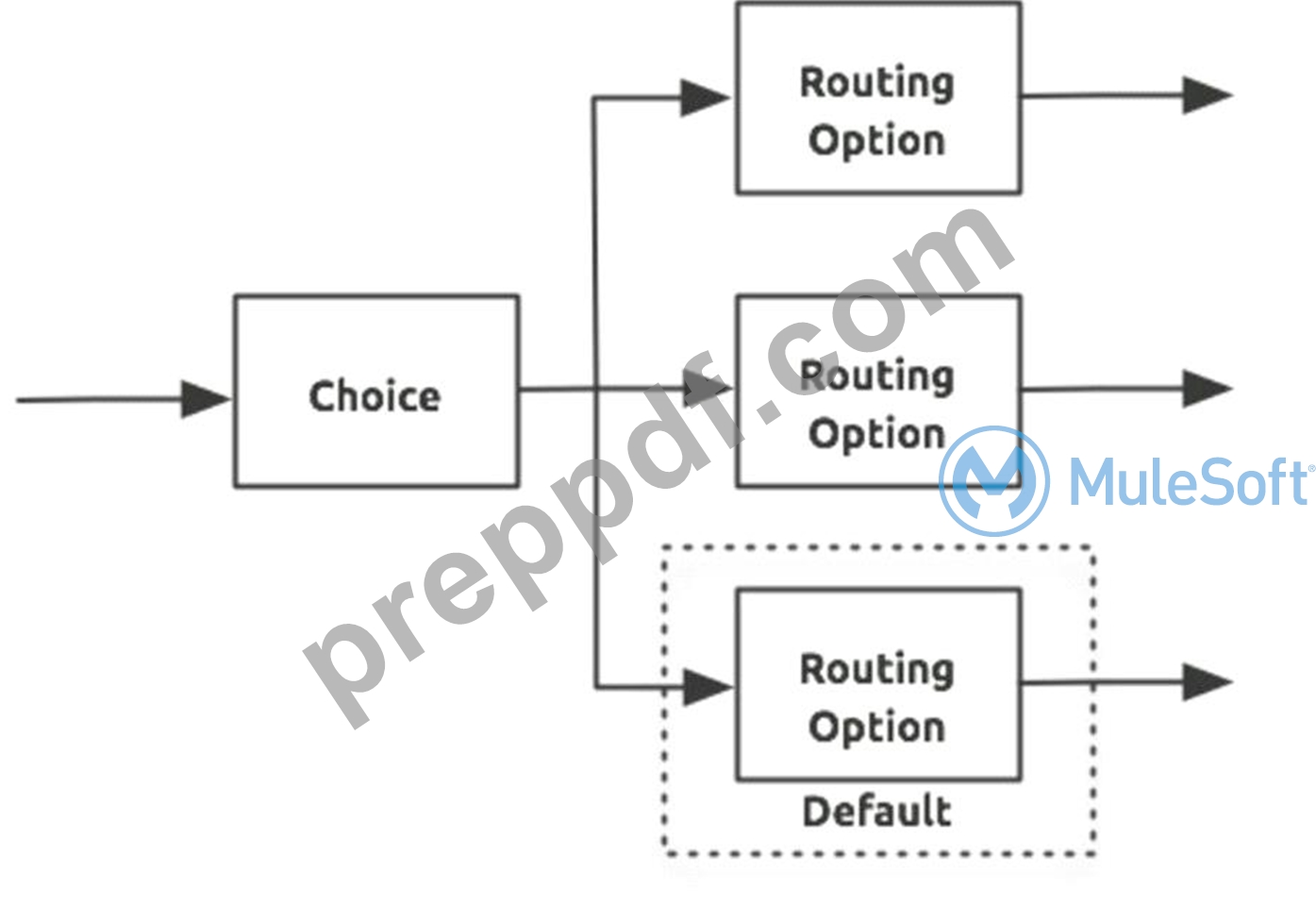
NEW QUESTION # 118
An app team is developing a mobile banking app. It took them two months to create their own APIs to access transaction information from a central database. The app team later found out that another team had already built an API that accesses the transaction information they need.
According to MuleSoft, what organization structure could have saved the app team two months of development time?
- A. Central API Review Board
- B. MuleSoft Support Center
- C. Center for Enablement
- D. Center of Excellence
Answer: C
Explanation:
Reference:
Center for Enablement is correct answer .It is a cross-functional team typically staffed with members from central IT, line-of-business departments, and digital innovation teams charged with productizing, publishing, and harvesting reusable assets and best practices. In this case , app team would have checked first with Center for Enablement before developing their own API's. Hence could have avoided re-work
NEW QUESTION # 119
How does APIkit determine the number of flows to generate from a RAML specification?
- A. Creates a separate flow for each HTTP method
- B. Creates a separate flow for each resource
- C. Creates a separate flow for each resource that contains child resources
- D. Creates a separate flow for each response status code
Answer: A
Explanation:
APIKIt Creates a separate flow for each HTTP method
NEW QUESTION # 120
Refer to the exhibit.
The error occurs when a project is run in Anypoint Studio. The project, which has a dependency that is not in the MuleSoft Maven repository, was created and successfully run on a different computer.
What is the next step to fix the error to get the project to run successfully?
- A. Edit the dependency in the Mule project's pom.xml file
- B. Add the dependency to the MULE_HOME/bin folder
- C. Install the dependency to the computer's local Maven repository
- D. Deploy the dependency to MuleSoft's Maven repository
Answer: C
Explanation:
As dependency is not present in Mulesoft Maven repository, we need to install the dependency on computer's local Maven repository.
https://docs.mulesoft.com/mule-runtime/4.3/maven-reference
NEW QUESTION # 121
Refer to the exhibits.
What payload and quantity are togged at the end of the main flow?
- A. [[1,2,3,4], 14]
- B. [orderlorder2order3order4, 14]
- C. [[1,2,3,4], 10]
- D. [[order1, order2, order3, order4], 14]
Answer: A
NEW QUESTION # 122
Refer to the exhibit. The input array of strings is passed to the batch job, which does NOT do any filtering or aggregating. What payload is logged by the Logger component?
- A. [ "Apple", "Banana" ]
- B. [ "Apptel2", "Bananal2" ]
- C. [ "Apptel", "Bananal", 2 ]
- D. Summary report of processed records
Answer: D
NEW QUESTION # 123
Refer to the exhibits.
The main flow contains an HTTP Request. The HTTP Listeners and HTTP Request use default configurations.
What
values are accessible in the child flow after a web client submits a request to http://localhost:8081/order? col or
= red?
- A. payload
quantity var color query param - B. payload
- C. payload
color query param - D. payload
quantity var
Answer: B
NEW QUESTION # 124
What is minimal requirement in a flow for a Mule application to compile?
- A. Source and processors both
- B. Event Processors
- C. Event Source
- D. Error handlers
Answer: B
Explanation:
Process section is must to get compiles. Process section must have one or more processors Diagram Description automatically generated
NEW QUESTION # 125
Refer to the exhibit.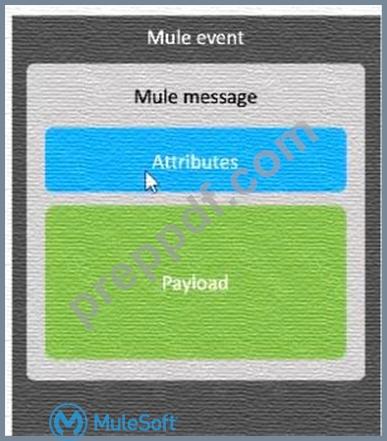
A Mule event is composed of a hierarchy of objects. Where in the hierarchy are variables stored?
- A. Mule event
- B. Mule message attributes
- C. Mule message payload
- D. Mule message
Answer: A
Explanation:
Variables are stored under Mule event. Please refer to below image for the hierarchy .
Graphical user interface Description automatically generated

NEW QUESTION # 126
Refer to the exhibit.
What is the response to a web client request to http://localhost:8081?
- A. before
- B. null
- C. Validation Error
- D. After
Answer: C
Explanation: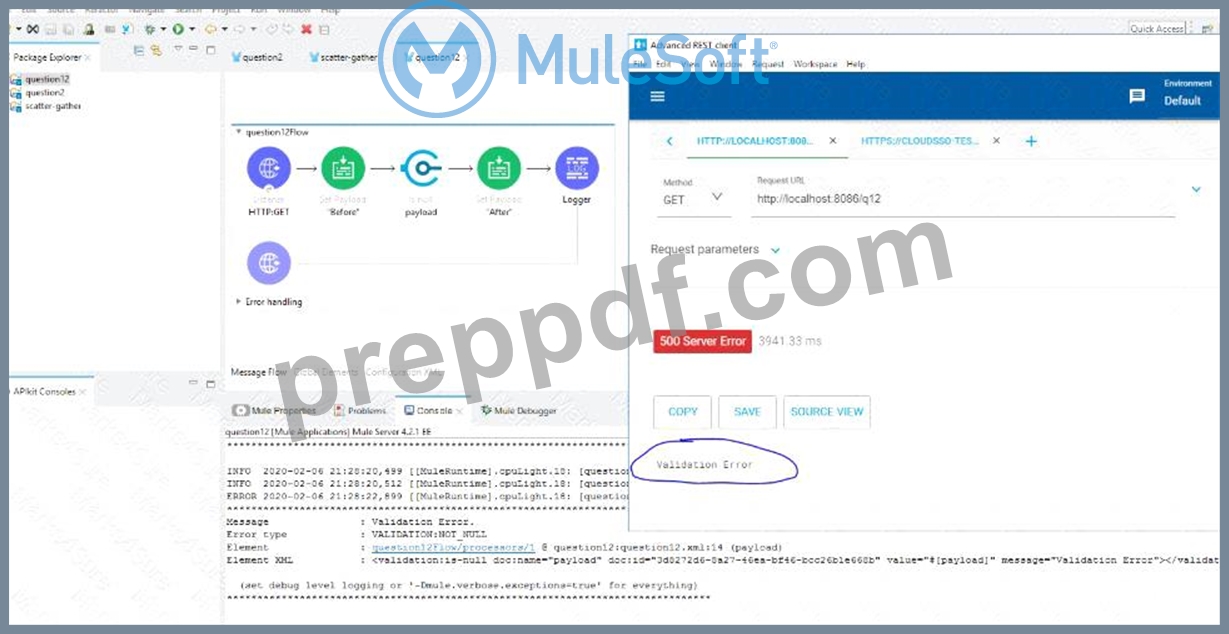
NEW QUESTION # 127
Refer to the exhibit.
In the execution of the Scatter_Gather, the flow1 route completes after 10 seconds and the flow2 route completes after 20 seconds.
How many seconds does it take for the Scatter_Gather to complete?
- A. 0
- B. 1
- C. 2
- D. 3
Answer: A
NEW QUESTION # 128
Refer to the exhibits. What payload is logged at the end of the main flow?
- A. [order1, order2, order3, order4]
- B. order4
- C. order1order2order3order4
- D. [1, 2, 3, 4]
Answer: B
NEW QUESTION # 129
What is the output of Dataweave Map operator?
- A. Object
- B. String
- C. Map
- D. Array
Answer: D
Explanation:
Returns an array that is the result of applying a transformation function (lambda) to each of the elements.
MuleSoft Doc Ref : https://docs.mulesoft.com/mule-runtime/4.3/dataweave-cookbook-map The map operator is a function in Dataweave which iterates over the items in an array and outputs them into a new array. It basically accepts input as a list of items in an array and manipulates the items in the array in order to form a new array as an output.
I have created below chart for your easier understanding:
NEW QUESTION # 130
Refer to the exhibit.
What DataWeave expression transforms the conductorlds array to the XML output?
A)
B)
C)
D)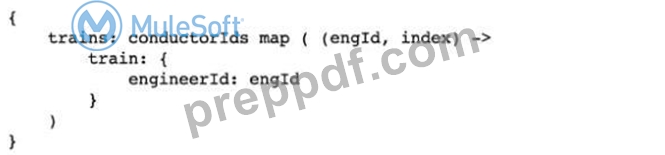
- A. Option D
- B. Option A
- C. Option C
- D. Option B
Answer: B
NEW QUESTION # 131
An API was designed in API Designer, published to Anypoint Exchange, then imported into API Manager.
A Mule application implements this API and is deployed to CloudHub. API Manager manages this deployed API implementation.
What is the easiest and most idiomatic (used for its intended purpose) way to enforce a Client ID Enforcement policy on this Mule application?
- A. In API Manager, apply a Client ID Enforcement policy for the API instance
- B. In Anypoint Studio, code a custom policy tor Client ID Enforcement and then add the custom policy to Runtime Manager for the Mule application deployment
- C. In API Designer, add Client ID Enforcement policy requirements to the API specification
- D. In Anypoint Design Center, code a custom policy for Client ID Enforcement and then publish the custom policy to the API portal in Anypoint Exchange
Answer: A
NEW QUESTION # 132
......
MCD-Level-1 Dumps Real Exam Questions Test Engine Dumps Training: https://www.preppdf.com/MuleSoft/MCD-Level-1-prepaway-exam-dumps.html