

C_HCMP_2311 Questions Pass on Your First Attempt Dumps for SAP Certified Application Associate Certified
C_HCMP_2311 Practice Test Pdf Exam Material
NEW QUESTION # 31
With which operation can you transfer wage types to an internal table?
- A. ADDWT
- B. OUTWP
- C. XINO
- D. PIT
Answer: A
NEW QUESTION # 32
What function generates time wage types on the TIP table?
- A. DAYPR
- B. GWT
- C. PZL
- D. PIT
Answer: B
NEW QUESTION # 33
All wage types in the input table (IT) must be processed using personnel calculation rule Z123. In addition, you need to consider the employee subgroup grouping for the personnel calculation rule.
What configuration should you set up to accomplish this?
- A. PIT Z123 GEN NOAB
- B. PIT Z123 <blank> <blank>
- C. PIT Z123 GEN <blank>
- D. PIT Z123 <blank> NOAB
Answer: B
NEW QUESTION # 34
Which settings can limit the retroactive accounting depth of SAP payroll? Note: There are 3 correct Answers to this question.
- A. The "Earliest personal retroactive accounting date" stored in the Payroll Status infotype (0003) for the personnel number
- B. The start date of the current data record for Basic Pay (infotype 8) for the personnel number
- C. The start date of the current payroll period
- D. The hiring date stored for the personnel number
- E. The "Earliest retroactive accounting period" in the Payroll control record
Answer: A,D,E
NEW QUESTION # 35
Which function does the new average processing perform?
- A. X016
- B. PIT X015 GEN
- C. AVERA
- D. MEANV
Answer: C
NEW QUESTION # 36
You call up a main schema using transaction PE01 (HR: Maintain Payroll Schemas) and you have several columns available in the editor. What are the names of these columns? Note: There are 3 correct Answers to this question.
- A. Function
- B. Line
- C. Parameter
- D. Return Code
- E. Feature
Answer: A,B,C
Explanation:
When you call up a main schema using transaction PE01, you have the following columns available in the editor:
Line: This column shows the line number of each entry in the schema. It is used to identify and navigate the schema entries.
Function: This column shows the name of the function that is executed by the payroll driver. A function can be a payroll operation, a personnel calculation rule, or a sub-schema. A function can have one or more parameters that define its behavior and output.
Parameter: This column shows the parameters that are passed to the function. Parameters can be constants, variables, or expressions that modify the function's logic or input.Parameters are separated by commas and enclosed in brackets.
Feature: This column shows the name of the feature that is used to determine the value of a parameter. A feature is a decision tree that evaluates certain conditions and returns a value based on the outcome.
Features are used to customize the payroll schema for different scenarios or requirements.
Return Code: This column shows the return code that is generated by the function. A return code is a numerical value that indicates the status or result of the function execution. Return codes can be used to control the flow of the schema or to trigger certain actions.
The columns B. Feature and D. Return Code are not always visible in the editor. They can be displayed or hidden by using the menu options View -> Feature or View -> Return Code. Therefore, they are not correct answers to the question.
References =
SAP Help Portal: Payroll Schema
SAP Community: Understanding functions in Payroll Schemas
NEW QUESTION # 37
Which of the following personnel calculation rules does the system use in the subschema of XAL9 factoring and storage? Note: There are 2 correct Answers to this question.
- A. X020
- B. XVAL
- C. XPPF
- D. X015
Answer: C,D
NEW QUESTION # 38
Which tables can you find in the PC_PAYRESULT transaction? Note: There are 2 correct Answers to this question.
- A. Results Table (RT)
- B. Bank Transfer (BT)
- C. Output Table (OT)
- D. Internal Table (IT)
Answer: A,B
NEW QUESTION # 39
Under what condition will a time wage type be selected using the rule shown in the attached graphic?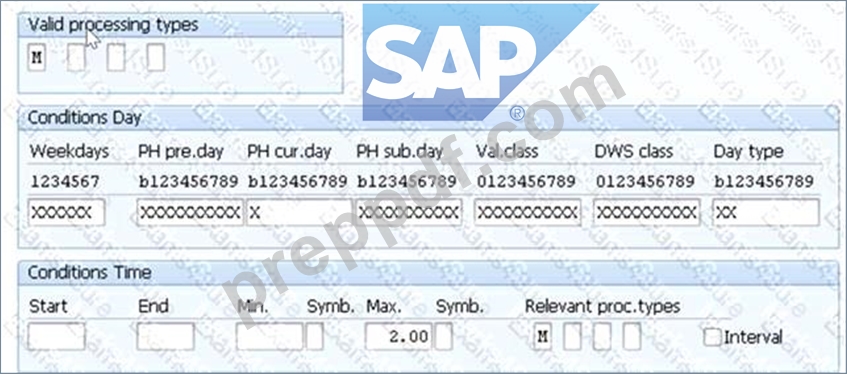

- A. After a maximum of two work hours
- B. For all planned work
- C. On a Sunday
- D. NOT on a public holiday
Answer: D
Explanation:
Conditions Day: This section specifies the days when the rule applies. Weekdays are highlighted, indicating the rule applies on weekdays. Public holidays (PH) are not highlighted, meaning the rule is not applicable on public holidays.
Conditions Time: This section doesn't have any selections, so there are no time-based conditions for selecting the time wage type.
Therefore, considering weekdays are highlighted and public holidays are not, the only condition that aligns with selecting the time wage type isNOT on a public holiday.
NEW QUESTION # 40
What operation must you use to query an employee's personnel area in a personnel calculation rule (PCR)?
- A. OUTWPPARTT
- B. OUTWPABART
- C. OUTWPPLANT
- D. OUTWPPAYSB
Answer: C
NEW QUESTION # 41
You want to calculate partial period factors including unpaid absences in work days for all counting classes. What variable do you use?
- A. SAP02
- B. AAU**
- C. SAP**
- D. KAU**
Answer: D
NEW QUESTION # 42
What can be included in an average calculation rule? Note: There are 3 correct Answers to this question.
- A. Relevant average period
- B. Cumulation rules
- C. Final processing
- D. Function PARTT
- E. Modifier groupings
Answer: A,B,E
NEW QUESTION # 43
The following wage type with its wage type fields is given:
What is the result of the wage type in the output IT if it only runs through the following calculation rules:
MULTI RAA and ADDWT *?
- A. Rate = 0
Number = 0
Amount = 0 - B. Rate = 0
Number = 0
Amount = 130 - C. Rate 10
Number = 0
Amount = 0 - D. Rate = 10 Number = 0
Amount = 130
Answer: D
Explanation:
In SAP HCM Payroll for SAP S/4HANA, the calculation rules MULTI RAA and ADDWT * are used to process wage types. The MULTI operation multiplies two fields of the current entry of table OT and stores the result in a third field1. The ADDWT operation adds the wage type affected to an internal table1. Given the wage type 5000 with Rate = 10, Number = 0, and Amount = 13, if it only runs through the MULTI RAA and ADDWT * calculation rules, the result in the output IT would be Rate = 10, Number = 0, and Amount =
130. This is because the MULTI operation would not change the Rate or Number as they are multiplied by 0, and the ADDWT operation would not change the Amount as it is added to an internal table without any modification1. References = 1
NEW QUESTION # 44
You are using operation ADDWTE*.
Into which table will the wage type be transferred?
- A. Results table (RT)
- B. Time Input table (TIP)
- C. Working Place Basic Pay table (WPBP)
- D. Output table (OT)
Answer: A
NEW QUESTION # 45
In addition to the fixed values from SAP, you want to use customer-specific values of the"Employee subgroup grouping for personnel calculation rule" in your personnel calculation rules. What values can you use for this?
- A. 1 to 3
- B. 00 to 99
- C. 1 to 4
- D. 5 to 9
Answer: B
Explanation:
Employee Subgroup Groupings for PCRs:This setting allows you to categorize employees into groups to apply different payroll rules. SAP reserves values below 10 (00 - 09) for its use.
Customer-Specific Values:You can use the range 00 to 99, excluding the fixed SAP values of 5 to 9, to create your custom groupings. This flexibility allows you to tailor payroll rules according to your company's specific needs.
NEW QUESTION # 46
Which elements can you use to build wage type selection rules? Note: There are 2 correct Answers to this question.
- A. Conditions for the day
- B. XMOD grouping
- C. Processing type
- D. Work schedule rule
Answer: A,B
NEW QUESTION # 47
What function generates time wage types on the TIP table?
- A. DAYPR
- B. GWT
- C. PZL
- D. PIT
Answer: B
Explanation:
In SAP HCM Payroll for SAP S/4HANA, the function that generates time wage types on the TIP table is GWT (Generate Wage Types). This function processes the entries of table T510S (Time Wage Type Selection), which contains the wage types that can be selected and the conditions that must be met for the selection of a wage type1. References =
https://help.sap.com/docs/SAP_S4HANA_ON-PREMISE/85346b7b83c8474e993429d934f77cc0/de38c2531bb9
NEW QUESTION # 48
You want to use a wage type in infotype 8 (Basic Pay) that valuates your amounts indirectly from the pay scale table. Which module do you use for this?
- A. PRZNT
- B. TARIF
- C. SUMME
- D. ARBPL
Answer: B
Explanation:
When you want to use a wage type in infotype 8 (Basic Pay) that valuates your amounts indirectly from the pay scale table, you use the TARIF module. The TARIF module is used for indirect evaluation of wage types. Indirect evaluation defines the actual amounts for each wage type that the employee is eligible for according to his or her Pay Scale Grouping for Allowances1. When using pay grades for basic pay wage types, you will use indirect evaluation module 58710 to retrieve pay grade level and store it into AMT field of the wage type2. References = 2, 1
NEW QUESTION # 49
......
SAP C_HCMP_2311 Exam Syllabus Topics:
| Topic | Details |
|---|---|
| Topic 1 |
|
| Topic 2 |
|
| Topic 3 |
|
| Topic 4 |
|
C_HCMP_2311 [Oct-2024] Newly Released] Exam Questions For You To Pass: https://www.preppdf.com/SAP/C_HCMP_2311-prepaway-exam-dumps.html
C_HCMP_2311 Answers C_HCMP_2311 Free Demo Are Based On The Real Exam: https://drive.google.com/open?id=1Ge1WZuMx7Lu_Hw4cxjWJGb7u4s_6ln_N