

Cisco 300-215 Real Exam Questions and Answers FREE
Exam Dumps 300-215 Practice Free Latest Cisco Practice Tests
Cisco 300-215 exam is designed to test an individual's skills and knowledge in conducting forensic analysis and incident response using Cisco technologies for CyberOps. 300-215 exam is intended for those who are interested in pursuing a career in cybersecurity and want to specialize in digital forensics and incident response. It covers a wide range of topics that are essential for anyone seeking to become a cybersecurity professional.
NEW QUESTION # 36 
- A. MD5 D634c0ba04a4e9140761cbd7b057t>8c5 is identified as malicious
- B. Destination IP 51.38.124.206 is identified as malicious
- C. The stream must be analyzed further via the pcap file
- D. Path http-req-51.38.124.206-80-14-1 is benign
Answer: B
Explanation:
Comprehensive and Detailed Explanation:
From the exhibit, Cisco Secure Malware Analytics (formerly Threat Grid) has captured outbound HTTP POST communication to the IP address 51.38.124.206 on port 80. This destination is highlighted in the analysis under "Outbound HTTP POST Communications," indicating exfiltration behavior or command-and- control (C2) signaling.
Key indicators:
* The report shows that binary data was POSTed to this IP.
* The source system generated 22 packets and sent 6,192 bytes.
* The system has flagged the behavior with a severity of 25 and confidence of 25-suggesting that this is an IoC worth acting on.
Therefore, the artifacts suggest that the destination IP 51.38.124.206 is involved in malicious activity, and the correct answer is:
A: Destination IP 51.38.124.206 is identified as malicious.
NEW QUESTION # 37 
Refer to the exhibit. An engineer is analyzing a TCP stream in a Wireshark after a suspicious email with a URL. What should be determined about the SMB traffic from this stream?
- A. It is sharing access to files and printers.
- B. It is redirecting to a malicious phishing website,
- C. It is requesting authentication on the user site.
- D. It is exploiting redirect vulnerability
Answer: D
NEW QUESTION # 38
Refer to the exhibit.
Which type of code is being used?
- A. VBScript
- B. Python
- C. BASH
- D. Shell
Answer: B
Explanation:
The code in the exhibit is written in Python. Here's how we can confirm:
* The function definition uses Python syntax: def function_name(args):
* It uses the b64encode and decode functions - typical of Python's base64 module.
* Data structures such as dictionaries are used with curly braces (e.g., form_data = {entry1: enc1, ...}).
* The conditional syntax uses "if r.status_code == 200:" which is Pythonic.
* The request object "r = post(...)" and use of headers show standard use of the Python requests library.
This type of script is typical in exfiltration scenarios where encoded information is sent via a web form (in this case Google Forms), bypassing detection systems.
Reference:CyberOps Technologies (CBRFIR) 300-215 study guide, Chapter on "Working with Malware and Exploit Scripts," which includes analysis of obfuscated and encoded scripts written in Python used for data exfiltration or C2 communication.
NEW QUESTION # 39
A security team is discussing lessons learned and suggesting process changes after a security breach incident. During the incident, members of the security team failed to report the abnormal system activity due to a high project workload. Additionally, when the incident was identified, the response took six hours due to management being unavailable to provide the approvals needed. Which two steps will prevent these issues from occurring in the future? (Choose two.)
- A. Create an executive team delegation plan.
- B. Provide phishing awareness training for the fill security team.
- C. Introduce a priority rating for incident response workloads.
- D. Conduct a risk audit of the incident response workflow.
- E. Automate security alert timeframes with escalation triggers.
Answer: C,E
NEW QUESTION # 40
Refer to the exhibit.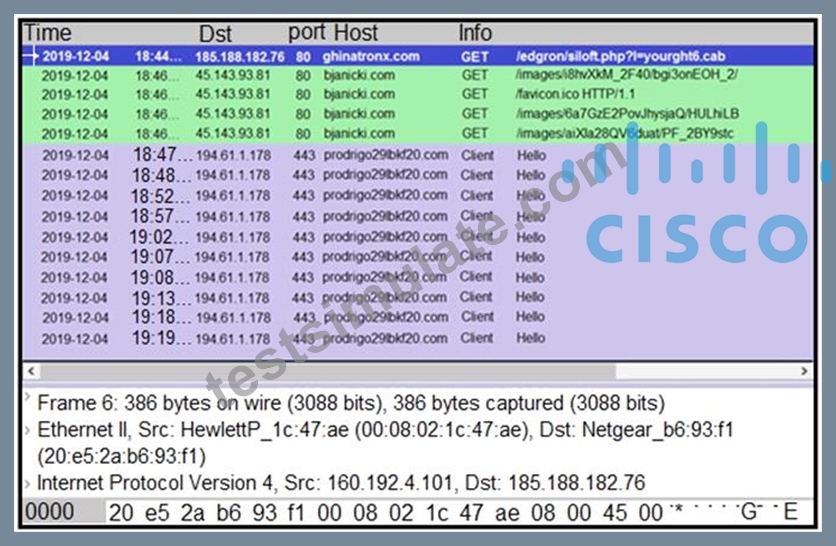
A network engineer is analyzing a Wireshark file to determine the HTTP request that caused the initial Ursnif banking Trojan binary to download. Which filter did the engineer apply to sort the Wireshark traffic logs?
- A. tcp.window_size ==0
- B. tcp.port eq 25
- C. http.request.un matches
- D. tls.handshake.type ==1
Answer: D
Explanation:
Reference:
https://www.malware-traffic-analysis.net/2018/11/08/index.html https://unit42.paloaltonetworks.com/wireshark-tutorial-examining-ursnif-infections/
NEW QUESTION # 41
An engineer received a report of a suspicious email from an employee. The employee had already opened the attachment, which was an empty Word document. The engineer cannot identify any clear signs of compromise but while reviewing running processes, observes that PowerShell.exe was spawned by cmd.exe with a grandparent winword.exe process. What is the recommended action the engineer should take?
- A. Upload the file signature to threat intelligence tools to determine if the file is malicious.
- B. Contain the threat for further analysis as this is an indication of suspicious activity.
- C. Monitor processes as this a standard behavior of Word macro embedded documents.
- D. Investigate the sender of the email and communicate with the employee to determine the motives.
Answer: A
NEW QUESTION # 42
Refer to the exhibit.
What do these artifacts indicate?
- A. An executable file is requesting an application download.
- B. A malicious file is redirecting users to different domains.
- C. A forged DNS request is forwarding users to malicious websites.
- D. The MD5 of a file is identified as a virus and is being blocked.
Answer: A
NEW QUESTION # 43
Which tool is used for reverse engineering malware?
- A. SNORT
- B. Wireshark
- C. NMAP
- D. Ghidra
Answer: D
NEW QUESTION # 44
Refer to the exhibit.
What should be determined from this Apache log?
- A. A module named mod_ssl is needed to make SSL connections.
- B. The SSL traffic setup is improper
- C. The certificate file has been maliciously modified
- D. The private key does not match with the SSL certificate.
Answer: D
Explanation:
The error logs indicate multiple PKCS12 and ASN.1 decoding errors, such as:
* PKCS12 routines:PKCS12_parse:mac verify failure
* rsa routines:old_rsa_priv_decode:RSA lib
* PKCS12 routines:PKCS12_key_gen_uni:malloc
These specific errors most commonly occur when:
* The private key does not correspond to the certificate being used.
* There is a mismatch between the public and private key pair required for SSL handshakes.
This is a well-documented condition in Apache SSL configuration issues and explicitly covered under TLS
/SSL troubleshooting sections in cybersecurity operations contexts. The Cisco CyberOps guide also notes that SSL errors with key verification usually result from "improper key/certificate pairing" rather than file corruption or missing modules.
Thus, the correct answer is:
B). The private key does not match with the SSL certificate.
NEW QUESTION # 45
During a routine inspection of system logs, a security analyst notices an entry where Microsoft Word initiated a PowerShell command with encoded arguments. Given that the user's role does not involve scripting or advanced document processing, which action should the analyst take to analyze this output for potential indicators of compromise?
- A. Confirm that the Microsoft Word license is valid and the application is updated to the latest version.
- B. Review the encoded PowerShell arguments to decode and determine the intent of the script.
- C. Validate the frequency of PowerShell usage across all hosts to establish a baseline.
- D. Monitor the Microsoft Word startup times to ensure they align with business hours.
Answer: B
Explanation:
According to theCyberOps Technologies (CBRFIR) 300-215 study guidecurriculum, when analyzing suspicious behavior-especially when scripts or shell commands are executed from applications like Word (which is uncommon)-the encoded PowerShell payload must be decoded to determine if malicious intent is present. Deobfuscation is a critical step in identifying command-and-control behavior, persistence, or malware execution paths.
-
NEW QUESTION # 46
An engineer received a call to assist with an ongoing DDoS attack. The Apache server is being targeted, and availability is compromised. Which step should be taken to identify the origin of the threat?
- A. An engineer should check the server's processes by running commandsps -auxandsudo ps -a
- B. An engineer should check the last hundred entries of a web server with the commandsudo tail -100 /var
/log/apache2/access.log - C. An engineer should check the services on the machine by running the commandservice -status-all
- D. An engineer should check the list of usernames currently logged in by running the command$ who | cut
- d' ' -f1| sort | uniq
Answer: B
Explanation:
The best immediate step during a DDoS attack against an Apache web server is to inspect theaccess logs, which will show which IP addresses are making requests, their frequency, and potential patterns of abuse. As covered in the Cisco CyberOps material, "Apache logs can reveal the IPs responsible for flooding the service with requests". The commandsudo tail -100 /var/log/apache2/access.logallows quick review of recent activity.
NEW QUESTION # 47
A cybersecurity analyst is examining a complex dataset of threat intelligence information from various sources. Among the data, they notice multiple instances of domain name resolution requests to suspicious domains known for hosting C2 servers. Simultaneously, the intrusion detection system logs indicate a series of network anomalies, including unusual port scans and attempts to exploit known vulnerabilities. The internal logs also reveal a sudden increase in outbound network traffic from a specific internal host to an external IP address located in a high-risk region. Which action should be prioritized by the organization?
- A. Organization should focus on C2 communication attempts and the sudden increase in outbound network traffic via a specific host.
- B. Focus should be applied toward attempts of known vulnerability exploitation because the attacker might land and expand quickly.
- C. Data on ports being scanned should be collected and SSL decryption on Firewall enabled to capture the potentially malicious traffic.
- D. Threat intelligence information should be marked as false positive because unnecessary alerts impact security key performance indicators.
Answer: A
Explanation:
According to theCyberOps Technologies (CBRFIR) 300-215 study guidecurriculum, command-and-control (C2) communication is a strong indicator that a system has already been compromised and is actively under the control of an attacker. Sudden outbound traffic to high-risk regions and resolution of known malicious domains are high-confidence signs of an active threat. Therefore, prioritizing detection and disruption of this outbound traffic is critical to prevent further damage or data exfiltration.
While monitoring vulnerability exploitation (B) and gathering port scan data (D) are also valuable, they are more preventive or forensic in nature. The most immediate threat-and therefore the top priority-is stopping active C2 communications.
NEW QUESTION # 48
What describes the first step in performing a forensic analysis of infrastructure network devices?
- A. initiating an immediate full system scan
- B. resetting the device to factory settings and analyzing the difference
- C. immediately disconnecting the device from the network
- D. producing an accurate, forensic-grade duplicate of the device's data
Answer: D
Explanation:
The first and most important step in forensic analysis is to preserve the integrity of the data. According to best practices outlined in the Cisco CyberOps Associate guide and NIST 800-86, forensic investigators must first produce a forensically sound, bit-by-bit copy of the system's data (i.e., imaging). This enables analysis to occur without altering the original evidence, which is essential for legal admissibility and maintaining the chain of custody.
NEW QUESTION # 49
Which tool conducts memory analysis?
- A. Volatility
- B. MemDump
- C. Memoryze
- D. Sysinternals Autoruns
Answer: A
NEW QUESTION # 50
Refer to the exhibit.
A company that uses only the Unix platform implemented an intrusion detection system. After the initial configuration, the number of alerts is overwhelming, and an engineer needs to analyze and classify the alerts. The highest number of alerts were generated from the signature shown in the exhibit. Which classification should the engineer assign to this event?
- A. True Positive alert
- B. True Negative alert
- C. False Negative alert
- D. False Positive alert
Answer: D
NEW QUESTION # 51
An "unknown error code" is appearing on an ESXi host during authentication. An engineer checks the authentication logs but is unable to identify the issue. Analysis of the vCenter agent logs shows no connectivity errors. What is the next log file the engineer should check to continue troubleshooting this error?
- A. /var/log/syslog.log
- B. /var/log/shell.log
- C. /var/log/vmksummary.log
- D. /var/log/general/log
Answer: C
Explanation:
In VMware ESXi systems, the vmksummary.log file is responsible for capturing general system events, including uptime, reboot statistics, and key service-related issues. It serves as a valuable source for troubleshooting persistent or unexplained system behaviors.
The Cisco CyberOps study guide references log file paths used in system diagnostics and incident response, and for authentication-related issues on ESXi where standard logs don't yield insights, vmksummary.log is the recommended next source for identifying systemic service faults or anomalies.
-
NEW QUESTION # 52
Which two tools conduct network traffic analysis in the absence of a graphical user interface? (Choose two.)
- A. NetworkDebuggerPro
- B. Wireshark
- C. TCPshark
- D. Network Extractor
- E. TCPdump
Answer: C,E
Explanation:
* TCPdumpis a CLI-based packet capture tool that is widely used for real-time traffic inspection and analysis on Unix/Linux systems.
* TCPsharkis a variant CLI tool used similarly for packet analysis.
AlthoughWiresharkis a powerful network protocol analyzer, it requires a GUI. Therefore, it is not suitable for environments without a graphical interface.
NEW QUESTION # 53
Refer to the exhibit.
What is the IOC threat and URL in this STIX JSON snippet?
- A. malware; malware--162d917e-766f-4611-b5d6-652791454fca
- B. malware;
'http://x4z9arb.cn/4712/' - C. malware; x4z9arb backdoor
- D. x4z9arb backdoor;http://x4z9arb.cn/4712/
- E. stix;
'http://x4z9arb.cn/4712/'
Answer: B
Explanation:
This STIX (Structured Threat Information eXpression) JSON snippet provides two key elements relevant for IOC (Indicator of Compromise) analysis:
* The indicator pattern shows a suspicious URL:#
"pattern": "[url:value = 'http://x4z9rb.cn/4712/']"
This is the actual IOC that can be used for detection.
* The type of object that the indicator relates to:# "type": "malware"# "name": "x4z9arb backdoor"This indicates the nature of the threat associated with the IOC is malware.
Therefore,
the threat is "malware" and the associated indicator (IOC) is the URL: http://x4z9rb.cn/4712/ Option A correctly captures both the IOC category ("malware") and the indicator value ("http://x4z9rb.cn/4712/").
Reference:CyberOps Technologies (CBRFIR) 300-215 study guide, Chapter on "Understanding Threat Intelligence Platforms," including the use of STIX/TAXII for representing threat data.
NEW QUESTION # 54
......
Cisco 300-215 exam, also known as Conducting Forensic Analysis & Incident Response Using Cisco Technologies for CyberOps, is a certification exam that is designed to test the knowledge and skills of IT professionals in conducting forensic analysis and incident response using Cisco technologies. 300-215 exam is part of the CyberOps Associate certification program and is intended for individuals who are interested in pursuing a career in cybersecurity or those who are already working in the field and are looking to enhance their skills and knowledge.
Verified 300-215 Exam Dumps Q&As - Provide 300-215 with Correct Answers: https://www.preppdf.com/Cisco/300-215-prepaway-exam-dumps.html
300-215 Exam Questions | Real 300-215 Practice Dumps: https://drive.google.com/open?id=1rVPd4jxCu5NlZUsv_0X9OU-MnaLrbxDE