

First Attempt Guaranteed Success in CAPM Exam 2025
Real CAPM Exam Questions are the Best Preparation Material
Earning the PMI CAPM certification demonstrates to employers and colleagues that you have the knowledge and skills needed to contribute to project success. It also provides a foundation for further certification, such as the PMI Project Management Professional (PMP) certification.
The Project Management Institute (PMI) created the Certified Associate in Project Management (CAPM) credential for entry-level project managers or individuals seeking to enter the project management profession. CAPM exam is designed to assess the knowledge and understanding of project management terminology, concepts, and practices as outlined in the Project Management Body of Knowledge (PMBOK) by PMI.
NEW QUESTION # 576
According to the PMI Talent Triangle, leadership skills relate to the ability to:
- A. guide, motivate, and direct a team to reach project goals
- B. tailor traditional and agile tools for the project
- C. understand the high-level overview of the organization
- D. work with stakeholders to develop an appropriate project delivery
Answer: A
NEW QUESTION # 577
Which of the following is a statistical concept that calculates the average outcome when the future includes scenarios that may or may not happen?
- A. Modeling and simulation
- B. Sensitivity analysis
- C. Expected monetary value analysis
- D. Three-point estimate
Answer: C
Explanation:
Section: Volume E
NEW QUESTION # 578
What describes the relationship between projects, programs, and portfolios?
- A. Project management focuses on doing the "right" programs and portfolios.
c. Program management focuses on doing the "specific" portfolios and projects. - B. Portfolio management focuses on doing the ''specific'' programs and projects.
- C. Portfolio management focuses on doing the "right" programs and projects.
Answer: C
NEW QUESTION # 579
Which tool is used to develop technical details within the project management plan?
- A. Project selection methods
- B. Expert judgment
- C. Project management methodology
- D. Project management information system (PMIS)
Answer: B
Explanation:
Section: Volume C
Explanation:
4.1.2.1 Expert Judgment
Expert judgment is often used to assess the inputs used to develop the project charter. Expert judgment is applied to all technical and management details during this process. Such expertise is provided by any group or individual with specialized knowledge or training and is available from many sources, including:
Other units within the organization,
Consultants,
Stakeholders, including customers or sponsors,
Professional and technical associations,
Industry groups,
Subject matter experts (SME), and
Project management office (PMO).
NEW QUESTION # 580
Taking out insurance in relation to risk management is called what?
- A. Avoidance
- B. Transference
- C. Mitigation
- D. Exploring
Answer: B
Explanation:
Section: Volume C
Explanation
NEW QUESTION # 581
Monte Carlo is which type of risk analysis technique?
- A. Sensitivity
- B. Probability
- C. Quantitative
- D. Qualitative
Answer: C
Explanation:
Explanation/Reference:
Explanation:
Monte Carlo Simulation. A process which generates hundreds or thousands of probable performance outcomes based on probability distributions for cost and schedule on individual tasks. The outcomes are then used to generate a probability distribution for the project as a whole.
NEW QUESTION # 582
A project manager uses their networking skills to build agreement with a difficult stakeholder. What level of influence did the project manager apply?
- A. Influential level
- B. Project level
- C. Organizational level
- D. Industry level
Answer: A
Explanation:
Relationship skills involving the development of extensive networks of people throughout the project manager's spheres of influence. These networks include formal networks such as organizational reporting structures. However, the informal networks that project managers develop, maintain, and nurture are more important. Informal networks include the use of established relationships with individuals such as subject matter experts and influential leaders. Use of these formal and informal networks allows the project manager to engage multiple people in solving problems and navigating the bureaucracies encountered in a project
NEW QUESTION # 583
Which quality tool may prove useful in understanding and estimating the cost of quality in a process?
- A. Control charts
- B. Checksheets
- C. Flowcharts
- D. Histograms
Answer: C
NEW QUESTION # 584
In which Knowledge Area is the project charter developed?
- A. Project Time Management
- B. Project Integration Management
- C. Project Cost Management
- D. Project Scope Management
Answer: B
Explanation:
Section: Volume A
Explanation:
Knowledge Areas
4. Project Integration Management
5. Project Scope Management
6. Project Time Management
7. Project Cost Management
8. Project Quality Management
9. Project Human Resource Management
10.Project Communications Management
11.Project Risk Management
12.Project Procurement Management
13.Project Stakeholder Management
Process: 4.1. Develop Project Charter
Definition: The process of developing a document that formally authorizes the existence of a project and provides the project manager with the authority to apply organizational resources to project activities.
Key Benefit: The key benefit of this process is a well-defined project start and project boundaries, creation of a formal record of the project, and a direct way for senior management to formally accept and commit to the project.
Inputs
1. Project statement of work
2. Business case
3. Agreements
4. Enterprise environmental factors
5. Organizational process assets
Tools & Techniques
1. Expert judgment
2. Facilitation techniques
Outputs
1. Project charter
NEW QUESTION # 585
After an internal deliverable review session with the team, the project manager identifies some issues that need to be fixed before submitting the deliverable for formal approval. The project manager will need to manage the additional costs and time for the required rework.
How would the project manager define these extra costs?
- A. Cost of conformance
- B. Appraisal costs
- C. Management reserves
- D. Cost of nonconformance
Answer: A
NEW QUESTION # 586
Which is an example of leveraging evolving trends and emerging practices in Project Integration Management?
- A. Hybrid methodologies
- B. Reliance on lessons learned documents
- C. Outsourced project resources
- D. Risk register updates
Answer: A
Explanation:
Section: Volume E
Explanation/Reference: https://www.project-management-prepcast.com/project-integration-management-overview-part-2
NEW QUESTION # 587
Match each dimension of the communications management plan to its corresponding focus.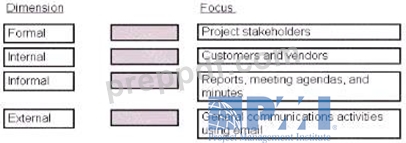
Answer:
Explanation: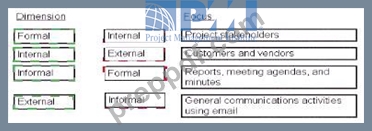
Explanation: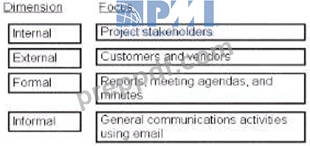
NEW QUESTION # 588
Progressively elaborating high-level information into detailed plans is performed by the:
- A. program manager
- B. project management office
- C. portfolio manager
- D. project manager
Answer: D
NEW QUESTION # 589
An input to the Collect Requirements process is the:
- A. stakeholder register.
- B. project scope statement.
- C. requirements management plan.
- D. project management plan.
Answer: A
Explanation:
Section: Volume E
Explanation:
5.2.1.5 Stakeholder Register
Described in Section 13.1.3.1. The stakeholder register is used to identify stakeholders who can provide information on the requirements. The stakeholder register also captures major requirements and main expectations stakeholders may have for the project.
13.1.3.1 Stakeholder Register
The main output of the Identify Stakeholders process is the stakeholder register. This contains all details related to the identified stakeholders including, but not limited to:
Identification information. Name, organizational position, location, role in the project, contact information;
Assessment information. Major requirements, main expectations, potential influence in the project, phase
in the life cycle with the most interest; and
Stakeholder classification. Internal/external, supporter/neutral/resistor, etc.
The stakeholder register should be consulted and updated on a regular basis, as stakeholders may change- or new ones identified-throughout the life cycle of the project.
Process: 5.2 Collect Requirements
Definition: The process of determining, documenting, and managing stakeholder needs and requirements to meet project objectives.
Key Benefit: The key benefit of this process is that it provides the basis for defining and managing the project scope including product scope.
Inputs
1. Scope management plan
2. Requirements management plan
3. Stakeholder management plan
4. Project charter
5. Stakeholder register
Tools & Techniques
1. Interviews
2. Focus groups
3. Facilitated workshops
4. Group creativity techniques
5. Group decision-making techniques
6. Questionnaires and surveys
7. Observations
8. Prototypes
9. Benchmarking
10.Context diagrams
11.Document analysis
Outputs
1. Requirements documentation
2. Requirements traceability matrix
NEW QUESTION # 590
What can the project manager find among the factors that could lead a project to be tailored?
- A. Earned Value
- B. Schedule Performance Index
- C. Company culture
- D. Return on investment
Answer: B
NEW QUESTION # 591
The following is a network diagram for a project.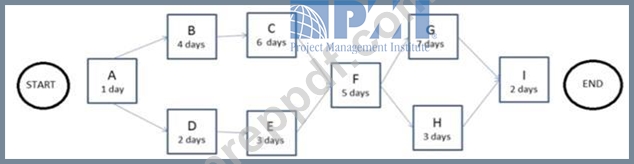
The free float for Activity E is how many days?
- A. 0
- B. 1
- C. 2
- D. 3
Answer: A
NEW QUESTION # 592
What is the tool and technique used to request seller responses?
- A. Bidder conferences
- B. Procurement documents
- C. Expert judgment
- D. Contract types
Answer: A
Explanation:
Section: Volume E
Explanation:
12.2.2.1 Bidder Conferences
Bidder conferences (sometimes called contractor conferences, vendor conferences, and pre-bid conferences) are meetings between the buyer and all prospective sellers prior to submittal of a bid or proposal.
They are used to ensure that all prospective sellers have a clear and common understanding of the procurement requirements, and that no bidders receive preferential treatment.
To be fair, buyers should take great care to ensure that all prospective sellers hear every question from any individual prospective seller and every answer from the buyer.
Typically fairness is addressed by techniques such as collecting questions from bidders or arranging field visits in advance of the bidder conference. Responses to questions can be incorporated into the procurement documents as amendments.
NEW QUESTION # 593
......
Practice LATEST CAPM Exam Updated 1253 Questions: https://www.preppdf.com/PMI/CAPM-prepaway-exam-dumps.html
Download Latest CAPM Dumps with Authentic Real Exam QA's: https://drive.google.com/open?id=1LZG_W4l0u3FeywrN0iS1aShPCluJbpKe