

Pass Your PEGACPSSA23V1 Exam at the First Try with 100% Real Exam Questions
New Pegasystems PEGACPSSA23V1 Dumps & Questions Updated on 2025
NEW QUESTION # 27
Which two configurations must you make when you add a Split for Each shape to your case life cycle? (Choose Two)
- A. Enter a unique name for the shape in the Split for Each field.
- B. Enter the Page List or Page Group property that is the basis of the split.
- C. Define when the parent process resumes processing.
- D. Define a condition to control when the flow runs for each iteration of the subprocess.
Answer: B,C
Explanation:
When adding a Split for Each shape to your case life cycle, you must specify the Page List or Page Group property that forms the basis of the split and define when the parent process resumes processing after the iterations of the subprocess are complete. Reference: Pega Platform Help - Case Design.
NEW QUESTION # 28
Which three items are generated and displayed in the compliance score of an application? (Choose Three)
- A. Unweighted compliance score out of 100
- B. Total core rules used in the application
- C. Rules with unjustified warnings in the application
- D. Rules with warnings in the application
- E. Percentage of compliant rules in the application
Answer: C,D,E
Explanation:
The compliance score of an application in Pega Platform includes items such as rules with unjustified warnings in the application (A), rules with warnings in the application (D), and the percentage of compliant rules in the application (E). These metrics provide insights into the application's adherence to best practices and guardrails, highlighting areas that may require attention to improve application quality, maintainability, and performance.Reference: Pega Community documentation on Application Quality Dashboard and compliance scoring.
NEW QUESTION # 29
In an online shopping application, you enable class-level encryption for the entire case type and optimize First Name, Last Name, Social Security number (SSN), Total Cart, and Account Number properties for reporting.
To secure sensitive data, how do you enable property-level encryption for SSN and Account Number?
- A. Create a TextEncrypted property type, and then add the properties.
- B. Update the class-level encryption to enable property-level encryption.
- C. Create a PropertyEncrypt access control policy, and then add the properties.
- D. Create a PropertyEncrypt data transform, and then add the properties.
Answer: C
Explanation:
To enable property-level encryption for sensitive data such as SSN and Account Number, you create an Access Control Policy of type PropertyEncrypt. This policy specifies which properties should be encrypted and how the encryption should be applied. References: Pega Platform Help - Access Control Policies.
NEW QUESTION # 30
You are integrating two Pega Web Mashups into a client's mortgage loan financing page. What do you configure to successfully embed both mashups?
- A. Load both mashups simultaneously.
- B. Run the mashups on the same thread.
- C. Define identical URLs for each mashup.
- D. Identify unique names for each mashup.
Answer: D
Explanation:
When integrating multiple Pega Web Mashups into a single page, it is necessary to identify unique names for each mashup to ensure that they are embedded and function independently without conflict on the client's page. References: Pega Platform Help - Pega Web Mashup.
NEW QUESTION # 31
Identify two options for passing data between a Pega application and a webpage containing a web mashup. (Choose Two)
- A. Call a Pega API function from the host server
- B. Use REST methods to call Pega microservices
- C. Use the attribute data-pega-event-onpagedata
- D. Call the function pega.web.api.doAction()
Answer: C,D
Explanation:
A: Calling the function pega.web.api.doAction() allows for specific actions to be performed in the Pega application from the web mashup, such as refreshing a section or submitting an assignment.
D: Using the attribute data-pega-event-onpagedata allows for passing data from the web mashup to the Pega application when specific events occur on the page. Reference: Pega official documentation on Pega Web Mashup methods and attributes.
NEW QUESTION # 32
Which two methods allow you to identify the Pega Platform application type? (Choose Two)
- A. View the Application layers widget for the ruleset stack.
- B. View the Settings tab of the case designer.
- C. View the portals used by the application.
- D. View the Application definition rule.
Answer: A,D
Explanation:
The application type can often be identified by viewing the Application layers widget for the ruleset stack, which gives an overview of how the application is structured, and by viewing the Application definition rule, which provides detailed information about the application's setup and its components. Reference: Pega Platform Help - Application Layers.
NEW QUESTION # 33
If a customer reports an issue with their order, an Investigation case is created. All investigation cases are higher priority than other case types.
What configuration supports this requirement?
- A. Configure an optional action to enable manual changes to case urgency.
- B. Create a service-level agreement (SLA) rule and ensure that the assignment is ready immediately.
- C. Create a service-level agreement (SLA) rule and increase the initial urgency.
- D. Increase the initial urgency on the case type settings.
Answer: C
Explanation:
To support the requirement that all investigation cases are higher priority than other case types, create a service-level agreement (SLA) rule and increase the initial urgency (B). By setting a higher initial urgency on the SLA rule for Investigation cases, you ensure that these cases are prioritized over others from the moment they are created. This configuration directly influences the assignment urgency and worklist prioritization, aligning with the business requirement.References: Pega Community documentation on service-level agreements and case prioritization.
NEW QUESTION # 34
As a best practice, in which situation do you configure a keyed data page?
- A. A short list of delivery options that rarely changes
- B. A short list of emojis that often changes
- C. A long list of images that often changes
- D. A long list of vehicle parts that rarely changes
Answer: D
Explanation:
A keyed data page is best used for data that does not change frequently and can be retrieved by a unique key. A long list of vehicle parts that rarely changes fits this criterion because the data can be cached and doesn't require frequent updates, optimizing performance. Reference: Pega Platform Help - Data Pages.
NEW QUESTION # 35
You perform a major skim on the ruleset ABC:02-02-01 to ABC:03-01-01.
In the Answer area, select the ruleset versions that the skim operation uses to copy rules into ABC:03-01-01.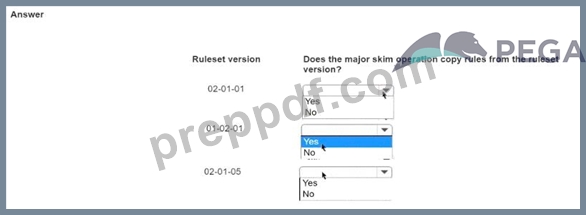
Answer:
Explanation: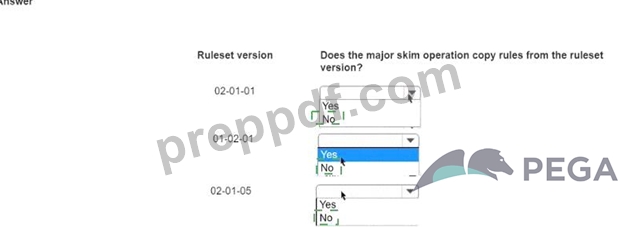
Explanation:
The major skim operation copies rules from the highest minor version of the current major version of a ruleset to create a new major version. In this scenario, the ruleset being skimmed is ABC:02-02-01, indicating that the current major version is 02.
Given this, the ruleset versions that would be used by the skim operation to copy rules into ABC:03-01-01 would be the highest minor versions within the major version 02.
* 02-01-01: This is not the highest minor version (since we have 02-02-01), so it would not be used. The answer should be "No."
* 01-02-01: This is from a different major version (01), so it would not be used. The answer should be
"No."
* 02-01-05: Despite having a higher patch version, it belongs to the minor version 01 within the major version 02. Since we have a higher minor version 02, this would not be used. The answer should be
"No."
Only the highest minor version from the current major version (in this case, 02-02-01) is used for the skim operation to create the new major version ABC:03-01-01. If the ruleset version 02-02-01 were listed, the correct answer would be "Yes" for that version, but as it is not listed, none of the provided ruleset versions would be used in this skim operation.
NEW QUESTION # 36
A hospital uses a case type to manage the treatment of patients visiting the Emergency Room (ER). Cases are created when the patient checks in at the registration desk, and are resolved when the patient is released from the hospital. Stakeholders identify the following security requirements for the case type.
* Patients access cases on a read-only basis.
* Patients can only access their own cases.
* Doctors and nurses can modify cases throughout the case life cycle.
* Only doctors are allowed to write prescriptions.
Which configuration allows doctors and nurses to modify cases while complying with all identified security requirements?
- A. Create two access roles, one for doctors and one for nurses, and set the modify action for each to 5.
- B. Create two access roles, one for doctors and one for nurses, and set the modify action for each to 1.
- C. Create a single access role for both doctors and nurses, and set the modify action to 5.
- D. Create a single access role for both doctors and nurses, and set the modify action to 1.
Answer: C
Explanation:
To allow both doctors and nurses to modify cases while complying with the identified security requirements, the best approach is to create a single access role for both doctors and nurses (C) and set the modify action to 5. This configuration grants both user groups the necessary permissions to modify cases throughout the case life cycle. By using a single access role with a high level of access for modifications, the application simplifies role management while ensuring that both doctors and nurses can perform their duties effectively, without compromising the security and integrity of patient cases.Reference: Pega Community documentation on Access Role to Object and case management best practices.
NEW QUESTION # 37
Application Settings allow you to____________.
- A. execute connectors in parallel to improve performance
- B. store references to an external system connected to an application
- C. simulate data in an environment for testing purposes
- D. automate the application migration process
Answer: B
Explanation:
Application Settings allow you to store references to an external system connected to an application. These settings can be used to manage environment-specific parameters such as URLs, file paths, and other data that may vary between development, testing, and production environments. Reference: Pega official documentation on application settings.
NEW QUESTION # 38
A fitness organization wants to ensure that data is entered correctly into an online form when users apply for, or update, their membership information.
Which scenario requires an edit validate rule?
- A. The credit card number must be entered in the correct format for the payment type.
- B. New members must be at least 18 years of age at the time they sign up for membership.
- C. The customer email address must match the expected format.
- D. The customer first and last name must be combined to create the full name.
Answer: A
Explanation:
An edit validate rule is used to ensure that data is entered in a specific format. For membership numbers that need to match a particular pattern (M-######-0#), an edit validate rule would be the appropriate mechanism to enforce this format upon entry. References: Pega Platform Help - Edit Validate.
NEW QUESTION # 39
What is the purpose of the Policy Verification landing page when configuring a security solution in Pega Platform?
- A. To test if a user's channel-specific password meets defined property requirements
- B. To test if a user has the required access to a case
- C. To manually authenticate a specific user on an integrated external database
- D. To configure mapping of access control attributes
Answer: B
Explanation:
The purpose of the Policy Verification landing page in Pega Platform is to test if a user has the required access to a case (A). This tool allows administrators and developers to verify access control policies by simulating how the policies would apply to different users, ensuring that the security configurations align with the application's requirements and that users have appropriate access levels to cases and data.Reference: Pega Community documentation on security policies and Policy Verification tool.
NEW QUESTION # 40
Select the three Pega best practices for developing activities. (Choose Three)
- A. Limit activity calls to at most three to prevent performance problems.
- B. Keep activities short. Limit your activities to fewer than 15 steps.
- C. Limit the use of activities. Use alternative rule types such as data transforms whenever possible.
- D. Limit custom Java steps whenever possible.
- E. Use only activities to support queue processing and interfaces.
Answer: B,C,D
Explanation:
Pega best practices recommend keeping activities short to enhance maintainability and readability. Custom Java steps should be limited to reduce complexity and potential errors. Activities should also be limited in general, with preference given to other rule types that are more declarative and less procedural, like data transforms, to improve application performance and maintainability. References: Pega SSA course materials on activity best practices.
NEW QUESTION # 41
A flow action calls a pre-processing data transform to initiate values. There are several flow actions available for the assignment. You want to make sure that the values are only initiated once for each flow action.
How do you implement a solution?
- A. Configure the data transform as post-processing instead of pre-processing.
- B. Add logic to the pre-processing data transform to test if values were already initiated.
- C. Make sure that the flow action does not have the highest likelihood since it will always be invoked.
- D. Do nothing. The pre-processing data transform is only called once for each assignment.
Answer: B
Explanation:
To ensure that the values are only initiated once for each flow action, add logic to the pre-processing data transform to test if the values were already initiated (A). This logic can prevent the reinitialization of values that have already been set, allowing the pre-processing to only set default values when they are not present, avoiding any unwanted overwrites or duplications of effort.References: Pega Community documentation on data transforms and flow action pre-processing.
NEW QUESTION # 42
A courier company wants to create a mobile app to scan and track the parcels collected from remote areas that are without internet access. Which mobile app do you develop to fulfill the requirement?
- A. Signed app
- B. SDK app
- C. Unsigned app
- D. Native app
Answer: D
Explanation:
A native app is suitable for remote areas without internet access because it can be installed on the device and has the capability to function offline. This allows the courier company employees to scan and track parcels regardless of internet connectivity. References: Pega Mobile Client Developer Guide.
NEW QUESTION # 43
University admission application cases automatically advance in the case life cycle if the applicant's standardized test scores are above a certain threshold. The threshold is determined each year based on the provided national average score.
Which two configurations, when applied together, support this requirement? (Choose Two)
- A. Configure a process with a decision shape that continues if the TestThreshold Configuration setting is less than the applicant's test score.
- B. Configure a TestThreshold Configuration setting that calculates the national average for the test score threshold.
- C. Configure a TestThreshold Configuration setting with the national average for the test score threshold.
- D. Configure a process with a decision shape that continues if the TestThreshold Configuration setting is greater than the applicant's test score.
Answer: A,C
Explanation:
* A: Configuring a process with a decision shape that continues if the TestThreshold Configuration setting is less than the applicant's test score supports the requirement for automatic case advancement based on
* standardized test scores.
* B: Configuring a TestThreshold Configuration setting with the national average for the test score threshold allows for the necessary comparison to determine if a case should advance automatically.
References: Pega official documentation on decision shapes and configuration settings.
NEW QUESTION # 44
A developer has identified resource-intensive queue processors as the source of performance issues that application users are experiencing.
Which two actions do you perform to resolve the performance issues? (Choose Two)
- A. Configure the queue processors to run multiple times a day.
- B. Select the Include in background processing option on the application rule.
- C. Configure the application nodes with node types.
- D. Associate the queue processors with the appropriate node types.
Answer: C,D
Explanation:
To resolve performance issues caused by resource-intensive queue processors, it's essential to ensure that these processors are associated with appropriate node types (A) and that application nodes are configured with node types (D). Associating queue processors with specific node types allows for the distribution of workload across the application infrastructure, optimizing resource utilization and improving performance. Configuring application nodes with node types ensures that tasks are executed on the most suitable nodes, further enhancing system efficiency and scalability.References: Pega Community documentation on queue processors and node types.
NEW QUESTION # 45
A class group is used to____________________.
- A. combine related properties by usage
- B. assign work to a specific group of users
- C. associate child classes with a single database table
- D. identify a layer of the Enterprise Class Structure
Answer: C
Explanation:
A class group is used to associate child classes with a single database table. This mechanism is known as class table inheritance, where instances of different but related concrete classes that belong to the same class group are stored in the same database table. Reference: Pega official documentation on class groups and class inheritance.
NEW QUESTION # 46
In a hiring case type, only HR Managers should have read access to a candidate's reference letter attachment. Which two tasks are used to fulfill this requirement? (Choose Two)
- A. Define a separate Attachment Category for HR Managers
- B. Restrict read access according to a When condition
- C. Configure read access for a user according to a privilege
- D. Configure attribute-based access control on the Attachment Category
Answer: B,D
Explanation:
To ensure that only HR Managers have read access to a candidate's reference letter attachment, the tasks involved include restricting read access according to a When condition (B) and configuring attribute-based access control on the Attachment Category (C). The When condition can specify criteria that must be met for the attachment to be accessible, such as the user's role being an HR Manager. Attribute-based access control allows for the definition of access rules based on attributes of the data or user, providing a flexible and granular approach to securing sensitive attachments like reference letters.Reference: Pega Community documentation on attachment security and attribute-based access control.
NEW QUESTION # 47
......
Updated Exam PEGACPSSA23V1 Dumps with New Questions: https://www.preppdf.com/Pegasystems/PEGACPSSA23V1-prepaway-exam-dumps.html
Dumps to Pass your PEGACPSSA23V1 Exam with 100% Real Questions and Answers: https://drive.google.com/open?id=1zvW3xrxTWoDiQkN65i7O6Ju3idDxRJF6