

L4M5 Dumps are Available for Instant Access [2026]
Practice with these L4M5 dumps Certification Sample Questions
CIPS L4M5 certification exam is a valuable credential for procurement professionals seeking to advance their negotiation skills. L4M5 exam provides candidates with a comprehensive understanding of negotiation strategies, techniques, and approaches, enabling them to effectively negotiate commercial agreements. With the global recognition of the CIPS certification, successful candidates can enhance their career prospects and demonstrate their competence to potential employers.
CIPS L4M5 (Commercial Negotiation) exam is a professional certification exam that assesses an individual's knowledge and skills in commercial negotiation. The Certified Institute of Procurement and Supply (CIPS) is the awarding body for L4M5 exam, and it is recognized globally as a leading qualification for procurement and supply chain professionals.
NEW QUESTION # 61
Procurement team is required to improve leverage with their suppliers through spend consolidation. To check whether there is any opportunity to consolidate spend, which of the following should be priority of procurement team?
- A. Price analysis
- B. Total cost analysis
- C. Spend analysis
- D. Value engineering
Answer: C
Explanation:
In order to identify opportunities where you can increase your leverage with supplier, you need to understand your spend. Undertaking spend analysis of your accounts payable (AP) data is an essential first step here.
NEW QUESTION # 62
Which of the following is a source of information on microeconomic factors?
- A. Published economic indices such as the Retail Price Index (RPI)
- B. Data published by financial markets and commodity exchanges
- C. The marketing and corporate communications of suppliers
- D. Analysis published in the mainstream and financial media
Answer: C
Explanation:
Microeconomic factors concern the conditions specific to suppliers, buyers, and markets - such as supplier communications, annual reports, and industry-specific data. These provide insight into cost structures, capacity, and competitive positioning. Macroeconomic factors, by contrast, include inflation indices (RPI), financial market trends, or global commodity prices. Distinguishing between micro and macro sources allows negotiators to build more precise intelligence for supplier discussions.
Reference: CIPS L4M5 (2nd ed.), LO 1.2 - Micro vs macroeconomic factors in negotiation preparation.
NEW QUESTION # 63
There are no commitments in hypothetical questions. Is this statement true?
- A. No, because hypothetical questions are made explicitly to the other party
- B. Yes, because hypothetical questions only mention possible situations
- C. No, because the party who makes hypothetical questions cannot withdraw their proposals
- D. Yes, because hypothetical questions generate a specific response
Answer: B
Explanation:
Explanation
There are four types of questions that can be used in a commercial negotiation:
Hypothetical questions, where you ask about a possible situation or abstract concept, are very useful at the testing and proposal phases. Hypothetical question does not state any commitment as it is only about 'if something happens, then ...'. This type of question can be useful at giving suggestion.
Text Description automatically generated
LO 3, AC 3.3
NEW QUESTION # 64
If the price of a good is above the equilibrium price, which of the following will happen?
- A. The quantity demanded is equal to the quantity supplied and the price remains unchanged
- B. There is a surplus (i.e. an excess supply) and the price will rise
- C. There is a shortage (i.e. an excess demand) and the price will fall
- D. There is a surplus (i.e. an excess supply) and the price will fall
Answer: D
Explanation:
In microeconomics, equilibrium price is determined when the quantity demanded is equal to the quantity supplied at equilibrium price in a market, there will be no shortages and no surpluses. If we combine our supply and demand curves on one graph, the point at which they converge determines the equilibrium price. If the price is set above this price and you read across the graph you will see the supply excess demand and there will be a surplus. In order to reduce this surplus, the price will need to fall. The scenario is illustrated in the graph below:
Chart, line chart Description automatically generated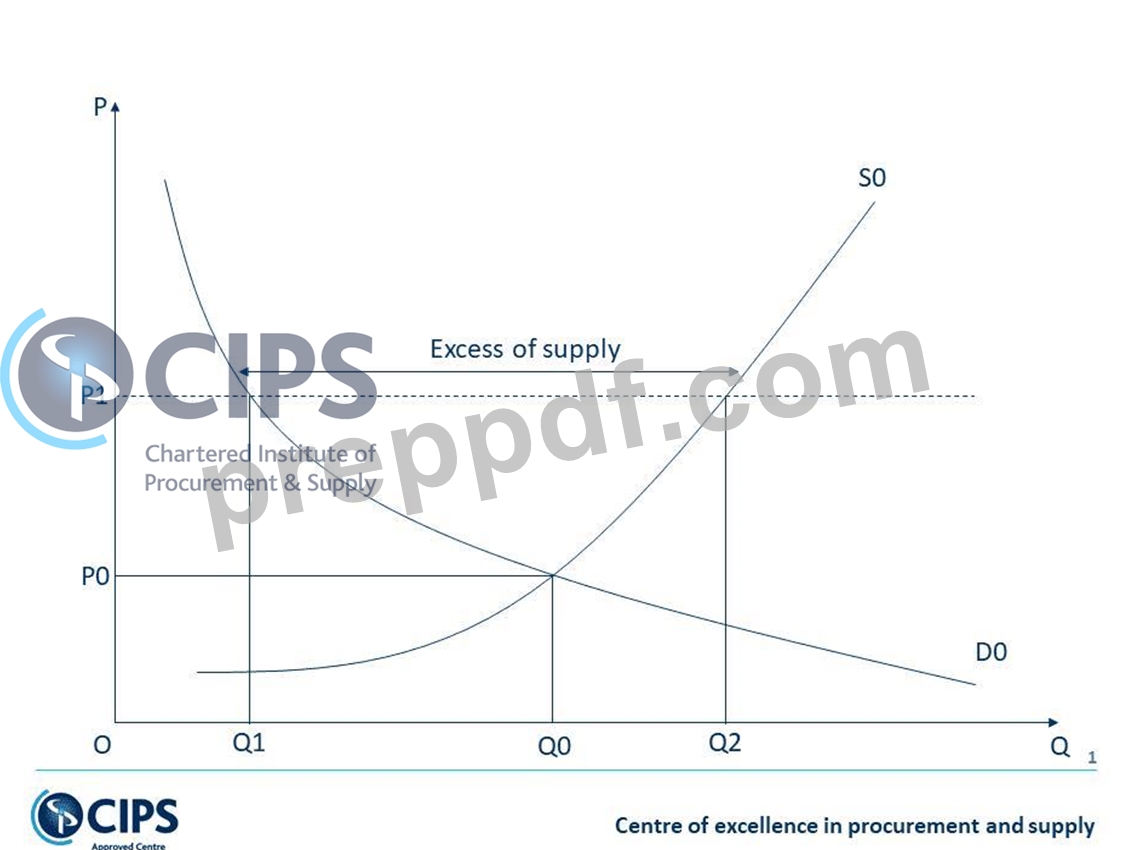
NEW QUESTION # 65
Lina Rawlins, a senior buyer for a medical equipment company, is in charge of the company's largest supplier account. Recently, the supplier's performance has declined, leading to more rejected items. Lina has asked the supplier for an urgent meeting. In the meeting, she asks: "Can you tell me exactly what you are doing to ensure quality?" What type of question is Lina asking?
- A. Probing
- B. Hypothetical
- C. Leading
- D. Reflective
Answer: A
Explanation:
Lina's question seeksdetailed informationabout the supplier's actions and is aimed at uncovering the root cause or assurance measures. This makes it aprobing question, designed to delve deeper into specifics.
Probing is a key technique in negotiations for uncovering critical insights, particularly duringissue resolution or when seeking complianceon performance terms.
Reference: L4M5 Commercial Negotiation 2nd edition (CORE), Section 3.3 - Questioning Styles: Probing for Clarity and Assurance
NEW QUESTION # 66
A supplier's mark-up on all products is 25%. Supplier's profit margin is...?
- A. 30%
- B. 75%
- C. 15%
- D. 20%
Answer: D
Explanation:
LO 2, AC 2.1
NEW QUESTION # 67
Which of the following are the most typical characteristics of integrative approach to negotiation? Select TWO that apply.
- A. Positional-based
- B. Claiming value
- C. Interest-based
- D. Creating more value
- E. Short-term wins
Answer: C,D
Explanation:
Integrative approach to negotiation used when the interested parties are attempting to create more of something of value to share, also known as collaborative approach or win-win. Integrative, interest-based negotiation can facilitate constructive, positive relationship and establishes contracts between parties on a foundation of goodwill. In integrative bargaining, both parties seek to 'expand the pie' by creating more value for both the buyer and the seller. Integrative negotiation 'shares the pie' and is interest rather than positional based.
In distributive bargaining, the focus is on claiming value and getting as much of the pie as parties can.
LO 1, AC 1.2
NEW QUESTION # 68
Which of the following is NOT a barrier to entry in a monopolized market?
- A. A single firm is very large
- B. The government gives a single firm the exclusive right to produce some good
- C. The costs of production make a single producer more efficient than a large number of producers
- D. A key resource is owned by a single firm
Answer: A
Explanation:
:
Monopolies exist in many markets in real life for very different reasons:
Ownership of a Key Resource: When one company exerts sole control over a resource that is necessary for the production of a specific product, the market may become a monopoly. For example, the only medication deemed acceptable to treat a disease comes from a particular ingredient X, and knowledge of this ingredient X is owned by a single family owned company. The company can, therefore, be said to have a monopoly over ingredient X that is needed to cure the disease because it is the only company that can produce a product deemed acceptable.
Government Franchise: In certain instances, a monopoly may be explicitly created by the government if it grants a single company, whether private or government-owned, the right to conduct business in a particular market. For example, when a national railways transportation service is created by the government, in most cases they are granted a monopoly on the operation of passenger trains in the country. As a result, other firms are only able to offer passenger train services with the cooperation and/or permission of the government- owned provider.
Intellectual Property Protection: Extending intellectual property protection to a company in the form of patents and copyrights is yet another way in which monopolies are created. When a government does this, it is in fact giving a single company an exclusive right to provide a particular product / service to the market.
Patents and copyrights work in providing owners of intellectual property with the right to act as an exclusive provider of a new product for a specific length of time. This creates a temporary monopoly in the market with regards to new products and services.
Natural Monopoly: A market may also become a monopoly simply because it may be more cost-effective for one company to serve the whole market than to have several smaller firms in competition with one another. A company with virtually unlimited economies of scale is referred to as a natural monopoly. Such firms become monopolies due to their position and size, which makes it impossible for new entrants in the market to compete price-wise. Natural monopolies are common in industries with high fixed costs and low marginal costs of operation such as providers of television, telephone, and internet services.
In this question, 'A single firm is very large' is not enough to tell whether this market is monopolistic.
NEW QUESTION # 69
An automotive company purchases high quality steel to produce components. The steel is an important raw material and the contract value is enormous. They sources the steel from oversea and contact some potential suppliers. One of the potential suppliers invites the procurement team to their premise for a new business opportunity. Should the procurement team accept the invitation?
- A. Yes, because the visit would increase the buyer's bargaining power
- B. No, because the travel would incur unnecessary costs
- C. Yes, because this is an opportunity to assess the supplier's capacity
- D. No, because negotiating over telephone is enough to collect information on supplier's capability
Answer: C
Explanation:
Explanation
In the scenario, the value of contract as well as the importance of purchased item justify the procurement's travel. Visiting a supplier at their HQ or operational facility may facilitate the procurement team in assessing, albeit briefly, the culture of the organisation, how busy they seem and how staff engage with each other. A visit is a good opportunity to assess supplier's capacity.
LO 2, AC 2.2
NEW QUESTION # 70
Maria is a professional services category buyer within the National Health Service. Due to severe financial budget cutbacks the National Health Service is facing, the procurement team has been tasked with achieving cost savings so that funding available can be spent on patient care. Maria plans to achieve savings with one of her collaborative suppliers. Which negotiation approach should she undertake?
- A. Lose-Lose
- B. Win-Lose
- C. Win-Perceived Win
- D. Win-Win
Answer: D
Explanation:
Reference: CIPS L4M5 Study Guide, Section 1.2 - Approaches to Negotiation
NEW QUESTION # 71
Which of the following best describes Leverage quadrant in Kraljic matrix?
- A. Low risk, high importance
- B. High complex, low importance
- C. High value, high complex
- D. Low risk, low importance
Answer: A
Explanation:
In 1983, Peter Kraljic devised a means to segment the supplier base in the article in HBR. In this, he argued that supply items should be mapped against two key dimensions: risk and profitability.
Risk relates to the likelihood for an unexpected event in the supply chains to disrupt operations. For instance, in important areas of spend, such as tire suppliers for an automotive are business critical, and should a disruption occur, the auto company is likely itself to face substantial problems.
Profitability describes the impact of a supply item upon the bottom line. For certain areas of spend, such as stationery, supplies have only a negligible effect on profits. In other categories, a single source of supply can make or break a business.
Putting these two dimensions together yields a classic two-by-two matrix.
Source: Peter Kraljic, HBR
NEW QUESTION # 72
Which of the following are examples of non-verbal negotiation? Select THREE that apply.
- A. Explaining to the supplier about the scope of the project
- B. / Speaking softly with long pauses
- C. Communicating with the other party by using gestures
- D. Asking the supplier to repeat their proposal
- E. Getting messages across with facial expressions
- F. Using the body language
Answer: C,E,F
Explanation:
Nonverbal communication is important because it gives us valuable information about a situation including how a person might be feeling, how someone receives information and how to approach a person or group of people.
There are several types of nonverbal communications you should be aware of, including:
1. Body language
Body language is the way someone situates their body naturally depending on the situation, the environment and how they are feeling.
Example: Someone might cross their arms if they are feeling angry or nervous.
2. Movement
The way you move your arms and legs such as walking quickly or slowly, standing, sitting or fidgeting, can all convey different messages to onlookers.
Example: Sitting still and paying attention in a meeting conveys respect and attention.
3. Posture
The way you sit or stand can also communicate your comfort level, professionalism and general disposition towards a person or conversation.
Example: Someone might slouch their shoulders if they feel tired, frustrated or disappointed.
4. Gestures
While gestures vary widely across communities, they are generally used both intentionally and unintentionally to convey information to others.
Example: Someone in the United States might display a "thumbs up" to communicate confirmation or that they feel positively about something.
5. Space
Creating or closing distance between yourself and the people around you can also convey messages about your comfort level, the importance of the conversation, your desire to support or connect with others and more.
Example: You might stand two to three feet away from a new contact to respect their boundaries.
6. Paralanguage:
Paralanguage includes the non-language elements of speech, such as your talking speed, pitch, intonation, volume and more.
Example: You might speak quickly if you are excited about something.
7. Facial expressions
One of the most common forms of nonverbal communication is facial expressions. Using the eyebrows, mouth, eyes and facial muscles to convey can be very effective when communicating both emotion and information.
Example: Someone might raise their eyebrows and open their eyes widely if they feel surprised.
8. Eye contact
Strategically using eye content (or lack of eye contact) is an extremely effective way to communicate your attention and interest.
Example: Looking away from someone and at the ground or your phone may convey disinterest or disrespect.
9. Touch
Some people also use touch as a form of communication. Most commonly, it is used to communicate support or comfort. This form of communication should be used sparingly and only when you know the receiving party is okay with it. It should never be used to convey anger, frustration or any other negative emotions.
Example: Placing your hand on a friend's shoulder may convey support or empathy.
NEW QUESTION # 73
John Browne, a junior buyer for a corporation, is analyzing the global supply market before undertaking negotiations and is wondering whether foreign exchange rates are important to factor into his research. Should John consider the foreign exchange rates?
- A. No, as they only affect the bank's interest rates for loans
- B. No, exchange rates only apply to the national economy
- C. Yes, as they can affect profit and turnover
- D. Yes, only if the organization can handle foreign currencies in their accounts
Answer: C
Explanation:
Foreign exchange rates impact import costs, profit margins, and overall turnover when transactions are conducted in foreign currencies. Understanding these fluctuations allows buyers to anticipate changes in purchasing costs, supporting informed decision-making, as highlighted in CIPS guidance on global procurement considerations.
NEW QUESTION # 74
Jasmine and the IHL sales team have a negotiation scheduled with one of AB's lead buyers, Samuel, at AB's premises. This is one of the biggest negotiations that Jasmine has been involved in and is eager not to make any mistakes. Jasmine has heard from a colleague that Samuel tends to adopt an integrative negotiation style.
IHL senior management decides to send a team of three members to the negotiation. Jasmine is among the team and she is assigned to check body language, reactions, feeds insight to her leader and to record important comments and information from the meeting for minutes. Which of the following are roles of Jasmine in the forthcoming negotiation? Select TWO that apply.
- A. Commercial expert
- B. Observer
- C. Secretary(Correct)
- D. Technical expert
- E. Chief negotiator
Answer: B,C
Explanation:
A negotiating team can be as few as two people, and one person can play one or more of these roles:
As from the scenario, Jasmine will act as an observer and a scribe (or secretary).
NEW QUESTION # 75
According to Fiona Dent and Mike Brent, which of the following are characteristics of Push approach? Select TWO that apply.
- A. Seeking commitment
- B. Persuasion
- C. Inspirational
- D. Directive
- E. Collaborative
Answer: B,D
Explanation:
According to the book 'Influencing: Skills and techniques for business success' by Fiona Dent and Mike Brent, there are two major influencing styles. Push tends to be directive. It tells, and is clear and resolute, but needs to be employed in situations where firmness is required because of difficulties that exist or weakness is evident.
Pull is more participatory and collaborative. It seeks to incorporate everyone's perspective. It can appear wishy-washy if not skilfully employed. That approach should be followed which is most likely to secure commitment and not mere compliance.
The two divisions can be further divided into four style categories: directive; persuasive reasoning; collaborative - team oriented, people oriented to inspire them with a vision. The directive style relies on your expertise and reputation being respected by others, and where there really does seem to be one answer. It is "I" driven whereas persuasive reasoning is more "we" and issue driven. Directive styles can make the user appear as "a bull in a china shop"; persuasive reasoning can be portrayed as tough guy.
Collaborative influencing takes the "we" element further and seeks to mobilise everyone's ideas in a journey of discovery. It may have the flavour of "I'm your best friend", which may not go down too well. Visioning style is concerned to stir people's emotions in support of achieving an objective. This last one has been used by demagogues to stir people's hearts and minds for evil purposes as well as good.
A useful table offers the benefits, problems, words and body language associated with each style along with advice on when to use and when to avoid each. Cases and exercises illustrate these styles.
Empathy comes in for extended treatment with the definition of "standing in the other's shoes". This does not necessarily happen just intuitively, and therefore before a specific influencing effort there should bean intense effort to think about the other person or persons and to sense what it might feel like to be them - their hopes, fears, concerns, what turns them on, what turns them off, where are they coming from.
NEW QUESTION # 76
All of the following shift the supply of watches to the right except...?
- A. An advance in the technology used to manufacture watches
- B. An increase in the price of watches
- C. Manufacturers' expectation of higher watch prices in the future
- D. A decrease in the wage of workers employed to manufacture watches
Answer: B
Explanation:
A supply curve will slope upward from left to right showing more supply at higher prices, as illustrated in the graph below:
A picture containing chart Description automatically generated
A movement along the supply curve will be brought about by a change in price, but a shift of the whole curve will be caused by a determinant other than price:
- The physical feasibility and time and energy required to produce the products
- Technology and innovation
- The objectives of the producers and their future expectations
- Prices of other goods and services
- Government's policies
LO 2, AC 2.2
NEW QUESTION # 77
Different types of relationships impact on commercial negotiations. At a negotiation, which one of the following sources would help to support leverage for the buyer?
- A. Friends power
- B. Personality power
- C. Legitimate power
- D. Powerful colleagues
Answer: C
NEW QUESTION # 78
Where a market consists of a large producer of a product with high market power, it is known as:
- A. A monopoly structure
- B. A monopsony structure
- C. An oligopoly structure
- D. A monopolistic structure
Answer: A
NEW QUESTION # 79
Which of the following are characteristics of the pull approach?
* Aimed at securing compliance, often against resistance
* Influencers are fully aware of the process, which is overt
* Persuasion or interpersonal influence
* Can secure commitment if influencers accept the viewpoint as fitting their goals
- A. 1 and 2 only
- B. 2 and 3 only
- C. 3 and 4 only
- D. 1 and 3 only
Answer: C
Explanation:
The pull approach relies on persuasion, interpersonal influence, and aligning proposals with others' goals to secure commitment. It is not about forcing compliance (that is push). By engaging influencers and presenting a vision they can adopt, pull fosters buy-in and voluntary agreement. This method is particularly effective in collaborative negotiations where relationships and long-term trust are important.
Reference: CIPS L4M5 (2nd ed.), LO 3.2 - Influence approaches: push vs pull.
NEW QUESTION # 80
During a negotiation, a procurement manager suggests that the two companies should split the difference which would benefit both the supplier and buyer. Which persuasion method is she using?
- A. Compromise
- B. Good cop/bad cop
- C. Threat
- D. Logic
Answer: A
Explanation:
In the scenario, the manager propose to 'split the difference', which means each party will accept some of their demands and concede some. This is known as 'Compromise'.
Reference: CIPS study guide page 163-165
NEW QUESTION # 81
Which of the following will help to indicate personality preferences in four dimensions?
- A. Thomas-Kilmann Conflict Resolution model
- B. Mill's RESPECT mnemonic
- C. Myers-Briggs Type Indicator
- D. Intelligence quotient
Answer: C
Explanation:
The Myers-Briggs Type Indicator (MBTI) is an introspective self-report questionnaire indicating differing psychological preferences in how people perceive the world and make decisions. MBTI indicates personality preferences in four dimensions.
The Thomas-Kilmann Conflict Mode Instrument (TKI) is a conflict style inventory, which is a tool developed to measure an individual's response to conflict situations.
Mill's RESPECT mnemonic is set out by Harry A. Mills which describes seven steps to agreements An intelligence quotient (IQ) is a total score derived from a set of standardized tests designed to assess human intelligence.
NEW QUESTION # 82
......
Get Instant Access REAL L4M5 DUMP Pass Your Exam Easily: https://www.preppdf.com/CIPS/L4M5-prepaway-exam-dumps.html
L4M5 Free Exam Questions with Quality Guaranteed: https://drive.google.com/open?id=1JHTDogVfu5CAXaW-PggUfaIQdt_j2h3f